
A prolific writer on mysticism and the paranormal, among other things, the English author Colin Wilson has passed on. In the video (audio recording, really) he discusses some of his work and personal experiences.
What Did Jesus Know about Rome?
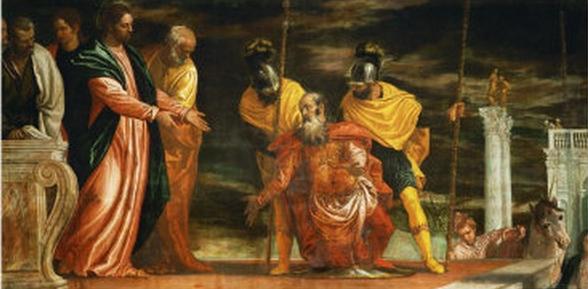
Jesus healing the centurion’s servant. Paolo Veronese, 16th century (Wikimedia Commons).
An interesting short essay in which a historian conjectures just how much Jesus of Nazareth would have known about the Roman Empire, in which he lived. The assumption is that he spoke Greek as a second language; otherwise, how did he communicate with Pontius Pilate, not to mention the centurion of the miracle?
1971: Witches in Bellbottoms, Talking Heads
Here is a 1971 documentary from the BBC that is supposed to be about witches. But at the time it was made, no one was making much effort to sort out the new Pagan Witches, anthropological and folkloric witches, and Satanic witches of the Church of Satan variety. So what you get is all of them! Plus talking heads — academics, clergy, exorcists . . .
Like so many of the paperback “I go among the witches” books of the time, the filmmakers interview a few of the most public Pagans, such as Doreen Valiente (who should get equal billing with Gerald Gardner in creating Wicca), Alex and Maxine Sanders, and others. But they quickly run out of interview subjects — there were not too many in Britain back then — so they start skipping around: a famous murder case with a possible (folk) witchcraft connection, desecration of graveyards, the evil grip of Satanism, and so forth, to fill up their 49 minutes.
I write about this period in Chapter 4 of Her Hidden Children: “The Playboy and the Witch: Wicca and Popular Culture.” Looking at a number of paperback books on the American scene, I created a rough spreadsheet of places visited and people interviewed. It was interesting how much overlap there was. There seemed to be a “witchcraft trail” that the writers followed — you could imagine it starting at the Warlock Shop/Magical Child store in New York City and ending at Church of Satan founder Anton LaVey’s house in San Francisco.
What is missing at this moment from the outsiders’ view is an overall sense of the new Paganism, at least until Hans Holzer’s 1972 book, The New Pagans. Even the participants themselves were just coming to the view that Wiccans, for instance, might share a Pagan outlook with Druids — the new Druids, that is. We often forget how deliberately isolated those covens were (“We can’t circle with Coven XYZ because it would mean sharing our secrets!” Really, I heard stuff like that in the 1970s.)
Serious academic study of the new Paganism(s) would not really get rolling until the 1980s. For instance, during the 1970s Robert Ellwood, Jr. at the University of Southern California was writing Alternative Altars: Unconventional and Eastern Spirituality in America (1979), which would offer some theoretical models applicable to the new Paganism, but he did not incorporate it into his discussion in that book.
Welcome, visitors from The Wild Hunt. Look around a bit.
(Thanks to Renna in Denver for the link.)
Animism, Religion, Bloggers, and the AAR
The annual meeting of the American Academy of Religion is followed by what I think of as Hell Weekend. At least it is that if you chair or co-chair one of the many program units. Me, I am co-chair of the Contemporary Pagan Studies Group, but I suspect that all my colleagues go through the same process — after Thanksgiving wears off, you have just a weekend to answer the online survey that constitutes your program-unit survey and, most importantly, to compose the “call for papers” for next year’s meeting.
The last part is done in collaboration with your steering committee, which in our case is scattered over nine Northern Hemisphere time zones — plus one in Australia.
The “call” is released in January, and people have about two months to submit proposals for papers, invited panel discussions, roundtables, etc. — most of which will be turned in at the last possible minute, for what are professors but students who never left the university?
Then the AAR staff, aided by wizard computer algorithms and trained owls, must fit all of the planned sessions into a four-day meeting, knowing that whoever gets the dreaded Tuesday-morning slots (when many participants are already leaving) will feel marginalized, disrespected, and sad.
One of our themes in 2014 (in San Diego) will be the New Animism, “new” in that it moves away from Edward Tylor’s old idea that animism is merely the first step of the ladder on the way to monotheism and instead treats it as a viable way of approaching the world, in which other-than-human entities are also active agents.
Not coincidentally, there is a book tie-in, the release of Graham Harvey’s edited collection, the Handbook of Contemporary Animism, currently available only in high-priced hardback from the friendly people at Acumen Publishing for whom I have nothing but the highest regard.
But while academia moves at its careful pace, there are plenty of other people writing about animism.
I have some books that I need to review here, but, meanwhile, click over to read about the December Animist Blog Carnival on the theme of “Animism and Religion.” Lots of good stuff here. (No connection with the AAR.) And consider this blog post to be my after-the-fact contribution to the blog carnival.
Orthography and the Modern Pagan
One thing I did at the recent American Academy of Religion annual meeting was stop by the University of Chicago Press booth and get the name of the managing editor of the press’s Manual of Style, which is the holy book, all 1,028 pages of it, for editors of academic books and journals—plus many publishers of serious nonfiction.
A petition has been sent to her by Oberon Zell of the Church of All Worlds, etc., as well as to the editors of the Associated Press Stylebook, the holy book of American journalists, about the capitalization of the word “Pagan.” Oberon has lined up forty-some writers and academics in support of the petition, which reads in part,
The current journalistic convention of printing lower case for these terms seems to have originated with the Associated Press Stylebook, first published in 1953. However, a new era of religious pluralism has emerged over the past sixty years. The terms “Pagan” and “Paganism” are now being capitalized in a variety of publications, texts, documents, and references, including religious diversity education resources such as On Common Ground: World Religions in America, The Pluralism Project, Harvard University, and Inmate Religious Beliefs and Practices, Technical Reference Manual, Federal Bureau of Prisons, U.S. Department of Justice.
You can read the full text here.
So far, the University of Chicago Press has acknowledged receiving it and plans to forward it to its Reference Committee.
This is a worthwhile cause, I think, and it is a battle that I have fought since the early 1990s (at least) when I was writing The Encyclopedia of Heresies and Heretics for the reference book publishers ABC-Clio. (A friend working there at the time commissioned it.) I won the battle on Pagan — even for ancient polytheists — but lost on BCE/CE versus BC/AD.
As editor of The Pomegranate, I have continued to insist on capital P’s except in direct quotations. This has put me in gentle conflict sometimes with British and other European contributors who favor “pagan” or at most use “Pagan” for self-conscious contemporary new religions and “pagan” for pre-Christian practices. I think that bouncing back and forth is confusing for the reader’s eye.
So the movement to change the stylebooks is underway, although I expect the process to be a slow one.
Someone Should Burn for This
 Seen at the booth of a large, evangelically oriented Christian publisher at the American Academy of Religion–Society of Biblical Literature joint annual meeting.
If anyone had made a bobblehead of John Calvin in 16th-century Geneva, JC would have had the maker burned, most likely. Martin Luther might have laughed, depending how much beer he had drunk.
And bobbleheads do not exist in Middle Earth.
How to Dress for an Academic Conference
This combined annual meeting of the American Academy of Religion and the Society of Biblical Literature starts this evening. As I lay in my Baltimore hotel bed this morning, thinking about what to wear for the day, my mind kept going back to an essay read yesterday, “Conference Chic, or, How to Dress like an Anthropologist.”
Anthropology . . . religious studies . . . there is about a 90-percent overlap, sartorially if not methodologically.
Carole McGranhan’s piece is full of great quotes:
As one male professor offered, “To my eyes, for the ladies, it is all about the boots/shoes. The guys, it is all about the jacket.”
There are subtle clues about class and region. People pretend to want to hide upper class, but want others to notice their expensive shoes and other articles.
“The only place that scarves are more popular than at an anthropology conference was at an airline hostess convention in the 1970s.”
“I’m also ambivalent about the scarf–they’re so cliché for anthropologists, but they are warm and pretty and useful and I have a lot of them, so… it will be a game time decision.”
“As a biocultural anthropologist is it appropriate for me to wear scarves?”
Why else expect accessories to do all our stylish heavy lifting, conveying cosmopolitaneity, political consciousness, and personal good taste at once? Such familiar, modernist anxieties lurk under our carefully chosen scarves and jackets, worrying that by acknowledging the importance of surfaces we are therefore superficial, which must mean we aren’t intelligent. The bigger the earrings, the smaller the brain, so we seem to think.
Now I must critically re-examine what I packed. Today: blue jeans with well-polished low boots.
Excavating Witches
It was the obligatory Halloween content over at Bones Don’t Lie, but I had too much else on my plate to link to it then.
The question is, how can you tell if a buried ancient skeleton was that of a witch (in the anthropological sense)? Does the mouth full of iron nails mean something?
And by the way, what happened to the bodies of the “witches” of Salem?
Those latter unfortunate victims gave birth to such a present-day tourism boom that I am waiting for the local promoters to stage a “discovery,” as was done for King Henry II with “Arthur” and “Guinevere” at Glastonbury Abbey. (Assuming that you accept the explanation that the 12th-century “discovery” was a money-raising ploy to help rebuild the burnt abbey.)
Tree Beings, New Age Bodies, and Censored Folklore
Here is the table of contents of the latest Journal of Ethnology and Folkloristics ( vol. 7, no. 1 ), published in Finland, “a multidisciplinary forum for scholars. Addressed to an international scholarly audience, JEF is open to contributions from researchers all over the world. JEF publishes articles in the research areas of ethnology, folkloristics, museology, cultural and social anthropology.”
Links go to PDFs of the articles.
Full Issue
| View or download the full issue |
Table of Contents
Articles
| Folk Religion in Discourse and Practice | |
| James Alexander Kapaló | 3-18 |
| Tree Beings in Tibet: Contemporary Popular Concepts of klu and gnyan as a Result of Ecological Change | |
| Jakub Kocurek | 19-30 |
| Sowing the Seeds of Faith: A Case Study of an American Missionary in the Russian North | |
| Piret Koosa | 31-48 |
| The Body in New Age from the Perspective of the Subtle Body: The Example of the Source Breathwork Community | |
| Katre Koppel | 49-64 |
| Immoral Obscenity: Censorship of Folklore Manuscript Collections in Late Stalinist Estonia | |
| Kaisa Kulasalu | 65-81 |
| Anthropological Interpretation of the Meaning of Ritual Objects in the Contemporary Urban Wedding in Bulgaria | |
| Rozaliya Guigova | 83-104 |
| Places Revisited: Transnational Families and Stories of Belonging | |
| Pihla Maria Siim | 105-124 |
| Official Status As a Tool of Language Revival? A Study of the Language Laws in Russia’s Finno-Ugric Republics | |
| Konstantin Zamyatin | 125-153 |
| Gendered Rural Spaces | |
| Piret Koosa |
Doggerland, a Professor of Esotericism, and the Passing of a Priestess of Isis
¶ That Doggerland existed is not news (do you expect breaking archeology news in the Daily Mail?) but here are some cool images of this lost land. I am still waiting for someone to create an authentic Pagan tradition based there.
¶ Ethan Doyle White interviews a Norwegian scholar of Paganism and esotericism, Egil Asprem. Asprem credits role-playing games, among other things, for his ending up as a professor of esotericism at the Norwegian University of Science and Technology.
¶ Philip Carr-Gomm reports on the passing yesterday of Olivia Robertson, founder of the Fellowship of Isis.
M. and I visited her (and became members, of course) in 1978 when honeymooning in Ireland. At that time the household of Clonegal Castle (a Jacobean great house) in Co. Carlow, consisted chiefly of her, her brother Derry, and her brother’s wife, Poppy, whose role seemed to be the “voice of normality” while Olivia and Durry (a retired Anglican clergyman) planned for the future of Goddess-worship — all while living in a mostly unheated and crumbling 17th-century manor.
Once while walking down the drive after a visit with a member of Stewart and Janet Farrar’s coven, the covener, who was English, turned to us and said in amazement, “One reads about people like that.”
And now that is all that we will be able to do.