People are always trying to make money off podcasts, Instagram, etc., but have you thought about dolls? Haunted dolls, that is. And who is to say they are haunted? You, the seller!
But whether any of these dolls are truly haunted seems beside the point. As I scroll through pages of smudged cheeks and wonky eyes, pausing on “ ‘Gracelyn’ (not vampire)” and “Bethany, Sad, Lonely Spirit” and “MECA VERY OLD POWERFUL SOUL,” I feel smug that even a sprawling corporation like eBay, with all its accompanying blandness-inducing powers, can’t suppress the batty and outright bizarre. In their unapologetic weirdness and scrappy prose, haunted-doll listings offer a reprieve from the Internet age’s slick, ironic posturing and its distancing effects.
In Scotland, the Edinburgh Samhuinn (“Sah’ween”) fire festival is back after skipping 2020 for the usual reasons. More torches! And catch the costumes — and stilts — at about the 7-minute mark.
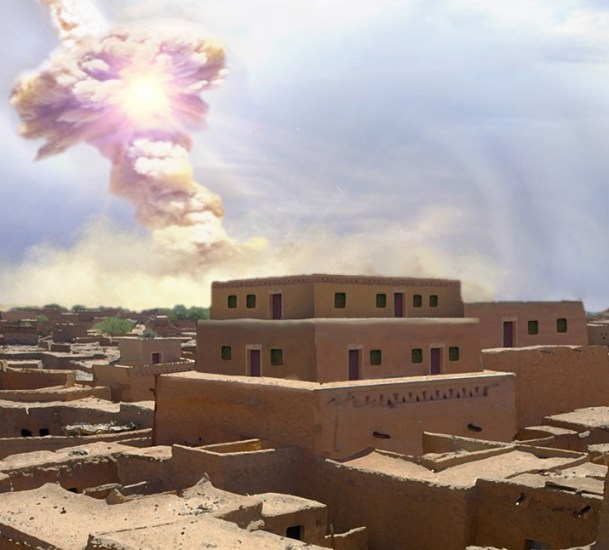
It was a liveable, walkable city until it suddenly vanished (Rice/West et al, 2021).
There you are, living your polytheistic/animistic Bronze Age life in a middle-sized city of about 8,000 people in what today we call the Jordan Valley when boom!
“What god did that?” the outlying surivors wonder. Some hollow-eyed bearded guy has an explanation: the Lord of Storms was punishing the land, and now we must obey Him.
Then the LORD rained upon Sodom and upon Gomorrah brimstone and fire from the LORD out of heaven;
And he overthrew those cities, and all the plain, and all the inhabitants of the cities, and that which grew upon the ground. (Genesis 19:24–25)
Obviously, the people there deserved it. What did they do to anger the LORD? Clearly he wreaked his vengence upon future generations:
The proposed asteroid that exploded over Tall el-Hammam may have also vaporized and ejected the nearby water from the Dead Sea over the area. Being highly toxic from the sheer amounts of salt in the water, the toxic water may have scattered across the lands from the impact; this, according to the research team, may be the reason why the city,together with some nearby settlements, remained uninhabited for hundreds of years after the proposed event took place. The resulting levels of salinity in the area would have been damaging for any crops they may have attempted to grow on the same soil, and would have needed hundreds of years’ worth of rain to wash out.
Fourteen miles away, the important city of Jericho was also smashed.
The very same winds that finished off Tall el-Hammam then reached Jericho, toppling some of its famous walls; some parts of Jericho burned as well.
Well, no. Jericho’s walls came tumbling down two or three centuries before the Hebrews conquered Canaan (an event that not all historicians — even Israeli historians — think actually happened). The destruction formerly blamed on an Egyptian army might well have been caused by this “giant space rock.”
If you live in an “enchanted” world, in which events have meaning, what meaning would you draw from massive destruction out of nowhere?
Across the wide Missouri — and she is extra-wide here, backed up by the Big Bend Dam (completed 1963) downstream into a winding reservoir called Lake Sharpe.
We still had some good time outdoors, working the new dog1 under the big skies, driving the long straight roads, and eating lunch at quirky small-town cafes. In one, I ordered a Reuben sandwich for a change, bit into it, and realize that something was different. Rather than the usual corned beef, it was made with roast beef. But the menu had promised local beef—and that probably was the case, whereas corned beef would have come off the Sysco truck or something like it. And it tasted good, so who cares?
Then on the 22nd it was time to turn southwest again. When I cross the Missouri River on US 83 — the longest river in North America, actually — it’s always a homecoming, leaving the intensely farmed Midwest for the tan rolling hills of western South Dakota, a change of ecosystems and time zones all at once.
Once in Fort Pierre, South Dakota, I wheeled into a riverside parking lot. I had meant to stop at a municipal park in Pierre, on the east bank (Central Time), but it was full of construction materials and blocked to visitors — a new highway bridge is being built.
In thanksgiving for having returned to the West, I clambered down the rocky riprap with a plastic mug of Jim Bean whiskey and poured it (generously!) to Mother Missouri with a prayer of thanks.
And then on south to Valentine, Nebraska, which has its own poetic bridges across Minnechaduza Creek and the Niobrara River, if you know to take the old highway over the “most beautiful” Bryan Bridge.
The heart of western South Dakota: US Highway 212 near the town of Faith.
Leaving Spearfish, South Dakota, on October 17then route to eastern North Dakota, I decided to skip the Green Bean coffeehouse, as much as I like it, and fueled up on motel-room coffee and a leftover partial burrito. I was on the road shortly after eight, up to Belle Fourche and then east on US 212.
US 50 across Nevada is often publicized as “the loneliest road in America,” but US 212 between Belle Fourche and the Missouri crossing at Charger’s Camp also qualifies. You come to a town of what looks like thirty people and then it’s forty miles to the next place. Tan rolling hills with the occasional butte—Bear Butte, Mud Butte, and the rest—to serve as landmarks. So it goes for more than two hundred miles.
Between Faith and Dupree, having crossed into the Cheyenne River Indian Reservation, I saw a figure walking east beside the road. I thought he was a (probably) Lakota teenager with an instrument case (trumpet?) slung on his back. I blew past him at 75 mph and then re-considered. There was almost no traffic. There never is. He was miles from anywhere. Well, who will pick him up if I don’t? I turned the Jeep around. (It’s so hard to break that driving rhythm when you have 450 miles to go.)
As I drove back west, I scanned the two vehicles that I met, a pickup truck and a sedan full of people. I did not spot him. But suppose he was lying down in the bed of the truck?
“I’ll drive to the top of the next rise and have a look,” I thought. Sure enough, a dot in the distance, there he was. I tossed some stuff from the passenger seat into the back.
Travis (we exchanged first names) was grateful. He was no teenager, but rather 33 years old—I got his birthdate and much of his life story. Father an Anglo biker, a regular at the Sturgis motorcycle rally every summer (they had lived in nearby Rapid City), Vietnam vet, died of prostate cancer in 2016. Mother Lakota. For some trivial reason, he had missed visiting his dad at the VA hospital in Sioux Falls, and shortly afterwards, his dad was gone, and he was still angry with himself. He told me where his mom was from—I recognized the name, a little town off the rez, that’s about all.
The grey thing on his back was a duffle bag with everything he owned in it.
He had been visiting a man whom he called his “father figure” (a maternal uncle?) in Iron Lightning, a place I know only from seeing the sign when I go by the turnoff. Let’s just say that there is no Wikipedia entry for Iron Lighting.1 He said that the evening before, he and the other man had walked along the meandering little Moreau River to a butte where eagles nest. They had prayed there.
Then they went to the man’s house and started drinking—sweet wine, by the smell of his sweat. The “father figure” passed out, but Travishad started walking south toward the highway some time around 2 a.m. It is about ten miles out to the highway. He had stopped for a sleep, he said, and was walking again when I saw him about 10:00 a.m.
Food and water? None. I gave him cold coffee and apples from a neighbor’s tree. He said that he had done this kind of reservation hitchhiking before, with an emphasis on “hiking.”
I got his story: the jobs he took off the rez (there is nothing on the rez except tribal government work, basically). The broken marriage to a Lakota woman, who was currently in Eagle Butte, the reservation’s administrative center. The 11-year-old daughter he has not seen for several years. The recent time spent at some rehab center in Wyoming for his alcoholism, which was a good experience, he said, but of course after a couple months, back in his old situations, he fell off the wagon. He had worked construction recently in Rapid City, but oddly did not know where Canyon Lake School2 was, so he must have had a circumscribed view of that town. Or maybe he just paid no attention to elementary schools.
He was headed for Mobridge, a larger town about ninety miles away. I turned north at Dupree, having planned to go through the Standing Rock reservation and on up to I-94 that way, a new route for me. But I realized that turning east to Mobridge and then continuing north on US 83, one of my usual routes, would be about the same distance, so I gave him the hitchhiker’s dream—a straight-through trip to a friend’s house where he hoped to be able to stay awhile. The friend’s pickup was in the driveway, so Travis hopped out, thanked me, and was gone.
Everyone in the world is damaged, has susto or “soul loss,” I often think. We medicalize this condition with terms like post-traumatic stress disorder, but I heard one curandera say that even your birth can set off susto, if it was a difficult birth. This is all just starker out there on US 212, where the tan prairie rolls away and there are no other human beings for miles.
I gently suggested at one point to Travis that he go out somewhere and offer up his problem to his ancestors on both sides . . . make a little offering . . . there might be someone who could give him a nudge in the right direction. Maybe. It’s his choice.
It’s just ten or twelve houses, I gathered, probably BIA housing.↩︎
Part of the Vinland Map, supposedly from the mid-1400s, before Columbus (Wikimedia Commons).
The Vinland Map has been controversial since the 1960s when it popped into public view. Did it really record a Norse partial-mapping of North America? Its modern history is viewed as scandalous. Most scholars who examined it leaned toward its being a forgery.
Acquired by Yale in the mid-1960s, the purported 15th-century map depicts a pre-Columbian “Vinlanda Insula,” a section of North America’s coastline southwest of Greenland. While earlier studies had detected evidence of modern inks at various points on the map, the new Yale analysis examined the entire document’s elemental composition using state-of-the-art tools and techniques that were previously unavailable.
The analysis revealed that a titanium compound used in inks first produced in the 1920s pervades the map’s lines and text.
It looks like another case of a forger using paper — or in this case, parchment — from the appropriate historical era but not taking the time to re-create the inks of the time. The ink, the Yale researchers say, is 20th-century.
In the modern era, the European discovery of North America became a proxy for conflicts between American Protestants and Catholics, as well as northern Europeans who claimed the pagan Vikings as their ancestors and southern Europeans who touted links to Columbus and the monarchs of Spain. Feted on the front page of the New York Times, the map’s discovery appeared to solidify the idea of a pre-Columbian Norse arrival in the American mindset.
As it turns out, the map was indeed too good to be true.
The Viking Age seems to be undergoing a kind of global renaissance in various fields, spanning from popular culture to spirituality and even some misguided political trends. Often this “viking revival” manifests itself in ahistorical and superficial ways, but not always. Here I share a few thoughts on how some lesser known aspects are also slowly gaining ground and understanding: the animist perspective.
Vikings armed with “myth, music, and merchandise”!
I was reading something recently that dumped all over The Matrix (1999), the movie that gave us the term “red-pilled.”
It’s pretty gnostic, but I liked it. I did not see the second two in the series.
But now there is a new one coming at Christmas, and John Morehead posted the trailer at TheoFantastique. It’s on YouTube, so I lifted that. Keanu Reeves, Carrie-Anne Moss, and Jada Plnkett Smith will be back.
Meanwhile, are Matrix, Reloaded and Revolutions worth watching? Is there more there than CGI and explosions?
The sound track for the trailer is “White Rabbit” which rock historians know was released in 1967. That song has legs! (Insert Energizer Bunny joke here.)
The Alchemist, a blended red from the Winery at Holy Cross Abbey.
What has been happening over at the Winery at Holy Cross Abbey, down in Cañon City, Colorado? They have gone hermetic!
M. and I celebrated equinox season today by attending the winery’s Harvest Festival. It was packed. SInce the focus is on wine, many attendees turned it into a picnic in front of the music stage.
But this year we were ready for something smaller and leisurely, more focused on the grapes than the grain and hops — but with roasting green chiles too, of course!
Picnickers at the 2021 Harvest Fest, the Winery at Holy Cross Abbey, Cañon City, Colorado.
I was wandering though the tasting booths and craftspeople’s booths when I saw one tasting booth labeled “As Above, So Below.” Every occultist knows that phrase, but what was it doing at a wine-tasting? Had I stumbled into a John Crowley novel?
This was the sort of event where you pay your money, get a glass and some tickets, and trade tickets for tastes. And I was out of tickets.
No matter, I asked some questions, then went to the “express” tent and bought a bottle of The Alchemist: “Perfectly balanced and sustainable, as the universe intended. Syrah and Verona grapes come together for a wine that is sure to enlighten. Have a drink, it’s your destiny.”
I might have been just as happy with The Theurgist: “Fun and approachable – magically delightful.” Well, no one ever called the Emerald Tablet “fun and approachable,” but wouldn’t “Emerald Tablet” be a good name for a vinho verde?
The Astrologist, meanwhile, is a riesling-sauvignon blanc blend: “Fun and refreshing in a way Nostradamus would never have predicted.” But M. and I drink more reds, so . . .
I should point out that despite the name and the cross on the label, it’s the Winery AT Holy Cross Abbey, not OF.
“The abbey,” as everyone in the area calls it, was indeed started by Benedictine monks in the 1920s. They operated a respected high school for boys, both day students and boarders, until the 1980s, when it closed due to the lack of vocations — not enough new monks, and the existng brothers all elderly. It’s the same problem that hit many Roman Catholic institutions around then. Eventually the order sold the whole complex after renting out the school buildings for a while for a satellite community college campus and other uses.
“I don’t agree with all her views, but in the history of the craft, she is an important person,” said Sabina Magliocco, professor of anthropology and religion at the University of British Columbia. “When you look at all of the witchcraft as feminist resistance that flowered in the Trump era, none of that would have existed if it hadn’t been for what Z and others like her did in the 1970s.”
Here she speaks in Malcolm Brenner’s 1991 documentary Out of the Broom Closet, which was digitized and placed on YouTube by the New Age Movements, Occultism, and Spiritualism Research Library. Archives and Special Collections. Valdosta State University. Valdosta, Georgia.




 I was reading something recently that dumped all over

 I was wandering though the tasting booths and craftspeople’s booths when I saw one tasting booth labeled “As Above, So Below.”