Talking about Tlaloc, 4

Last June, as our creek began to dry up, I blogged about building a little shrine to Tlaloc, “god of the hydrological cycle” as Craig Childs described him, in a big culvert under our county road.

It snowed, nearly a foot on October 26. The combination of trees pulling up less ground water after freezing weather came, plus the melting snow, started the creek running again. On Halloween night, M. and I were walking the dogs before bed, and we heard a gurgle in the creek bed. Slowly, rock by rock, tiny pool by tiny pool, it was coming back.

By yesterday, the flow had increased. While everything in the shrine was natural (rocks) or biodegradable (turkey feathers, etc.), I thought that I should retrieve the glass jar for the votive candles, before it washed away, broke, and became litter. So I pulled on a pair of rubber boots-of-many-names and waded into the flow.

There was the little shrine, still dry. But what’s this? Here was a bundle of herbs, tied with a string. And here was a bunch of dried-out marigolds. Marigolds, hmmmm. Very traditional, but we had not grown any this year.

I took the jar and left the rest. At night, as we set out on dog walk, I remembered to ask M. if she had left those offerings.

Blank look. No, she had not.

So who did? Not the bears and raccoons. One of the neighbors—and there are not very many of them—has joined in on the cultic activity. But which?

Those Wacky Muslims

We keel you! (Part 241).

French magazine fights back after firebombing. Cartooni-jihadis also swarmed its Facebook page, leading the group Reporters Without Borders to call on Facebook to “renounce censorship” and let the editors access their own page.

I give them credit for guts: They plan to republish the “guest-edited by Muhammend” edition.

• Arab spring? Let the killing begin! Coptic Christian high school student murdered  by his own teacher (with help). Does teacher-education in Egypt include a course on strangling and bludgeoning, or is that learned in continuing-education classes? This sheikh perhaps inspired him.

I expect that we are going to see a whole lot of Coptic Christians in North America very soon, the ones who survive.

• Toy guns made in China are part of an anti-Islamic plot.

Refresher: Aisha  was the prophet’s 9-year-old wife. And he consummated the marriage right away. But, hey, it’s a different culture, and who are we to judge?

An Islamist group whose name means “Western education is forbidden” kills 63 people in Nigeria.

Samhain Is Still Three Days Away

If you are in the Northern Hemisphere and following a solar calendar with quarter days and cross-quarter days, it falls at 1827 hours Universal Time on Monday the 7th.

You don’t need a henge, just a website for all your solar-calendrical needs.

The Day of the Dead is not Just for Humans

At Adventures in Animism, Heather Awen builds a shrine.

The Campus Day of the Dead, 2011

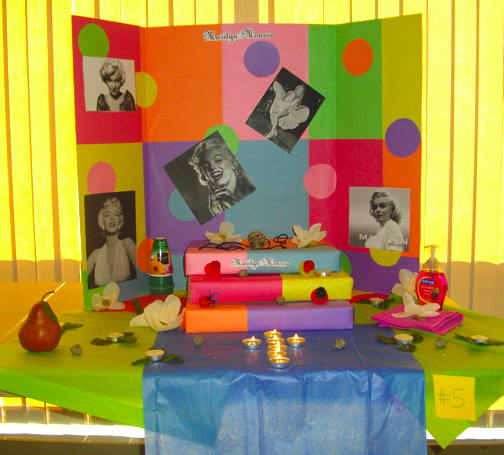
Day of the Dead altar to Marilyn Monroe, CSU-Pueblo

Day of the Dead Altar to Marilyn Monroe

As planned,  I stopped by the Student Center on Wednesday to check out the Day of the Dead altars.

No Vlad the Impaler altar this year! No altars to firefighters or Victorian writers either. Apparently Chicano Studies conformity was enforced, with Catholic Campus Ministries stepping in as a co-sponsor as well. Lots of crosses, “correct” altar decorations, Jesus candles, and Guadalupe candles—even if She is, as we say in religious studies, a multivalent symbol.

The altar to Marilyn Monroe shown above was the only one that broke the mold a little, sharing the “anyone can participate” feeling from previous years.

I drank some cups of colada morada with my Ecuadorian professor friend and nibbled some guaguas de pan. Eating babies—that’s a little edgy, but remember, it’s cultural. (Some pisco would have helped the colada.)


No, Not in Your Apartment

Russian guy seems a little confused over this whole Day of the Dead concept. You don’t dress up real skeletons.

While We Are Still in the Halloween Season

Here is a wonderful rant : “A**holes and Autumn People.” Bonus Ray Bradbury reference.

The Ethnographer and the Magicians

At the site freq.uenci.es, described as “a collaborative genealogy of spirituality” (“Ask scholars, writers, and artists what they think of when they think of the word spirituality.”), anthropologist Tanya Luhrmann glosses an anecdote from her time studying British occultists in the 1980s.

Her book Persuasions of the Witch’s Craft: Ritual Magic in Contemporary England (Harvard U. Press, 1989) still resonates, although not always in ways that Professor Luhrmann intended.

For some, it became a case study in how not to do research on new religious movement. In her article “Psychology of Religion and the Study of Paganism,” published in the collection Researching Paganisms, Melissa Harrington writes, “[Luhrmann’s] resulting thesis presents a rich ethnography, replete with original anthropological material, but with a weak conclusion that has been refuted by practitioners and academics alike.”

In the same volume, sociologist Douglas Ezzy critiques her “methodological atheism,” although he admits that “there is a long history of academic disciplinary boundary maintenance that this argument derives from.”

(Her faculty web page describes the work this way: “Her first project was a detailed study of the way reasonable people come to believe apparently unreasonable beliefs.”)

Ezzy continues, “The methodological atheism at the heart of Luhrmann’s thesis does not derive from an attempt to sensitively understand the experience of Witches, but from her enforced adherence, on pain of significant social sanction, to the atheistic tenets of academe.”

In her defense, you expect a PhD student to be acutely aware of “social sanction.”

I would have to say that Researching Paganisms (Google sample here) was party a response to Luhrmann’s 1980s work, or as the editors wrote, “In particular, it highlights the relationships of researchers with the communities researched, ‘ownership’ of knowledge so created, and problems in presenting a nonmainstream, and seemingly ‘nonrational,’ area within academic discourses across discipline boundaries.”

Is This Ancient Image an Etruscan Mother Goddess?

Etruscan image of woman giving birth

Image from Discovery,.com

Archaeologists have found an ancient Etruscan pottery fragment that appears to be the oldest-known image of a woman giving birth. The piece of a large pottery vessel might be 2,600 years old.

The Etruscan civilization dominated northern Italy before being eventually absorbed by Rome. They used Greek letters to write their non-Indo-European language, so as a result, we know sort of how it sounded, but not what the words meant—beyond some lists of kings and things of that nature.

 The image show the head and shoulders of a baby emerging from a mother. Portrayed with her face in profile and a long ponytail running down her back, the woman has her knees and one arm raised.

The image could be the earliest representation of childbirth in western art, according to Phil Perkins, professor of archaeology at the Open University, in Milton Keynes, England.

Some scholars want to see it as a goddess rather than a woman. Regardless, you will probably be able to buy a reproduction in the Sacred Source catalog in a year or two.

(Via Caroline Tully.)

Viking “Sunstones” Were Icelandic?

Now everyone will want a “Viking sunstone.”

Sunstones (BBC News)

This bit of information about the polarizing rocks has been around for a while. As far as I can tell, the “news hook” is just that a specific Icelandic source is suggested.

Expect a Llewellyn book on how to use them in about two years.