The Cup that Cheers but does not Cause OCD

Caffeine is good for creative workers, whereas stimulants like Adderall do not necessarily help.

Caffeine also blocks adenosine receptors in your brain. Stephen Braun, author of Buzz: The Science and Lore of Alcohol and Caffeine, once explained it as an “indirect stimulant, as opposed to, say, amphetamine which liberates dopamine, a directly stimulating neurotransmitter. By blocking adenosine receptors, caffeine allows the brain’s own stimulating neurotransmitters (i.e. glutamate and dopamine) to do their thing with greater gusto and less restraint.”

For a time in college I did experiment with a combination of coffee and the now-obsolete tranquilizer Meprobamate (a/k/a Miltown).* Two inches off the floor and flying steady. It’s a good thing that I was too poor to get seriously into that kind of thing.


* People calling Milwaukee “Mil-town” are too young to get the joke?

Spica, Online Cultural Astrology Journal, Launched

The Sophia Centre for the Study of Cosmology in Culture at the University of Wales Trinity St. David (formerly at Bath Spa University College) now has an online journal, Spica, with work by students in the MA program in cultural astronomy and astrology.

Spica is available as a free PDF here.

Articles in the premier issue include “An investigation into how counsellors/psychotherapists respond to clients who introduce astrological beliefs into therapy sessions” and “Do consumers of astrological services use astrology as a method of actively seeking divine guidance? If so, what astrological services are sought for the purpose? A Pilot Study.”

Sacred Geography in the Cumberland Plateau

Interpreting prehistoric rock art is a challenge, and I suspect that some of Professor Simek’s colleagues may well challenge his interpretation, but he has been looking at petroglyphs from the Mississippian culture and thinks that they describe a three-tier cosmology (Upper, Middle, and Lower Worlds), already attested elsewhere.

A Mississippian priest, with a ceremonial flint mace and severed head. Artist Herb Roe, based on a repoussé copper plate. (Wikipedia).

The Mississippian Culture is a term applied to people living in the area from about 800–1500 CE, contemporary with the European Middle Ages. These people  lived in fortified villages, and some built large ceremonial mounds.

Simek and his team analyzed 44 open- air art sites where the art is exposed to light and 50 cave art sites in the Cumberland Plateau using nondestructive, high-tech tools, such as a high-resolution laser scanner. Through analysis of the depictions, colors, and spatial organization, they found that the sites mimic the Southeastern native people’s cosmological principles.

“The cosmological divisions of the universe were mapped onto the physical landscape using the relief of the Cumberland Plateau as a topographic canvas,” said Simek.

The “upper world” included celestial bodies and weather forces personified in mythic characters that exerted influences on the human situation. Mostly open-air art sites located in high elevations touched by the sun and stars feature these images. Many of the images are drawn in the color red, which was associated with life.

The “middle world” represented the natural world. A mixture of open air and cave art sites hug the middle of the plateau and feature images of people, plants and animals of mostly secular character.

The “lower world” was characterized by darkness and danger, and was associated with death, transformation and renewal. The art sites, predominantly found in caves, feature otherworldly characters, supernatural serpents and dogs that accompanied dead humans on the path of souls. The inclusion of creatures such as birds and fish that could cross the three layers represents the belief that the boundaries were permeable. Many of these images are depicted in the color black, which was associated with death.

Read the rest at Heritage Daily, an online archaeology magazine. Wikipedia’s article on the Southeastern Ceremonial Complex connects with all this, particularly the section on cosmology.

Weird Covers for Classic Novels

Plucky redheaded farm girl from PEI.

How did I miss this? Embarrassing moments in book cover design.

Celebrating a Slavic Solstice

From EnglishRussia

From EnglishRussia

The website EnglishRussia displays photos of a group of Russians celebrating Kupalo, the summer solstice.

Polish Pagans Hold Congress

Scott Simpson, co-editor of Modern Pagan and Native Faith Movements in Central and Eastern Europe, is quoted in an article on Polish Paganism in a June 18, 2013 article in Rzeczpospolita, one of Poland’s largest daily newspapers.

He offers this translation:

Polish Pagans Combine Their Strength

Three Polish Pagans (Rzeczpospolita newspaper).

At their first congress in years, the followers of the old beliefs will try to overcome their theological differences.

Making harvest offerings to the gods, jumping through bonfires and releasing wreathes [into running water] — that’s how Rodzimowiercy, the followers of the old Pagan beliefs, will celebrate Kupala [Summer Solstice]. Poland’s largest celebration in a chram, the temple at Pruszkow in Mazowia, will begin on Thursday. The culmination falls on the shortest night of the year — from 21 to 22 June.

Pre-Christian beliefs started to return in the 1980s, and the Pagans say that the followers of their religion is growing. In August, in Łódz the first National Convention of Rodzimowierczy will be held. “From the point of view of this milieu, this is a breakthrough,” Scott Simpson, a scholar of religion from the Jagiellonian University tells Rzeczpospolita.

Polish Pagans celebrate six major holidays, most of them related to dates marking changes in the length of the day. On the spring equinox they celebrate Jare Gody, Dozynki [harvest] marks the beginning of autumn, and Swięto Godów – the beginning of winter. Added to this Dziady [Forefathers’ Eve], in memory of the dead, which is celebrated twice,  in spring and autumn.

The most important role, however, is played by Święto Kupaly [Midsummer Night]. Pagan rites will be celebrated, among others in Warsaw, Szczecin, Wrocław, Opole, Poznan, Łódż and Sopot.

Ratomir Wilkowski, who is a żerca, that is, a Slavic priest of the Native Polish Church tells Rzeczpospolita that the biggest celebration near Pruszkow expects some [missing number] participants. “A similar turnout came last year. However, more and more people are asking about the celebration,” he adds.

How many Rodzimowierców are there in Poland? Scott Simpson says that there are around two thousand committed followers.”But there is a much broader periphery of supporters. I think that the number is growing, although not as rapidly as it was in the 90s,’”he says.

However, recently the Pagans have done much to integrate their movement.

They have managed to reactivate the Gniazdo periodical dedicated to their religion. The next step will be to organize the Congress for several communities in Łódż. One of the speakers will be author Witold Jablonski, who recently published a novel [Słowo i Miecz] about the Pagan uprising in the eleventh century in Poland.

In the registry of the Ministry of Administration and Digitization there are currently four religious Rodzimowiersto organisations: the Polish Slavic Church, Native Faith, Slavic Faith and the Native Polish Church. They try to find the principles of the faith of their ancestors in historical sources. They believe in the gods, who are identified with the forces of nature. Mother Earth is Mokosh, the Sky — Swiatowid, the Sun — Svarog, and Lightning — Perun.

However, there have arisen theological differences between the adherents. “Some Rodzimowiercy claim that their religion can be combined with other faiths. I think that is unacceptable. I am counting on the congress helping to dispel theological doubts,” says Stanislaw Potrzebowski of Native Faith.

Why are Poles going back to pre-Christian beliefs? Religious Studies Professor Zbigniew Pasek argues that the reason is the desire to seek alternatives to the teachings of the Roman Catholic Church. “For these people, it is not credible today. The claim that we Slavs will never regain our identity if we do not go back to our roots, rejecting foreign gods, falls on fertile ground,” he explains.

The scholar adds that many people get involved in the Neopagan movement, because they are drawn to participation in the reconstruction [re-enactment] of history. Ratomir Wilkowski argues that his faith is authentic.

“We’re not a bunch of lunatics running around half-naked in the woods. If we did not believe in it we would not create religious organisations,” he assures.

To which he adds, “Again, the journalist (relatively harmlessly) made my vague hedging answer into something short and punchy that I didn’t really say. ”  So it goes!

Britain and the “Festival Gap”

A contributor to the BBC magazine takes the summer solstice as an opportunity to comment on the UK’s paucity of good festivals — particularly at midsummer:

If in this year of 2013, an interplanetary anthropologist came to England for fieldwork, what would they discover? On a variable Sunday each spring, we give our children more chocolate than is good for them, eat roast lamb and visit garden centres.

On the last day of October, we dress the kids up in old sheets, black bin liners and plastic fangs, and send them down the street to extort sweets from our neighbours. A few days later, we gather around a bonfire, set off rockets and celebrate the execution of a Catholic conspirator. The following month, we get together with our birth families to exchange gifts, to eat too much and to argue.

And that’s about it.

Not that he wants to be a Druid or anything: “Druids parading at Stonehenge seem to me as contrived as Morris dancers.” But there is a lack.

For American culture, I suggest, the Fourth of July takes the place of midsummer, falling less than two weeks later, and being a time for family and community gathering, feasting, and loud noises.

When Gods Sacrifice to Themselves

Almost all traditional Pagan cultures have one religious practice in common that contemporary Pagans for the most part avoid: Sacrifice, which means literally “to make sacred.”

Earlier this month, in fact, at a Pagan camp-out one of the elders was discoursing on the uselessness of sacrifice. If g/God were a carpenter working in his shop, sacrifice would be like bringing a hammer with the handle cut off and saying, “Here, I offer this to you.” Everyone thought that was profound.

In the entry on sacrifice in the HarperCollins Dictionary of Religion (edited by Jonathan Z. Smith, but individual entries are not signed), we read that “Naive and academic explanations of sacrifice abound. Sacrifice has been characterized as a gift (an offering)” [1], a means of communication between the profane and the sacred, an attempt to establish reciprocity between the human and the divine realms (most often expressed by the formula, “I give in order to get”), an expiation, a substitution, and a reenactment of primordial events.”

Theophrastus, a philosospher and student of Aristotle, wrote, “there are three reasons one ought to sacrifice to the gods: either on account of honor or on account of gratitude or an account of a want of things. . . . . We honor the gods either because we seek to deflect evils or to acquire goods for ourselves, or because we first have been treated well or simply to do great honor to their good character” [2]“.

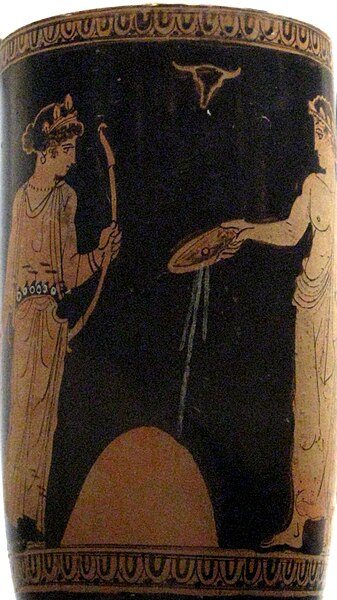
Libation of Artemis and Apollo at the omphalos. Master of Shuvalov (?), ca. 440 BC. Pushkin Museum. ? Wikipedia user Shakko 2009

This is an “insider” perspective, what Smith’s dictionary would characterize as a “naive” explanation.  So we think that we know what sacrifice means both in religion and in other areas of life: a killing (to Christians, Jesus’ bloody death was  the one big, final,  expiating sacrifice of human history), a giving up of pleasures (“She sacrificed her childhood to become a ballerina.”) or of life itself  in service to society (“Military members who gave ultimate sacrifice remembered at WWII Museum”).

Then I see this headline at the Tropaion blog: “Gods Sacrificing: Iconography and Divine Ritual Praxis.” It’s a  review of  Religion of the Gods; Ritual, Paradox, and Reflexivity :

The book examines the numerous iconographic depictions of Gods and Goddesses performing a libation or acting towards performing a sacrifice. One example is the attached picture: a libation of both Artemis and Apollo at the omphalos. In this red-figure lekythos, the poured liquid is visible from the Apollo’s phiale. It is logical that looking closely at those pictorial evidences makes you wonder and immediately questions arise. One of the questions is the following: what these depictions mean?

The review is worth reading, for it addresses the question, if sacrifice is addressed to a “higher” Other, than who is higher than the gods?

There are always surprises in the old Paganism.


1. If “sacrifice” and “offering” can be used simultaneously, what about “libation,” as illustrated on the vase painting? Some would say so; others want life in their sacrifice.

2. Quoted in Jan N. Brenner, “Greek Normative Animal Sacrifice,” in A Companion to Greek Religion, ed. Daniel Ogden (Malden, Mass.: Blackwell, 2007), 139.


Is the Church of England Desperate or Just Confused about Paganism?

With the obvious news peg of summer solstice celebrations at Stonehenge, the Telegraph reports on a rather odd initiative from the Church of England. The article begins,

The church is training ministers to create “a pagan church where Christianity [is] very much in the centre” to attract spiritual believers.

Ministers are being trained to create new forms of Anglicanism suitable for people of alternative beliefs as part of a Church of England drive to retain congregation numbers.

Reverend Steve Hollinghurst, a researcher and adviser in new religious movements told the BBC: “I would be looking to formulate an exploration of the Christian faith that would be at home in their culture.”

He said it would be “almost to create a pagan church where Christianity was very much in the centre.”

To which I can only ask, what are they talking about? Is this Christianity with mistletoe and pentacles? Do they think that they can attract the “party Pagans” to drum circles in the parish hall? The article continues,

The Church Mission Society, which is training ministers to “break new ground”, hopes to see a number of spiritual people align themselves with Christianity.

Andrea Campenale, of the Church Mission Society, said: “Nowadays people, they want to feel something; they want to have some sense of experience.

There is that.

Related: a Church Mission Society article on “being the light of Christ” at a Pagan festival in 2012. They gave free henna tattoos and did card readings with the “Jesus Deck.”

UPDATE: An Anglican priest involved says that the Telegraph’s article overstated what was going on.

i do not believe that a Christian church could adopt Paganism and remain Christian nor that a Pagan group (or individual) could adopt Christianity and remain Pagan. i do think that Paganism has much to say and offer to the world today and much that Christians can adopt – for instance whilst Christianity isn’t polytheistic, the Trinity does include the divine feminine as well as the divine masculine and those, including Pagans, who have criticized an apparently male lone christian deity are right to do so, and we as Christians need to acknowledge that and recover out own tradition of the divine feminine. similarly Pagans have often put Christians to shame when it comes to the environment when St Paul time and again talks of Jesus not saving people from the world but wanting to set the whole of creation free from suffering – we need to recover this ecological vision. i could go on but i hope you get the idea – that is what i meant by saying a Pagan church – on reflection i think i should have said a church in Pagan culture or one that learnt lessons from Paganism.

Vril: It’s the Secret

Before there was Robert Heinlein, Stranger in a Strange Land or The Moon is a Harsh Mistress, water-sharing, grokking, TANSTAAFL, and line marriage, there was Edward Bulwer-Lytton and The Coming Race, published in 1871.

As Egil Asprem recently noted in a blog post titled “The (all too) secret history of Vril,”

It is astonishing how much of modern occultism is dependent on works of fiction. The machinations of secret societies, the malicious rituals of satanic cults, and the magicians’ adventures on the astral plane have all been portrayed in great detail in works of fiction, which have in turn directly influenced the creation of real organisations and inspired new ritual practices among self-styled occultists. The entire current of Rosicrucian initiatory societies even had its main impetus in a text considered by its authors to be a playful ludibrium — although no doubt one that expressed deep convictions.

Read it.