Why Pagans Did Not Fight for Their Gods

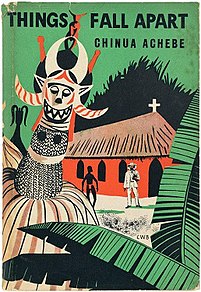
Things Fall Apart, by the Nigerian writer Chinua Achebe, published in 1958, is often labeled as the “archetypal modern African novel.” Set in the 1890s, at the beginning of British colonial rule, its protagonist is a hard-driving Igbo yam farmer, warrior, and village leader named Okonkwo, who holds himself, his wives, and his children to high standards of hard work and respect for ancestral traditions.

Things Fall Apart was always on my list of Classics I Should Read Some Day, and two weeks ago, facing a 1,000-mile drive, I checked out the audio book from the library. Having cleared the urban areas of Colorado Springs and Denver and entered the High Plains on Interstate 76, I slipped the first CD into the player.

Somewhere in  South Dakota I finished it. And I connected it with a a book that I had been reading in September, Alan Cameron’s The Last Pagans of Rome.

Achebe is writing historical fiction about villagers confronted (in the last fourth of the book) by the British colonial apparatus and Anglican missionaries. Cameron is examining the persistent idea that there was a self-consciously Pagan resistance in the Western Roman Empire during the 4th century to imperial Christianity — this a generation or two after the last Pagan emperor, Julian (who would have called himself a “Hellene”), failed in his attempt to decouple Christianity from the power of the empire.

Achebe’s characters are fictional subsistence farmers. Cameron looks at the writing and actions of upper-class Romans 1,600 years earlier, mostly men whose birth and wealth entitled them to a seat in the Roman Senate, even though little power came with the job — the power by then was centered far away in Constantinople.

As the book’s cover blurb notes,

It is indeed widely believed that a largely pagan [sic] aristocracy remained a powerful and active force well into the fifth century, sponsoring pagan literary circles, patronage of the classics, and propaganda for the old cults in art and literature. The main focus of much modern scholarship on the end of paganism in the West has been on its supposed stubborn resistance to Christianity. The dismantling of this romantic myth is one of the main goals of Alan Cameron’s book. Actually, the book argues, Western paganism petered out much earlier and more rapidly than hitherto assumed.

Cameron argues in fine-grained detail that there was no such stubborn resistance based on a clash of theologies. To these high-class Romans, the “old religion” was largely about social position and tradition. To be named to a college of priests was a social honor, perhaps like being invited to serve on the board of directors of a symphony orchestra. (Something similar happened on a smaller scale in Okonkwo’s village.) When they were able to keep their social position (and their copies of the Iliad) while accepting Christianity, they did so.

Likewise, in Things Fall Apart, as the Christian missionaries begin to attract more and more converts, and those converts attack the traditional religion, such as by killing a sacred python in a village shrine, someone asks one of the elders why they don’t fight back.

“It is not our custom to fight for our gods,” said one of them. “Let us not presume to do so now. If a man kills the python in the secrecy of his hut, the matter lies between him and the god. We did not see it. If we put ourselves between the god and his victim we may receive blows intended for the offender. When a man blasphemes, what do we do? Do we go and stop his mouth? No. We put our fingers into our ears to stop us from hearing. That is a wise action.”

And when one group, including Okonkwo, does burn the missionaries’ church, they are punished by the colonial authorities, which breaks their resolve. The disruption of the structure of traditional authority and the disruption of traditional religion go hand in hand.

I am left with some thoughts:

• Whereas the Emperor Julian understood that Hellenic religion, literature, and philosophy were all interrelated and strove to keep that cosmos in place, the glue was looser in the Western Empire.

In their world, confronted by one British district commissioner, his African policemen, and a missionary or two, the Igbo people did not understand the scale of what was happening.

• Most people do not fight over theology anyway. Theology is often just a group marker, “us versus them.” The theological claims themselves are secondary. People fight for their group more than “for the gods,” perhaps.

• People will change religion for a variety of reasons—to get along with a spouse’s family, to gain or to retain their social status (the Roman senatorial class), or to avoid having their heads chopped off (anyone confronted with Islamic expansionism).

• An “organic” Pagan society is the dream of many, but as Things Fall Apart illustrates, such a society can be transformed within one generation.

• I do, of course, consider both the traditional Igbo and the fourth-century Romans to be Pagan, using the term as we now define it. There is no other choice when “traditional religion goes global” either, as the recent New York Times piece about a West African traditional priest working in New York City described. When geographical and cultural boundaries are crossed, we need a “global” descriptor.

• Can we construct a theology — or is it part of Pagan theology today — to say that the gods fight their own battles?

Nevil Drury 1947–2013

drury

Nevill Drury

Nevil Drury, well-known Australian writer and teacher on magical and esoteric topics, died yesterday at home of cancer and liver failure.

I had the experience of working with not long ago when he did an article for The Pomegranate: the International Journal of Pagan Studies on “The Magical Cosmology of Rosaleen Norton.”

His Facebook page. His author page at Amazon.com.

A page of interviews with him from his website.

Pentagram Pizza: Not a Lie

pentagrampizza¶ An insightful interview with Pagan musician Sharon Knight.

¶ Why TED talks are lying to you.

This is what a dolmen should look like — “This enormous structure is the Soto dolmen in Trigueros, Spain, which has been returned to its prehistoric glory after a nine-year restoration. The mound is 60 metres across and 3.5 metres high, making it the largest of more than 200 dolmens, or megalithic tombs, that dot the Huelva province.”

Model T Religion

A hat tip to Wren at The Witches’ Voice, who posted on Facebook a news item about a parliamentarian in Kuwait, Abdulrahman Al-Jeeran, who is upset about the sale of non-Islamic statuary in Kuwaiti gift shops.

He revealed that statues representing gods believed by non-Muslim pagan worshippers during the primitive era are commonly seen at various shopping malls across the country.

He is not against freedom of religion, however, as he explained in this brain-twisting statement:

He explained that he was not trying to restrict the society to believing only one religion; however, he stressed that God Almighty commands human beings to accept faith without any alternative. He further stressed that issuing such a ban will protect future generations from deviating from the path of faith

Or as Henry Ford said c. 1922 about the Ford Model T car, “Any customer can have a car painted any color that he wants so long as it is black.”

Iron Mountain Ritual Site To Be Restored

Iron Mtn., Manitou Springs

Iron Mountain, Manitou Springs, Colorado. (photo by Colorado Springs Gazette).

When M. and I read this item in the Colorado Springs Gazette, our hearts soared. When we were newlyweds and bought our first house (a barely winterized 1920s cottage, 740 sq. ft.), it was just outside the lower left boundary of this photo of Iron Mountain in Manitou Springs, Colorado.

Iron Mountain is just a foothill, really, but when you look up from below, it blots out the higher ridges behind it.

Before we bought the house, we rented it, and our landlord was Tom McGee, who would later build “The House on Iron Mountain.” (I think the article’s date is wrong; we recall it being built around 1984.)

Before then, we would climb to the summit, where there was a natural stone throne, sometimes using it as a ritual site.

The coven we headed in the early 1980s was the Iron Mountain Coven, and Iron Mountain gave its name to a certain zine of the mid-1980s — Iron Mountain: A Journal of Magical Religion.

I put out only four issues, but they helped to inspire Fritz Muntean to start his own zine called The Pomegranate, and look at it now.

As for the McGees’ house, not only did it ruin “our” ritual site, but it was not even architecturally interesting. So they are razing it today? Hurray! And if that land upon which technically we trespassed becomes public open space, someone else can sit in the “throne,” if it is still there. I suspect that the rock outcropping survived the construction project.

Animist Blog Carnival: Death and the Blogger

This month’s Animist Blog Carnival is up. The theme is “death.”

I am represented by something from Southern Rockies Nature Blog.

Good Advice: “Run Your Own Race”

I hit bottom the summer I turned 36. Part-way through grad school, I took a break to work as managing editor of an outdoor magazine, Colorado Outdoor Journal. (You’ve never heard of it. I needed a job.) In May, the publisher pulled the plug on the magazine, but I had already registered for the June annual conference of the Outdoor Writers Association of America, so M. and I packed up our VW camper and — unemployed — drove to that year’s site, Kalispell, Montana.

At a reception, this guy — call him T. — came up and introduced himself. I did not know his face, but I knew his name: he had written several books I admired and was on the masthead of one of the leading magazines.

As freshmen at Reed College, he said, we had been in the same creative writing class. He remembered me. I had totally forgotten his being there. (He dropped out, started writing. I stayed.)

It wasn’t T’s fault, but in the wee hours one morning on that trip I woke up in the camper and had the nearest thing to a nervous breakdown that I ever had experienced. Everything that I thought I was or would be turned to dust and ashes. I was not suicidal, but I was crushed by an overwhelming sense of failure. No job. Maybe no career. Bills to pay. Taking the wrong path . . .

Someone should have given me this to read: “Run Your Own Race.

The best advice I’ve received about surviving in the competitive world of grad school was passed down from a colleague: “Kaitlin, make sure to run your own race.” . . . .  Looking around at your colleagues, there will be people publishing more, teaching more, and people who have more extracurricular activities, or more funding. It can be easy to think you don’t measure up. This self-deprecating thinking ignores strategies that can help make you successful and instead fixates on what others are doing.

I learned that lesson as writer, too: Be happy about your friends’ successes, and don’t measure yourself against them. Run your own race.

A Pastafarian Prophet

A surrealist and a proto-Pastafarian, SE Portland, Oregon.

A surrealist and a proto-Pastafarian, SE Portland, Oregon.

This recent post on Religion Clause describes the victorious struggle of a Texas Pastafarian for the right to wear the sacred pasta strainer in his driver’s license photograph.

It caught my attention because I had just finished editing an article by Joe “Vampires” Leycock, “wandering anthropologist of the occult,”  for the Bulletin for the Study of Religion: “Laughing Matters: “Parody Religions” and the Command to Compare.”

In it he mentions the similar struggle of an Austrian man, Nico Alm, for the same end. Laycock argues that Alm, like Pastafarianism’s founders, “wanted to demonstrate that religion is a category fundamentally preoccupied with the absurd and to question why Western democracies afford special privileges to religion.”

But then a memory of years ago trickled up.

Since this photo predates the founding of the Church of the Flying Spaghetti Monster, I think that that afternoon my friend and I were merely “preoccupied with the absurd.” Little did I know that I was an unheralded prophet of Pastafarianism.

The bare-chested fellow in the Greek fisherman’s cap is, in fact, Greek — my housemate Yioryos Chouliaras. He seemed to live on Turkish coffee (that’s what he called it) and strong cigarettes and wrote surrealist poetry by the yard. The last I heard, he was the cultural attache at the Greek embassy in Ottawa. Sounds like tough duty, but I am sure that Yioryos could handle it.

Resources in Pagan Theology

Christine Hoff Kraemer has assembled a list of books and websites on contemporary Pagan theology.

I was happy that I only once reacted with “What is X doing here?” And maybe I ought to give X a second look (or maybe not).

You really ought to read most of those books.

So You Want to Worship the Old Gods . . .

Hipster-Jon-Snow-game-of-thrones-23594329-362-500There are people who think that in order to do so, you have to learn “their” language, as spoken centuries ago, because the gods don’t keep up or something, let alone communicate in non-verbal ways.

All right, then.

You want to deal with Werunos (Sanskrit, Varuna), keeper of cosmic order? Talk this way.

It’s all explained at this link from Archaeology magazine on the reconstructed pronunciation of Proto-Indo-European: “Telling Tales in Proto-Indo-European.”

I played that clip for M., and she said that it reminded her of the 1970s–80s vogue for playing songs backwards to hear the “Satanic messages.” Maybe that’s the crucial fault in reconstructionism.