When Trees Disappear

First, the background story. Back in 2011, I wrote about making an offering to Tlaloc, Southwestern god of the hydrological cycle (among other things), at a tiny mountain spring near my home.

The spring is high on the side of a ridge, fed by that year’s snow and rain, which meant it often dries up in late summer.

It had its guardian, a three-foot-long (92 cm) rattlesnake, whom I encountered several times.

The area was thickly forested in ponderosa pine, Douglas fir, and Gambel oak — too thickly, to my eye. (This is what comes of being a forester’s son.) The pines were thick — in some places they lay like jackstraws, toppled by the chinook winds of winter.

When this slope burns, I thought, it will burn like a volcano. And it did, on October 23, 2012, a date seared into my memory.

October 23, 2012: The spring would be just left of the brightest area. My home is on the other side of the ridge.

I took this photo at dusk, bracing my pocket camera against a corral post (one of the ones that was not burning like a candle) while waiting for the the fire engine I was working on to be re-filled with water at the landowner’s well. It was too windy for air tankers, too close to darkness for hand crews to hike up there, so it just burned, while I implored the west wind to keep pushing the fire away from my home.

M. and I returned in November 2012 to see if we could find the little spring again with all the landmarks gone. For instance, there was a boulder that I called Bonsai Rock because of the tenacious little evergreens growing out of cracks in the stone. Not anymore.

Fisher the dog did what he does best, finding animal parts in the woods (including a bear cub’s paw) but even that activity seemed sadder.

We returned again in May 2013 to make an offering at the spring. During the previous month, the Bureau of Land Management had hired a contractor to re-seed the area with a grass mix by helicopter. The purpose was to get something growing and stabilize the slopes against the summer thunderstorms. It worked. We had adequate summer rains (not like the storms and flooding in northern Colorado), and by late summer the slopes were almost lush, as the photo below will show.
bear cub2

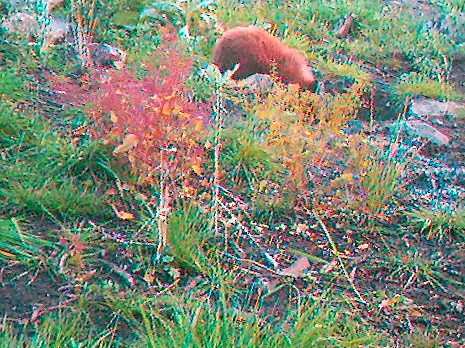
October 2013: A bear cub drinks at the spring.

I put my most expendable scout camera up there from late September until a couple of days ago — although the batteries died some time in November — which is how I got the photo. The best part is to see the spring running—you can see water flowing down the right-hand edge of the photo.
burn in December_sm

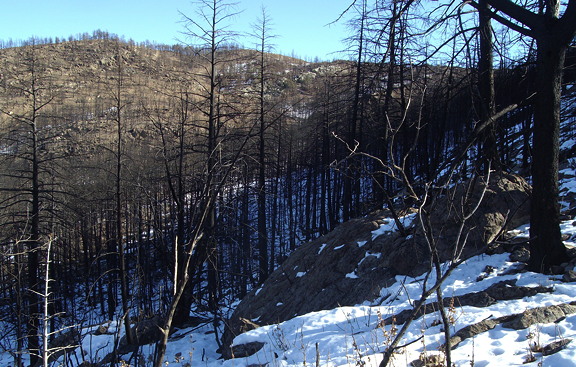
December 2013: Winter scene, with the spring off in the middle distance.

All this is prelude to thinking about how an animistic/polytheistic outlook copes with such changes to the land. No, it is not like someone paved it over and put up a Family Dollar store. Something will come back—the scrubby Gambel oak has re-sprouted, and there were wildflowers last summer, but the ponderosa pine and Douglas fir will be much slower to return. I probably won’t see this valley forested again.

I will never forget walking around a week or two after the fire, when the slopes just felt nuked. Crows overhead were the only life—the rattlesnake guardian almost certainly died, if tree roots were being burned underground.

The little seasonal spring, however, remains as sort of natural shrine, a focus for hope and continuity, bear cubs and wild turkeys.

A Song for the Winter Solstice

Thea Gilmore, “Sol Invictus,” with photos taken in and around the Horseshoe Lake nature reserve, Yateley, Hampshire UK.

Pentagram Pizza: An ‘Apocalypse’ for Witches

pentagrampizza¶ From Scarlet Imprint, Peter Grey’s Apocalyptic Witchcraft. In its review The Daily Grail said,

Grey sets out to explicate a perspective on the familiar symbols and stories of witchcraft in the West which has little truck with the formalities of scholarship, the sensibilities of the Wiccan paths or the white-light Newage perspective. His is a witchcraft both messy and impudent, one that stinks of mud, blood and spunk — in a good way. One where the oft-ignored or sidelined aspects — the legends of human sacrifice, poisons, curses and The Devil Himself — are both represented and, on some level, embraced.

¶ Once again, local authorities are deeply unimpressed by a legal defense based on “sacred prostitution,” especially when the woman involved is trying to get a license for a Colorado marijuana dispensary. 

¶ The list of polytheistic devotional books (and some Pagan SF) published by the Biblioteca Alexandrina  continues to grow. I have one and should get a couple of others.

Gamers and Ghost-hunters

What gaming I do has been on computers rather than consoles, so this is a development I missed—using the new Xbox for ghost-hunting.

Ever since the release of the Kinect motion sensor controllers in 2010, gamers have been posting videos of “Kinect Ghosts” detected by their Xbox 360. The Kinect prompts you when a new person is in the room, a phenomena dismissed as a glitch by most users if they’re alone. However there are hundreds of videos on youtube of not only ‘someone not there’ being detected, but these ‘ghosts’ also using the motion controller to operate the system.

It makes sense, really. Ever since the invention of the flash camera and the tape recorder, not to mention other instruments, people have been trying to record photos, audio, temperature anomalies, and other “hard” evidence of ghosts.

The blog posts links to this YouTube video of a “Kinect Ghost,” and from its links you can find others.

Have you tried it?

Wicker Man, Wicker Masks

One of the Armagh Rhymers’ masks, via The Bosky Man.

At The Bosky Man, Andy Letcher tells how playing a gig at the Ludlow Medieval Fair let him to meet an Irish band whose members perform wearing wicker masks, made by a 90-something-year-old Irish mask-maker who is the last of his kind.

That’s a pity because both invoke an odd, almost indescribable atavistic feeling. It seems to me extremely important that we all should know that feeling first hand, that we should experience it at key moments in our lives and in the yearly round of winter, spring, summer, fall. For whatever else the feeling is, it’s the sense of being brought up sharply against something Other, and you never know, that might just save us from ourselves.

I agree; in fact, I helped to write a book about that subject.

Colin Wilson 1951–2013

A prolific writer on mysticism and the paranormal, among other things, the English author Colin Wilson has passed on. In the video (audio recording, really) he discusses some of his work and personal experiences.

What Did Jesus Know about Rome?

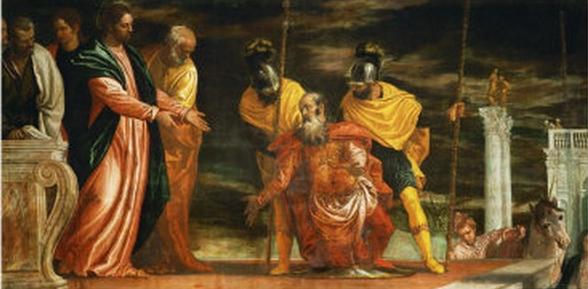
Jesus healing the centurion’s servant. Paolo Veronese, 16th century (Wikimedia Commons).

An interesting short essay in which a historian conjectures just how much Jesus of Nazareth would have known about the Roman Empire, in which he lived. The assumption is that he spoke Greek as a second language; otherwise, how did he communicate with Pontius Pilate, not to mention the centurion of the miracle?

1971: Witches in Bellbottoms, Talking Heads

Here is a 1971 documentary from the BBC that is supposed to be about witches. But at the time it was made, no one was making much effort to sort out the new Pagan Witches, anthropological and folkloric witches, and Satanic witches of the Church of Satan variety. So what you get is all of them! Plus talking heads — academics, clergy, exorcists . . .

Like so many of the paperback “I go among the witches” books of the time, the filmmakers interview a few of the most public Pagans, such as Doreen Valiente (who should get equal billing with Gerald Gardner in creating Wicca), Alex and Maxine Sanders, and others. But they quickly run out of interview subjects — there were not too many in Britain back then — so they start skipping around: a famous murder case with a possible (folk) witchcraft connection, desecration of graveyards, the evil grip of Satanism, and so forth, to fill up their 49 minutes.

I write about this period in Chapter 4 of Her Hidden Children: “The Playboy and the Witch: Wicca and Popular Culture.” Looking at a number of paperback books on the American scene, I created a rough spreadsheet of places visited and people interviewed. It was interesting how much overlap there was. There seemed to be a “witchcraft trail” that the writers followed — you could imagine it starting at the Warlock Shop/Magical Child store in New York City and ending at Church of Satan founder Anton LaVey’s house in San Francisco.

What is missing at this moment from the outsiders’ view is an overall sense of the new Paganism, at least until Hans Holzer’s 1972 book, The New Pagans. Even the participants themselves were just coming to the view that Wiccans, for instance, might share a Pagan outlook with Druids — the new Druids, that is. We often forget how deliberately isolated those covens were (“We can’t circle with Coven XYZ because it would mean sharing our secrets!” Really, I heard stuff like that in the 1970s.)

Serious academic study of the new Paganism(s) would not really get rolling until the 1980s. For instance, during the 1970s Robert Ellwood, Jr. at the University of Southern California was writing Alternative Altars: Unconventional and Eastern Spirituality in America (1979), which would offer some theoretical models applicable to the new Paganism, but he did not incorporate it into his discussion in that book.

Welcome, visitors from The Wild Hunt. Look around a bit.

(Thanks to Renna in Denver for the link.)

Animism, Religion, Bloggers, and the AAR

The annual meeting of the American Academy of Religion is followed by what I think of as Hell Weekend. At least it is that if you chair or co-chair one of the many program units. Me, I am co-chair of the Contemporary Pagan Studies Group, but I suspect that all my colleagues go through the same process — after Thanksgiving wears off, you have just a weekend to answer the online survey that constitutes your program-unit survey and, most importantly, to compose the “call for papers”  for next year’s meeting.

The last part is done in collaboration with your steering committee, which in our case is scattered over nine Northern Hemisphere time zones — plus one in Australia.

The “call” is released in January, and people have about two months to submit proposals for papers, invited panel discussions, roundtables, etc. — most of which will be turned in at the last possible minute, for what are professors but students who never left the university?

Then the AAR staff, aided by wizard computer algorithms and trained owls, must fit all of the planned sessions into a four-day meeting, knowing that whoever gets the dreaded Tuesday-morning slots (when many participants are already leaving) will feel marginalized, disrespected, and sad.

One of our themes in 2014 (in San Diego) will be the New Animism, “new” in that it moves away from Edward Tylor’s old idea that animism is merely the first step of the ladder on the way to monotheism and instead treats it as a viable way of approaching the world, in which other-than-human entities are also active agents.

Not coincidentally, there is a book tie-in, the release of Graham Harvey’s edited collection, the Handbook of Contemporary Animism, currently available only in high-priced hardback from the friendly people at Acumen Publishing for whom I have nothing but the highest regard.

But while academia moves at its careful pace, there are plenty of other people writing about animism.

I have some books that I need to review here, but, meanwhile, click over to read about the December Animist Blog Carnival on the theme of “Animism and Religion.” Lots of good stuff here. (No connection with the AAR.) And consider this blog post to be my after-the-fact contribution to the blog carnival.

Orthography and the Modern Pagan

One thing I did at the recent American Academy of Religion annual meeting was stop by the University of Chicago Press booth and get the name of the managing editor of the press’s Manual of Style, which is the holy book, all 1,028 pages of it, for editors of academic books and journals—plus many publishers of serious nonfiction.

A petition has been sent to her by Oberon Zell of the Church of All Worlds, etc., as well as to the editors of the Associated Press Stylebook, the holy book of American journalists, about the capitalization of the word “Pagan.” Oberon has lined up forty-some writers and academics in support of the petition, which reads in part,

The current journalistic convention of printing lower case for these terms seems to have originated with the Associated Press Stylebook, first published in 1953.  However, a new era of religious pluralism has emerged over the past sixty years. The terms “Pagan” and “Paganism” are now being capitalized in a variety of publications, texts, documents, and references, including religious diversity education resources such as On Common Ground: World Religions in America, The Pluralism Project, Harvard University, and Inmate Religious Beliefs and Practices, Technical Reference Manual, Federal Bureau of Prisons, U.S. Department of Justice.

You can read the full text here.

So far, the University of Chicago Press has acknowledged receiving it and plans to forward it to its Reference Committee.

This is a worthwhile cause, I think, and it is a battle that I have fought since the early 1990s (at least) when I was writing The Encyclopedia of Heresies and Heretics for the reference book publishers ABC-Clio. (A friend working there at the time commissioned it.) I won the battle on Pagan — even for ancient polytheists — but lost on BCE/CE versus BC/AD.

As editor of The Pomegranate, I have continued to insist on capital P’s except in direct quotations. This has put me in gentle conflict sometimes with British and other European contributors who favor “pagan” or at most use “Pagan” for self-conscious contemporary new religions and “pagan” for pre-Christian practices. I think that bouncing back and forth is confusing for the reader’s eye.

So the movement to change the stylebooks is underway, although I expect the process to be a slow one.