Jay Kinney Has a Blog

My old friend Jay Kenny, founder and editor of Gnosis: A Journal of the Western Esoteric Traditions, is now blogging at The Daily Grail.

His first post: “Do we want real history or lucid dreams?”

It was written in June, however, so I hope he does more.

Gallimaufry for a Cool September Day

• Check out Patheos’ story package on The Future of Paganism. Solitaries? Personal paganism? What’s next?

• Musings on that “Nazi” label and whether the climate of the Pacific Northwest encourages “black metal” bands, at Bioregional Animism.

• He comes to the festival as a lapsed Lutheran. He leaves as a Pagan—an interview from the Pagan Newswire Collective’s Minnesota bureau. (I’m waiting for the Prairie Home Companion parody of their piece.)

• Did a witch’s spell burn down the pub?

What Does that Tattoo Say?

It is to laugh. A blogger who reads Chinese and Japanese tells tattooed victims people what those Asian characters really say—if, indeed, they say anything.

Such as green vegetable. Or not chi (qi) but rice. Or not “beautiful” but “disaster.”

This must be the revenge of the Orient for our laughing at all those nonsensical Japanese “Engrish” T-shirts.

But you can take off a T-shirt.

Ups and Downs of Working at Home

Probably NSFW.

The artist also forgot to add blogging.

Hot Baths and Battle Wounds among the Norse

A summary of ancient Norse practices on personal hygiene, bathing, treatment of disease, and battle wounds.

Both the saga literature and forensic studies of skeletal remains suggest that battle injuries could be horrific …. The femur (leg bone) shown to the right is from another man who died of battle injuries in the 11th century. The bone shows clear marks of the impact of ring mail against the bone, suggesting his upper leg was hit with a sword blow so powerful as to force the rings of his mail shirt through the muscles of his leg into contact with the bone. Astonishingly, this injury was not the cause of his death. His skeletal remains show other serious injuries received in that battle. However, it was a cut that partially severed his spine at the neck that killed him.

My own modest reading of the sagas suggest that when two men went at each other with battle axes, usually after no more than two swings of the ax someone had serious arterial bleeding.

But in Iceland they sure loved their natural hot tubs—and who wouldn’t?

(Via Making Light.)

Elders Down the Memory Hole

All summer I have been editing and laying out a biography of the American Pentecostal evangelist Aimee Semple McPherson (1890-1944). I just sent the galleys to the writer, a professor in Arizona, and am working on my own corrections as well.

There have been the usual hassles—missing “essential” photos, notes that did not match the text, etc.—but we are working through all of that.

I mentioned the project on Facebook once, and got a response from a former student who was raised in the Assemblies of God, one of the larger Pentecostal denominations (the largest, says Wikipedia).

She had heard about Aimee when she was younger, but thought of her as a “scary” person.

Having lived with Aimee’s biography for six months, there is much that I could say about her, but “scary” is not a word that I would use. (I sent the student a PDF of the chapter about Aimee’s revival tour through Denver in the early 1920s.)

Do Pentecostal Christians send their elders down the memory hole as effectively as Pagans do?

Or does that process happen in all religions that do not have formal processes of canonizing saints or the equivalent—something that fixes them in memory?

I am still waiting for a serious academic biography of Gerald Gardner, who is after all the founder of a world religion, now that Wicca is in India, Brazil, Germany, and other places.

No doubt many young Wiccans have  either (a) not heard of him or (b) think that he was some “scary” old guy.

Philip Heselton (interviewed here), the author of two earlier books about Gardner, is supposed to have a new biography coming out from Thoth, although as of today I cannot find it on their fancy-but-unsearchable website.

I judged the earlier books as being strong on research and legwork, but weak on analysis and contextualizing. Credulous, even.  There is probably still room for a biography written by someone with a background in discussing new religious movements.

Meanwhile, Oberon Zell is at work on some new encylopediac work about “wizards of the world.” He has been trying to convince me to a write an entry about Gleb Botkin. Now there is someone who should be kept from sliding down the memory hole of Pagan history as well.


Falling Stars

A multicolored, long Perseid crossing the sky (from Wikipedia).

A multicolored, long Perseid crossing the sky (Wikipedia).

Last night after walking the dogs I spread an old blanket on the ground and lay watching the stars.

The Perseid meteor shower is under way, and in 15 minutes I saw five meteors.

One was just a blip of light, two were quick, and two left long streaks.

I had felt emotionally low all day. Isaac Bonewits’ passing was part of the cause, but only part, I think.

We were friends at a distance, but rarely saw one another. He moved East, and I have attended only one festival there in my life, and it was not one that he came to.

The time of year is part of it. After all those years in the classroom, mid-August still seems like the end of summer.

Last week I was talking with a friend at the university library. She mentioned that university convocation, which is followed by college and department meetings, comes next week. She said that I flinched when I heard that—even though it no longer affects me, even though it no longer means the end of summer break.

Back when our ancestors chopped with stone, they no doubt watched the night sky much more than we do. And they saw falling stars, of course, and no doubt they made analogies between meteors and human lives.

Isaac’s was one of the long streaks—at least so far as we Pagans are concerned. But there is so much black between the stars.

Still, watch the sky-show if you can. It is all that there is.

Freelancing: the Horror

Via Rod Dreher’s new blog, Macroculture, comes this essay by Richard Morgan on the horrors of freelancing.

By the time that I finished it, I was thinking of Knut Hamsun’s novel  Hunger. See the movie version—I saw it as a teenager, and how I ever became a writer afterwards, I do not know. Youthful optimism, I suppose.

I used to tell magazine-writing students that the first rules of successful freelancing were “Don’t quit your day job” and “Have an employed  spouse/partner who thinks that being married to/living with a writer is wonderful, romantic arrangement.”

Morgan, of course, was trying for the top tier of consumer magazines. Quite a few writers do make livings—of sorts—by specializing in something less eye-catching but more lucrative than celebrity-interviewing.

Specialists in financial writing or science writing might have a better chance.

P.E.I. Bonewits 1949-2010

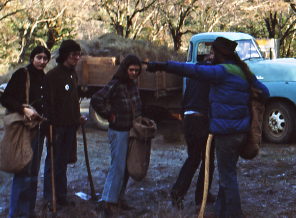
Isaac Bonewits (2nd from left) at the Greenfield Ranch tree planting, Jan. 1978

Isaac Bonewits, second from left, at a tree-planting in 1978.

All around the Pagan blogosphere, tributes are being written today for Isaac Bonewits, who died today.

Here is a chronology of his life and tribute by Ian Corrigan.

I can add only that he was one of the most prolific and visible figures of the Pagan revival from the 1970s forward.

As a student, he took what had been a sort of spoof “Druidry” and turned it into a genuine Pagan religion with a spoofy name, the Schismatic Druids of North America.

That in turn  become Ar nDraiocht Fein (ADF), which is very much alive today.

Druids are always associated with trees, and the photo is one that I took in January 1978 at a tree-planting at “Annwfn,” part of Greenfields Ranch, near Ukiah, California.

From left, Isaac’s then-wife Selene Kumin vega, Isaac (leaning on his hoedad), Morning Glory Zell, someone obscured (possibly Gwydion Pendderwen), and would that be Oberon Zell with arm outstretched?

I am glad that I was able to offer Phaedra some help in finding a home for his papers. Although I did not see Isaac often, we were always friends at a distance, and I shall miss his presence on the Pagan scene. Ave atque vale.

Maybe the Oldest Pagan Fashion Statement

The ongoing excacations at the Mesolithic site of Star Carr in Yorkshire has turned up what is now thought to be the oldest house in Britain—10,500 years.

Archaeologists describe finding “red deer skull tops which were worn as masks.”

“And the artefacts of antler, particularly the antler head-dresses, are intriguing as they suggest ritual activities.”

(Red deer are essentially the same as North American elk.)

So there you have it: antler headdresses and masks go way back.

Despite the recent slump in housing prices, the Star Carr home, originally built for a cost of three flint choppers, is now worth at least fifty bear skins.