Francis of Assisi: From Radical Monk to Garden Ornament

The real-estate supplement of the Taos News this week carried an article titled “Five Must-Haves for a Beautiful Backyard.” Oddly enough, four of the five items* were available at the store owned by a person interviewed for the story.

“Saint Francis of Assisi, the patron saint of animals, is one of our most popular statues,” said Char Austin, who works at Camino Real Imports. “People like the air of serenity that he brings in, more so when the statue is surrounded by trees, and birds can nest around. El San Francisco definitely contributes to create a peaceful environment.”

The real St. Francis of Assisi was anything but serene. He was more like “Occupy Rome”  AD 1204 — an upper middle class young man angry at the establishment, demanding radical change in the Roman Catholic Church. But history has turned him into a bird bath — and perhaps that metamorphosis was inevitable.

St. Francis as a bird bath with the wolf of Gubbio.

St. Francis as a bird bath, with the wolf of Gubbio.

Growing up as a Forest Service brat, with an agnostic father and a devoutly Christian mother, I noticed that Christianity seemed to end at the edge of town. Relations with the other-than-human world were not discussed in church. The Episcopal Church’s Book of Common Prayer contained a prayer for rain, as I recall, and that was about all.

For the rest, I was offered the secular gospel of conservation: scientific forestry, soil and water conservation, state-regulated hunting. At least that was better than what had gone before: cut-and-run timber cutting, market-hunting that wiped out species, the Dust Bowl . . .

Pope Innocent III has a dream of St. Francis of Assisi supporting the tilting church (attributed to Giotto).  Francis was more concerned with church reform than with nature itself. (Wikipedia.)

His Franciscan order grew to where it too was a bureaucratic organization, and some of the monks who clung too hard to Francis’ peace-and-poverty ideals (the “Spirituals”) ended up condemned as heretics. (The conflict between hard-core Franciscans and the Vatican appears briefly at the beginning of The Name of the Rose. Most viewers probably don’t get it.)

Yes, he wrote the “Canticle of the Sun,” in which all creation, including animals, the Sun and Moon, etc., is invited to praise God and is depicted as manifesting the divine. And he supposedly preached to birds — but he preferred to preach to people, even to the Muslim sultan of Egypt, who was enough of a sporting gent to let him live. In the story of the “wolf of Gubbio,” he saves the wolf from persecution by the local pastoralists, but at the price of giving up its wolf-ness. There is nothing in the canticle about the ecological role of predators.

Fast forward to 1967, when the journal Science published an essay by the historian Lynn White, Jr., “The Historic Roots of our Ecologic Crisis” (PDF), still widely read and anthologized today. In it, White blamed the crisis on the dualistic creator/created thinking fostered by the monotheistic religions, among which he included Communism, given the environmental crises created by Communist Party policies in the Soviet Union, China, and Eastern Europe:

Our daily habits of action, for example, are dominated by an implicit faith in perpetual progress which was unknown either to Greco-Roman antiquity or to the Orient. It is rooted in, and is indefensible apart from, Judeo-Christian theology. The fact that Communists share it merely helps to show what can be demonstrated on many other grounds: that Marxism, like Islam, is a Judeo-Christian heresy.

Christianity (and its parallel faiths) did not just end at the edge of town, it ended at a strip mine. Here is an interesting slide-show summary of the essay.

Casting about for an alternative to the “domination” model within the Christian tradition, White settled (rather half-heartedly, I always thought) on Francis, even though Francis’ view of non-human nature was thoroughly Catholic. To quote the Wikipedia entry,  Francis taught “that the world was created good and beautiful by God but suffers a need for redemption because of the primordial sin of man.” Contrary to the slide show linked above, this is not particularly “closer to Eastern philosophy.”

With the environmental movement growing, religious officialdom had to respond. Some Protestant Christians started talking “eco-justice,” while in 1979, Pope John Paul II named Francis “patron of ecology,” urging Catholics to be like Francis and take care of nature. Francis, said the pope, “offers Christians an example of genuine and deep respect for the integrity of creation” — as long as we understand that it is human-centric and required to praise God the creator, who is outside of creation, for letting it exist.

Of the hundreds of officially canonized saints, Francis was the only candidate for patron of ecology, even though the Vatican had squeezed all the radical ideas out of the Franciscan order within a century of his death.

Maybe as a medievalist Lynn White, Jr., was unaware of how nature, parallel to scripture, has served as  source of spiritual value in America.

We could see Bird Bath Francis as an attempt to bridge these traditions, to consecrate a safe, protected, and  cultivated nature — if not the self-organizing wolf-ridden wilderness. Followers of what Bron Taylor calls “dark green religion,” which may not be at all theistic, might not be so easily persuaded by the monk of Assisi, were they to meet him on the path.

*Wood carvings of saints, giant metal flowers, concrete animals, small water fountain, and ceramic Sun and Moon faces

Two Important New Books in Pagan Studies

Modern Pagan and Native Faith Movements in Central and Eastern Europe, edited by Kaarina Aitamurto and Scott Simpson, has now been released in hardcover. (No paperback edition appears to be coming in the near future.)

You can read the complete table of contents and see ordering information at Acumen Publishing’s website.

Also being released in June — Pop Pagans: Pagans and Popular Music, with contributions from some of the people on my blogroll, I am happy to say.

The same publishing arrangement applies, one of the reasons that my series co-editor and I said farewell to Acumen.

St. Georgia, Maker of Art, Pray for Us

St. Georgia (Wikipedia).

Here in the city whose patron is St. Francis (more about that later), I keep thinking that the new pope of the same name might as well go ahead and canonize — or at least beatify —  Georgia O’Keeffe.

Yes, there are some obstacles. For one, she was not Roman Catholic, not particularly Christian at all. But what a move to bring more of the bourgeois bohemians into the fold it would be!

Consider the devotion that she inspires.

Walking down Grant Street the other day, I could see little flocks of pilgrims (mostly female, mostly of a certain age) streaming off the streets around the plaza, headed for her shrine.

That shrine, meanwhile, is merely part of an entire O’Keeffe complex, where the pilgrim may enrich her life with programs and lectures on memoir-writing,  “art & leadership for adults,” plein-air pastel drawing, “O’Keefe’s language of forms,”  and many other sacred subjects.

Advanced initiates might seek a stipend in American modernism.

Many single women move to the little town of Aibquiu, a Santa Fe acquaintance tells me, where one may for a fee tour just part of O’Keeffe’s home there: the living room, kitchen, and pantry only, I am told. Have any of them experienced miracles? That would help the sainthood application clear a major hurdle.

Her other home, Ghost Ranch, has functioned as a spiritual retreat center for many years.  (It is owned by Protestants, which could be a problem. But no matter.)

Her followers look to her for lessons on the art of living and even study her rather plain menus for guidance on how an artist eats.

While her cultus already provides an economic lift to the old provincial capital, beatification or canonization would certainly increase that even more.

Just tell the bishops to keep their distance. Otherwise, it’s a win-win situation. Are you listening, Holy Father?

An Offering to Tlaloc in the Burned-Over Forest

offering_at_spring_sm

Last week M. and I climbed over the ridge to “Camera Trap Spring” (our personal name for it) to leave an offering to Tlaloc.

Thing have changed a little bit since a year ago. The ground is black with ash. Stones have cracked from the heat of a forest fire.

That ground-up bark on the ground is mulch dropped from a helicopter in mid-April. Mixed with grass seed, it is supposed to help the grass grow to hold the slope against erosion. For more about that re-seeding and our visit, see the other blog.

The tiny spring is in the upper right quadrant of the photo. The little jar holds a liquid offering, while the turkey feathers are offered in lieu of a real turkey, which if I had been an old-time Nahuatl-speaker, might have been offered in lieu of a human child.

Obviously, things change.

In my personal practice, I care less about questions of authenticity, ethnicity, book-knowledge, or “the lore” than I do about the land. I think that I live at the fringe of the area in which Tlaloc (or Someone like him) was anciently honored; therefore, for the past two years, I have been trying myself to do so.

This little seasonal spring is like a miniature version of the whole hydrological cycle. Rain and snow fall on the rocky ridge above it — the entire collection area is probably smaller than a football field. Then the spring flows, in direct proportion to the winter snows, until the water is all gone.Through evaporation, through the urine of bears and elk — however it goes — the water flows back into the cycle.

Talking like the Old Ones

Back in 2000, I was writing an article about a prescribed fire on the national forest near my home, so I hiked in with the ignition crew. Some point during the day, I heard a radio crackle with the message, “Come up that little ridge and bring fire with you.”

Bring fire with you. I thought of one of my favorite movies, Quest for Fire, and the language of its Neanderthal characters. And I thought of how that sentence could probably be translated into Neanderthal — if only we knew how — and certainly into a later Proto-Indo-European.

Those might be “utraconserved words,” as defined by this piece from the Washington Post.

You, hear me! Give this fire to that old man. Pull the black worm off the bark and give it to the mother. And no spitting in the ashes!

It’s an odd little speech. But if you went back 15,000 years and spoke these words to hunter-gatherers in Asia in any one of hundreds of modern languages, there is a chance they would understand at least some of what you were saying.

That’s because all of the nouns, verbs, adjectives and adverbs in the four sentences are words that have descended largely unchanged from a language that died out as the glaciers retreated at the end of the last Ice Age. Those few words mean the same thing, and sound almost the same, as they did then.

Read the rest and listen to the words themselves.

UPDATE: Another piece, this one from Wired, on the same research:

Pagel and his co-workers took a first step by building a statistical model based on Indo-European cognates. Incorporating only the frequency of a word’s use and its part of speech (noun, verb, numeral, etc.)—and ignoring its sound— the model could predict how long the word persisted through time. Reporting in Nature in 2007, they found that most words have about a 50% chance of being replaced by a completely different word every 2000 to 4000 years. Thus the Proto-Indo-European wata, winding its way through wasser in German, water in English, and voda in Russian, became eau in French. But some words, including I, you, here, how, not, and two, are replaced only once every 10,000 or even 20,000 years.

A Quick Encounter between Fire and Thunder

ogle_002_sm

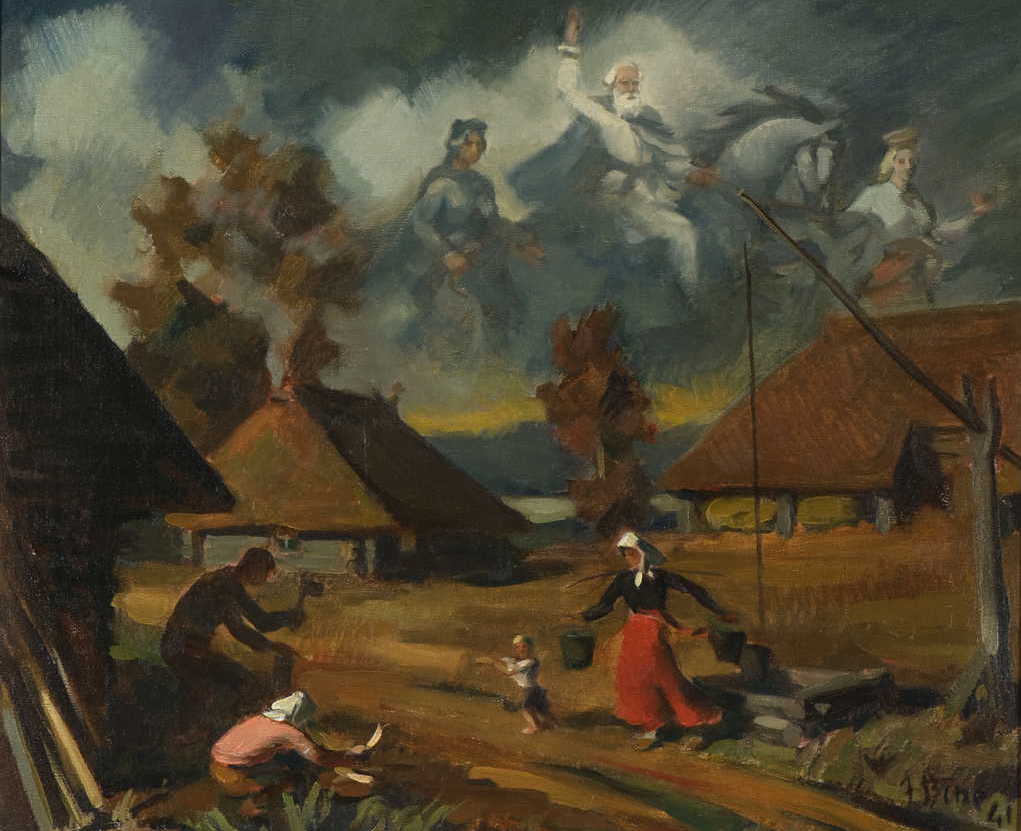
Jekabs Bine (1895–1955) “Perkons (Thunder),” 1941. Oil on canvas, 53 x 65 cm.
The Janis Rozentals Saldus History and Art Museum, Latvia.

The next issue of The Pomegranate will include a special section on the revival of Paganism in Latvia, a revival that blossomed in that Baltic nation’s first period of independence, 1917–1940, or between the Russian Revolution, which released Latvia from the old empire, and the beginnings of World War II, when the small nation was scooped up first Soviet Union, then by the Third Reich and then by the Soviet Union again, a crushing embrace that lasted until 1991.

I was partway through layout on an article by the Latvian art historian Kristine Ogle on Pagan themes in Latvian art before World War II, when M. came in from the veranda, saying that she could hear the emergency siren from down the valley.

Drop editor persona, assume volunteer firefighter persona.  Over my clothes I put on my “wildland interface” jacket and pants, since the sheriff’s dispatcher was saying this was a report of smoke, not a structure fire. I grabbed pack, radio, helmet, and was off, soon to be driving one of our brush trucks (wildland engines) up a county road that might lead to the site. But nothing.

Eventually we ended up with another firefighter and me in the brush truck, two more following in personal vehicles, a sheriff’s deputy, and an engine from the Bureau of Land Management. We split up to investigate different muddy ranch roads — still nothing. So after an hour, we called it off.

It had already hailed briefly in the morning, and soon after I came home, another little thunderstorm went through. So it seemed reasonable not to worry too much, not this week. People are still jumpy after the fire last October that took out 15 houses near mine—a wisp of low-hanging cloud might have looked like smoke.

Back at my computer, I continued where I had left off on the article. I had been just about to place a graphic in the file, and you can see it up above — the god of thunder.

Thunder has been much in evidence today here in the Wet Mountains, but given the painting’s date, you have to wonder if the dark clouds over the peaceful Latvian farmstead were more than thunderheads.

“Categories of Mishegas” and Other Medical Craziness

A new edition of the Diagnostic and Statistical Manual is coming out, the fifth such.

The DSM gives your “mental health provider” a code for your “adjustment disorder” or whatever, so that he or she may bill your insurance carrier, and if he or she is an MD, prescribe suitable psychotropic drugs.

The new version continues the trend of medicalizing everything. If you don’t feel happy happy happy all the time, then you need drugs and therapy. Some people disagree, but they are standing in front of a pharmaceutical bulldozer. (Sell more drugs! Sell more drugs!)

At least there is a Yiddishkeit parody of the whole mess:

Mishegas Minor: This category refers to most of us most of the time. We’re all a little mishugah, right? For example, a young woman who worries because the young man she is engaged to is more excited by a New York Knicks victory than oral sex.

Yes, we’re all a little mishugah, but once you have been diagnosed and coded, your civil, parental, and other rights start slowly to disappear because some social worker thinks you are “disordered.”

Call for Papers: Current Pagan Studies Conference

Below is the CFP for the 10th Conference on Current Pagan Studies, February 8–9, 2014, at Claremont, California.

Relationships With The World

What is our relationship as contemporary Pagans with the rest of the world at this point in history? What is the nature of our relationship with ourselves? With others? With the Divine? Who do we reach out to? Who do we support? What kind of communities are we building? As we ask for acceptance, who are we accepting? Who do we reject? Who do we love? Who do we make the enemy?

These questions have been running through our minds as we prepare for the 10th Conference on Current Pagan Studies. As usual, taking a very broad stance, we thought we might take a look at how we are living, loving, creating, singing, building, dancing, running, growing in this world.

This year we are encouraging proposals for academic panels. Please contact us early if you would like to organize a panel. We are looking for papers from all disciplines. A community needs artists, teachers, scientists, healers, historians, philosophers, educators, thinkers, activists, etc.

As usual, we are using Pagan in its most inclusive form, covering Pagans, Wiccans, Witches and the numerous hybrids that have sprung up as well as any indigenous groups that feel akin to or want to be in conversation with Pagans.

Abstracts should be no longer than 300 words and are due by August 3, 2013. Go to our website  for advice on presenting papers. Please email abstracts to pagan_conference -at- yahoo.com

The PC PC as Sacrificial Victim

Guidelines for the politically correct police constable who finds him- or herself in the Wicker Man.

A Police Federation spokesman said: “During stressful situations there is a tendency to use hurtful or insensitive language, especially if you’re trapped in a massive, highly flammable corn dolly while an entire village gambols around it with lit branches singing folk songs about ‘ye [sic] offerings’.

“Naturally this situation is a long way from best practise in terms of health and safety, but the officer should refrain from using ideologically inappropriate language while begging for egress.”

Read the rest.

Consciousness after Death: “Neurologically Inexplicable”?

Doctors performing “resuscitation medicine” keep finding people living longer after they are clinically dead — and talking about it:

New techniques promise to even further extend the boundary between life and death. At the same time, experiences reported by resuscitated people sometimes defy what’s thought to be possible. They claim to have seen and heard things, though activity in their brains appears to have stopped.

It sounds supernatural, and if their memories are accurate and their brains really have stopped, it’s neurologically inexplicable, at least with what’s now known. Parnia, leader of the Human Consciousness Project’s AWARE study, which documents after-death experiences in 25 hospitals across North America and Europe, is studying the phenomenon scientifically.

Read the whole thing.