Tag Archives: England

We Did Not Burn the Landowner After All

Jack o' Lantern depicting the Gunpowder Plot. Stacked barrels on the left, arches over head, Guy Fawkes with a torch at right—carved by the neighbors' daughter, an architecture student.

There is an Anglo-American couple (her from the UK, him from right here) down the road who always have a Bonfire Night party.

M. and I bumped into the American half recently, and he said that this year’s “Guy” would be a certain wealthy local hobby-rancher.

Having earned his money elsewhere, this guy is busy buying up every piece of vacant land he can find, erecting pretentious ranch gates, quarreling with the Forest Service, and possibly interfering with water rights (still unproved, but if so, it’s a hanging offense).

Unlike the actual largest landowner in this end of the county — who might be found on a mechanic’s creeper underneath one of the engines at the volunteer fire department, fixing something — he holds himself aloof from all community activities.

He has a bad case of “Texas Vertigo”—he thinks the world revolves around him. And, says the woman who waited tables down at the little steakhouse while working on her nursing degree, “He’s a two-dollar tipper.”

“All right,” I thought, on hearing my neighbor’s announcement, “it’s a real Aradia moment. Di legare il spirito del oppresore and all that.
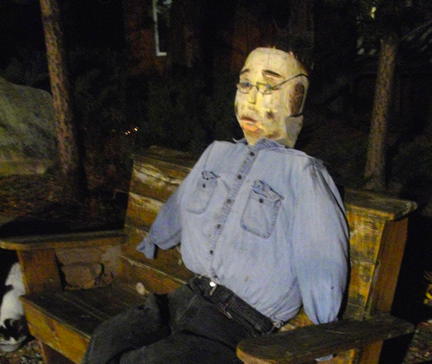
Not the neighboring landowner but a cable TV talker.

But when M. and I walked up the neighbors’ driveway, dish in hand, to where everyone gathered around the fire pit, beer kegs, and tables of food, the “Guy” was someone else—a certain cable television political pundit.

Not nearly as interesting from a folk-magic perspective, if you ask me.

Burn! Burn!

It is still an emotionally satisfying conclusion.

Another Blowhard Religious Leader, But Pagan

To Bo, the current Arthur Pendragon, “the nom d’épée of deluded old sponge John Rothwell,” holds up a Pagan mirror to religious leaders everywhere.

And in the long run, the attempt by some British Pagans to play the NAGPRA-derived “reburial of the sacred dead” card is going to be a public-relations disaster.

Mother Goddess Temple or Brothel?

From the fascinating”mortuary archaeology” blog Bones Don’t Lie, diverse explanations for the collection of babies’ skeletons in a ruin from Roman Britain.

Dr. [Jill] Eyers continues to argues for the brothel hypothesis, finding that further research and the combination of the human remains with archaeological evidence only further supports her conclusions. However this has been called into question by archaeologists, like Brett Thorn, who argue that the site also has evidence of a Mother Goddess cult, and may represent an area where women went to give birth.

Read more.

R.J. Stewart and the Old Ones

In this essay from 2006, R.J. Stewart discusses some of his teachers in occultism, particulaly Ronald Heaver (that’s Mr. Heaver to you), also known by the pen name of “Zadok.” (Bill Gray also figures in the essay, hence the plural.)

Before recounting my meetings with Ronald Heaver, I would like to share some brief insights regarding the teaching methods and general consciousness of the older generation of mentors in Britain. I am referring to those who, like Ronald Heaver, had come through both the 1st and/or 2nd World Wars. Few of them are left now. Many people today do not understand how different their methods were from those familiar to us in the last 20 years of spiritual, pagan, and New Age revival. There is, as a result, romanticizing, even fantasizing, about some of the founders of our spiritual and magical revival, and especially that powerful branch that relates so strongly to Glastonbury and the Sacred Mysteries. . . . .

Some of the methods of that older wartime generation of spiritual mentors may seem strange to us, but were essential to them in their day. This background, both individual and cultural, is helpful to our understanding of Ronald Heaver’s life and work, as he was of that generation, though in many ways he rose above it, despite a most difficult and dramatic life.

Firstly, many of these older generation teachers, mentors, and mystics of the British inner tradition, be they known or unknown, would teach different, even contradictory things, to different students. Therefore, students learning individually from one teacher, would each receive variations or even contradictions of the core teachings. This method was widespread, and was not as frivolous as we might think. Another method, which was well known, though supposedly secret, was to give an initiation or a confirmation of spiritual power, then tell the recipient that only he or she had received it. Years later, the recipients (plural) would find others who had had the same experience! There are typically certainly key secret phrases and dramatic unique subtle sensations, so no one (but no one) can fake receiving such spiritual empowerments.

In other words, you didn’t download the “Glastonbury” app and have instant knowledge, apparently. (Grumble grumble.)

Interesting stuff, worth reading.

‘At Least It Was Dry’

Photos from this year’s summer solstice revels at Stonehenge.

If You Really Practice the *Old* Religion . . .

. . . then you need some ritual skull cups.

Come to think of it, I think that I know someone who does.

On Misreading ‘Triumph of the Moon’

An earlier post of mine about writings on Wicca that lacked authority generated some responses around the Pagan blogosphere.

Some bloggers, however, simply do not understand scholarly writing. For instance, this:

For over a decade, Professor Ronald Hutton’s study on the history of Wicca, Triumph of the Moon, has been considered by most Pagan scholars to have closed the book on the issue of the survival of elements of Paganism from Pagan antiquity.

Let’s think about that. Edward Gibbons’ The History of the Decline and Fall of the Roman Empire is probably the one book on the topic that every educated person has at least heard of.

It was published in installments between 1776 and 1789. It is a classic. By the blog writer’s standards, therefore, it should have “closed the book” on writing about ancient Rome.

Yet new books on ancient Rome are published every year. How can that be?

No topic is ever “closed.” Historical works—which is how Prof. Hutton would describe Triumph—are not holy scriptures. New thinkers and new generations bring new scholarship and new interpretations.

But what Hutton has done is establish a standard. Anyone who challenges his conclusions (and given that ten years have passed, he has challenged some of them himself, I expect) must do at least as much in-depth research as he has done. They can’t just snipe from the sidelines.

Rhetoricians talk about “invented ethos,” by which a speaker or writer displays their qualifications to engage a topic: I have studied such-and-such at this or that level. I have done such-and-such. I have experienced such-and-such. (“Invention” does not imply falsification in this context.)

It is that level of ethos I see lacking in his critics—so far.

Another problem, probably too big to tackle here, occurs when people approach a book like Triumph looking for “right answers” or for information on which to base their personal religious practice.

Oh, you can do that. “The reader constructs his own text,” as all the postmodernists say, sure. You can also use a Stradivarius violin for a canoe paddle.

But I think one is better off reading a Triumph as a history of ideas, a history of the ways that English people, in particular, thought about and constructed the idea of “witchcraft.”

The 14th Thing to Love about Pagans

Writing at Pantheon, “the Pagan blog at Patheos.com,” Star Foster lists “13 Things I LOVE about Pagans,” for example, “Smaller is Better” and “Many Gods, Few Masters.”

I agree with all of them. But I could add one more: “Borrowing” with both hands. Mad eclecticism.

It is  illustrated by her embedded video of the “Celtic rock” band Coyote Run (American name, post-18th-century Scottish kilts) performing a musical version of Rudyard Kipling’s “A Tree Song” with no credit to him at all. (Maybe there is a credit in the printed liner notes—I hope so.)

Witches have been using that poem ritually since the 1960s, at least. You will find it in the Internet Book of Shadows.

As a newcomer to the Craft, I  actually thought it was indeed old  lore—a Pagan survivall! oral tradition!—instead of having been written by the India-born Kipling in the early 1900s, after he finally moved “home” to England. It was published in Puck of Pook’s Hill in 1906.

Because of this 14th characteristic, I just laugh when some earnest Pagan starts lecturing about “cultural appropriation.”

A Ritual Against Hitler That Really Happened?

Via the Pagan Newswire Collective (should I just have a dateline with “PNC” in it?) comes this link to a witchcraft ritual reportedly performed against Adolf Hilter and the Nazi regime in Maryland in January 1941, which is almost a year before the United States officially declared war.

It was  inspired by William Seabrook’s Witchcraft: Its Power in the World Today, originally published a few months before—Seabrook himself is in the photos.

In other words, this is not the Wiccan religion nor any variation thereof but witchcraft in the purely magic-working sense.

Having once worked briefly for one of the old-school, cigar-chomping big-city “press agents,” I immediately wonder if the whole thing was not a collaboration between some publicist and the photographer. In other words, was there media involvement from the beginning? So often, things that seemed to have “just happened” in fact did not.

Second, whether contrived or not, this magical working is better sourced than the more famous Lammas 1940 working supposedly performed by British witches. It was during the summer of 1940 when German invasion of southern England was imminent, until the German High Command canceled the invasion.

That Lammas ritual was fictionalized in Katherine Kurz’s Lammas Night. It was described in Gerald Gardner’s 1954 book Witchcraft Today, in which he coyly describes it as being performed by “witches” but does not say if he was there. (Although he was Wicca’s chief founder, his pose in the book is that of an ethnographer/historian, not a participant.)

They met, raised the great cone of power and directed the the thought at Hitler’s brain: “You cannot cross the sea,” “You cannot cross the sea,” “Not able to come,” “Not able to come.” Just as their great-grandfathers had done to Boney [Napoleon Boneparte, 1804] and their remoter forefathers had done to the Spanish Armada” [in 1588] (104).

The problem is, the only knowledge that we have of the 1940 is Gardner’s say-so. All accounts of it trace back to him. My old friend Evan John Jones was skeptical that more than half a dozen people participated, but I am more skeptical. I think that it is equally likely that Gardner, who served in the Home Guard (before moving inland away from the coast) and wrote letters to newspapers advocating desperate resistance to the expected invasion, described the ritual as something that should have happened.

It is  more attested that Dion Fortune’s ceremonial magic group (and possibly others) were trying to affect the course of the war by magical means.

Pagans Protest at the Daily Mail (UK)

As many readers may know—especially those who wander over here from The Wild Hunt—the Druid Network in the UK recently received official recognition as a charity, something similar to getting federal 501(c)3 tax status in the United States.

The process they went through was described in greater detail by Alison Shaffer, a guest poster at The Wild Hunt.

Francesca, an American living in London, puts a different face on Paganism at the Daily Mail protest. Photo: Mani Navasothy

The news prompted a snarky column by one Melanie Phillips at the Daily Mail, Britain’s second-largest newspaper, titled, “Druids as an official religion?”

Will someone please tell me this is all a joke. Until now, Druids have been regarded indulgently as a curious remnant of Britain’s ancient past, a bunch of eccentrics who annually dress up in strange robes at Stonehenge to celebrate the summer solstice.

Of course there was an online petition, which has been or will soon be delivered to the Daily Mail. But last week a few Pagans carried to the protest directly to the newspaper’s offices.

More links here about the petition and what happened.