
One of the jobs that usually falls on the writing program is teaching undergraduates not to be afraid of the university library. By contrast, in 2004, the University of Kansas, with gentle librarian humor, went the Lord of the Rings parody route, with this short video directed by then-film student Christopher D. Martin.
Pentagram Pizza for April 21st
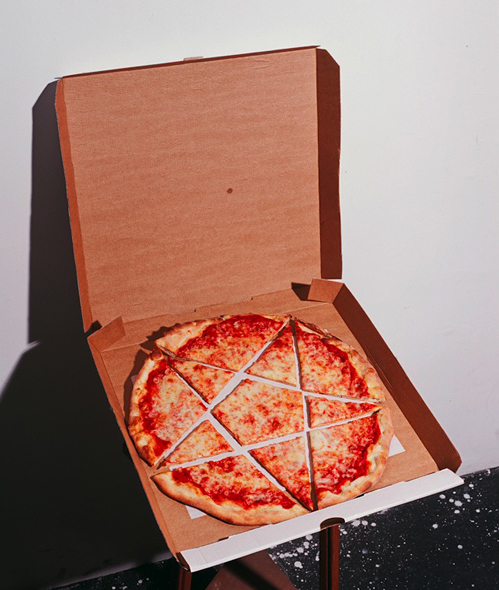 Week-old pizza from the back of the refrigerator …
• Here’s an idea for a novel: “two down-on-their-luck entrepreneurs who stumble upon the idea of reviving for-profit idolatry. Selling statues of household gods to the masses, and building a neo-pagan religion around it.” Um, I think that people have been doing this for some time.
• Circus Breivik. Norwegian scholar of esotericism Egil Asprem analyzes the trial of Anders Behring Breivik. (He wrote about the shootings for the current Pomegranate.)
This trial will be about two things: psychiatry and ideology. Two drastically conflicting reports on Breivik’s mental health have already ensured this. Added to this, of course, is Breivik’s own clearly stated wish to be judged as sane, and have his actions confirmed as ideologically motivated.
• Teaching classical philosophy to Brazilian schoolchildren:
I assured the students that until the nineteenth century hardly any philosopher was an atheist. Plato’s Euthyphro—with its argument about the relationship between ethics and the will of the gods—gets us into a lively discussion.
* This is called “edgy, irreverent outreach” by some of today’s Christians Jesus Followers. I think the pastor needs to look up “pathos” in the rhetorical dictionary, because he is doing it wrong. But to be fair, some long-ago saints would have agreed with him.
• Alcohol “sharpens the mind.” But “beer goggles” are real too.
Hanging the Salem Witches was a Good Idea, said the Zuñis.
From Philip Jenkins’ Dream Catchers: How Mainstream America Discovered Native Spirituality, which I am reading as part of some research on changing attitudes towards shamanism:
In 1882 when a group of Zuñi emissaries visited Salem [Mass.] . . . they congratulated the citizens for their ancestors’ determined response to the witchcraft problem. Through the 1890s, U.S. authorities were struggling to suppress Zuñi persecution of witches in conflicts that nearly led to war. (31)
Which reminded me of one of my all-time favorite articles, Malcolm Brenner’s “A Witch among the Navajo,” or what happens when Pagan Witchcraft meets witch-as-translation-for-our-word-for-evil-magic-worker.
At the time of writing it, Malcolm was a newspaper reporter in Gallup, New Mexico, and the Zuñi tribal government was part of his beat. Previously he had lived on the Navajo reservation to the north, during which the events he described took place. His website.
An Anthology on Priestesses
Announcement
It is with great enthusiasm that we announce a new anthology to be published by Goddess Ink. This anthology comprises works of, about and by priestesses, and will be edited by Dr. Candace Kant and Dr. Anne Key.
As priestesses and scholars, we endeavor to create an anthology that will serve as a resource and a source of inspiration to both those engaged in and those interested in the role of priestesses. The anthology will contain material addressing ancient and modern priestesses including academic pieces, ritual, essay, poetry, meditations and artwork.
We seek submissions that express the experience and knowledge of priestessing, particularly, but not limited to, the priestess’ role in ritual and group leadership.
Submissions may be in any printable form, including scholarly essays, personal essays, poetry, artwork, chants, rituals, meditations, invocations, or other genre. For prose submissions send a 150 word abstract outlining your approach to the subject.
Submissions other than prose should be sent in finished form. For poetry, up to three poems of no more than 50 lines each.
Previously published work will be considered, but authors must hold all rights and have written proof from previous publisher .
Include author bio of up to 200 words at end of submission Please submit proposals and any inquiries by email to <submissions@goddess-ink.com> .
Deadline for submissions: July 1, 2012
Planned publishing date for the anthology: January 2013.
Contributors will be compensated with one contributor’s copy of the anthology and reduced pricing on additional copies purchased at the first run.
Dr. Candace Kant and Dr. Anne Key Managing Editors, Goddess Ink, Ltd.
Quick Review: Two Books on Mind-Altering Herbs
My house holds several shelves of herb books, thanks to M.’s interest in herbalism, some of which rubs off on me.
Lots of them are not relevant to our ecosystem, but we keep them for one little bit or another. Of the best, my favorites include Charles Kane’s Herbal Medicine of the American Southwest, although it leans more to the Sonoran desert than the southern Rockies, and the late Michael Moore’s various works of herbalism and ethnobotany. (Others by Kane here.)
One thing this reading did for me is make me sensitive to which writers have gotten their hands dirty, so to speak, and which are just recycling.
I would put Kenaz Filan’s The Power of the Poppy: Harnessing Nature’s Most Dangerous Plant Ally in the first category and Steve Andrews’ Herbs of the Northern Shaman: A Guide to Mind-Altering Plants from the Northern Hemisphere, sadly, in the second.
I have a real negative reaction to phrases such as “is thought to contain tryptamine” or “has been reported to have been used in the berserker frenzies of the Viking tribes” or to borrowing from dear old Maud Grieve, who was indeed a leading herbalist of the early twentieth century, but has no one learned anything since?
Unfortunately, Herbs of the Northern Shaman is full of that kind of bluster that promises more than it delivers.
Some sentences are completely confused: “Further to all these uses the Thorn Apple was a hallucinogen that ancient Greek priests employed as an oracle” (118). Presumably, the priest, not the plant, was the oracle, but if he employed Datura (thorn apple) as an entheogen, how was it done? And where and when and in what god’s service were these priests?
You won’t learn that here. Herbs of the Northern Shamanism is too elementary to be a solid historical work and too vague to be useful to the hands-on herbalist. It offers precious little about cultivation, preparation, or dosage. And for a book with “Shaman” in the title, it has little solid to say about the entheogenic uses of plants except for bland references to other peoples in other places. You would get much more at Erowid.org.
Open The Power of the Poppy, by contrast, and you will find a solid, documented history of humankind’s various interactions with Papaver somniferum, both the plant itself, its chemical constituents (heroin, morphine, etc.), and its synthetic imitations. Filan can write several interesting pages just on the history and development of the hypodermic syringe:
The hypodermic quickly became a status symbol among physicians, a sign that they had the finest and most modern medical equipment at their disposal [in the late 19th century]. Wealthy clients learned how to inject themselves or trained their servants in the technique . . . . The 1897 Sears Roebuck catalog feature hypodermic kits (a syringe, two vials of cocaine or morphine, two needles, and a carrying vase) for$1.50. (255)
The chapter on cultivation is basic but accurate enough, but the payoff is the chapters on dependence, tolerance, and getting clean.
Finally, if shamanism is partly about relationships with the other-than-human world, you will find that here too. It is not merely a literary device to write, “Poppy wants to alter your consciousness; that is one of the major means by which she encourages human cultivation . . . . But be advised that Poppy has her own best interests at heart, not yours. We may believe that Poppy is a tool that suits our purposes. Be advised that Poppy feels the same way about us” (276).
The Puzzle Path to Witchcraft

Clues to Witchcraft's Riddles?
Looking at the box, M. said, “It reminds me of the Christina Collection.” That took me back to the year we first lived together, when we rented a somewhat-winterized 1920s summer cabin in the faded resort town of Manitou Springs, Colorado, on the western edge of Colorado Springs.
Exploring the attics (there were two), we found a suitcase. Evidently it had been up there for several years. Inside were some clothes, a diary, and other items. From them we pieced together a partial picture of a twenty-something woman named Christina, her misadventures in Colorado Springs’ tiny lesbian bar scene, and other facts about her.
We never figured out her last name or any contact details, though, or why she stored her suitcase there—and she never came back for it in the six years we lived at that address.
All of this is a long introduction to “In the Drip of an Eave,” which is described by its maker as “a unique new way to learn witchcraft, this kit contains three books and handmade items, puzzles, and riddles. Carefully designed to evoke a true witchcraft experience.”
It’s the same principle as the Christina Collection, but with a smaller cardboard box instead of a suitcase.
Modred, the creator, is selling the kit. Mine is a review copy, and having sent a major editing project off to the printer, I now want to settle down in front of the wood stove (it’s chilly tonight) and start reading that diary.
Choosing This Year’s AAR Pagan Studies Papers
Finally finished — I hope — with the process of selecting papers to be presented in the Contemporary Pagan Studies Group’s sessions and in our joint session with the Indigenous Religious Traditions Group at next November’s American Academy of Religion annual meeting.
Being co-chair is one of those secretarial-type gigs I get stuck with. It’s the penalty for being literate.
Thanks to all the steering committee members of both groups for their proposal evaluations, and thanks to the AAR staff for selecting a new software program that makes evaluation and session-creation easier. I still sweat bullets over the process, but it all seemed to work OK.
The less enjoyable part of the process is having to write to the people whose proposals were not scored highly enough. Here again the new software makes it easier to scoop up all the evaluation comments, paste them into a document, remove identifying names, etc., and pass them on. People need to know why their proposals were scored the way they were — were they just not suitable for the “call,” were they insufficiently analytical, or did they just promise too much? At least one proposal this year sounded more like a book outline than what could be covered in a 20-minute talk.
Some folks must just skip over this excellent advice on proposals.
Some sessions have respondents — scholars who summarize, evaluate, and critique all the papers after the presentations are over, serving as a sort of discussion leader during the Q&A. My next goal is to try to get the writers and the respondents communicating earlier in the writing process. I had a bad experience once of serving as a respondent and trying to write my critique only hours before the session — I felt as though all I produced was incoherent babble.
What will the papers’ topics be? I don’t want to jump the gun on the AAR’s process, but I will announce them in due course.
What’s Your Religious IQ?
As I blogged yesterday, too much reporting on religion is written by people who are religiously illiterate — and, sometimes, proud of it.
Every reporter at least ought to score well on this quiz from the Pew Forum on Religion and Public Life. Go ahead, take it. Fifteen questions — it’s easy*.
Note that it is the “U.S. Religious Knowledge Quiz,” and at least two questions are specific to America’s religious history. Nothing about the Pentecostal Christians, though. Couldn’t they have worked the Azusa Street Revival into it?
*Yes, I scored 100, but this is what I do.
Reporters Miss the Religion Story and Their Readers Lose
We rightly complain that Pagan matters are poorly or perfunctorily covered in the news media. Jason Pitzl-Waters writes many blog posts sorting through news coverage and pointing out its failings (and occasional successes).
But the problem is bigger than us. Even the the major world religions’ roles in the news are overlooked or misunderstood by reporters whose frequent secular bias and lack of education leads them to disdain religious issues. How often, for example, does coverage of the incipient civil war in Syria mention that it falls right along the Sunni-Shiite Muslim divide?
In a blog post titled “Don’t Know Much about Theology,” Walter Russell Mead makes what should be the obvious point.
Even where religion isn’t driving conflict, it plays a powerful role in the way people understand their own personal identities and life stories and in the way they interpret world events. Turkey, Iran, Israel, India, Pakistan, Nigeria: in these countries and in many others, it is impossible to understand contemporary politics without a deep feel for the religious identities and traditions that shape the way the people of these countries perceive and interpret political and historical realities.
A lot of news stories are missed or misunderstood, he says, and he’s right. It’s worth reading the whole thing.
Stop in at Get Religion for daily coverage on how the news “professionals” mangle or miss the religious element in the news.
“The Occult Experience” of 1985
A friend pointed me to the Vimeo page where you can see The Occult Experience (95 min.), an Australian television documentary from 1985, researched and co-produced by Nevill Drury, on witchcraftandprimitivepeopleandsatanismandexorcismandallkindsofspookystuff.
Watching it was hard, because I kept turning away after encountering such portentous statements as “The search for supernatural powers continues in spite of science and technology” or that people practice “ancient Celtic traditions of nature worship.”
No one unpacks these assertions at all. Rather, they are just delivered as though they were the Final Word.
At one point, the narrator intones, “How does it feel to be a witch in the computer age?” (At the time the documentary was made, I thought my KayPro II portable personal computer was cutting-edge.)
It has its historical interest. Hey, there’s Herman Slater doing ritual in a Manhattan street. Why? You won’t learn from the film!
And at about the 20-minute mark, Alex Sanders delivers version number 1,045 of the original “I was initiated by my grandmother” story, which has been imitated so many times.
Back then, boys and girls, to be a Craft leader you had to have some special story to tell about your magical heritage or you were nobody.
And look, there is Janet Farrar taking her clothes off while chatting with her late husband, Stewart. And the paintings of Rosaleen Norton—can’t have an Australian production without those. Drury would build his later academic career on them.
Margot Adler, Olivia Robertson . . . so many names. But no context.
The whole film is thunderingly pretentious and yet basically content-free. You would not learn anything systematic here about the development of contemporary Paganism—which might be Satanic and which might be “primitive” and might involve “altered states of consciousness” (quick clip of Esalen), and is certainly spooky spooky or silly silly, depending on your perspective.
It make me wish that I could take those clips and arrange them into a meaningful narrative. Maybe some day someone will.