When Gods Sacrifice to Themselves

Almost all traditional Pagan cultures have one religious practice in common that contemporary Pagans for the most part avoid: Sacrifice, which means literally “to make sacred.”

Earlier this month, in fact, at a Pagan camp-out one of the elders was discoursing on the uselessness of sacrifice. If g/God were a carpenter working in his shop, sacrifice would be like bringing a hammer with the handle cut off and saying, “Here, I offer this to you.” Everyone thought that was profound.

In the entry on sacrifice in the HarperCollins Dictionary of Religion (edited by Jonathan Z. Smith, but individual entries are not signed), we read that “Naive and academic explanations of sacrifice abound. Sacrifice has been characterized as a gift (an offering)” [1], a means of communication between the profane and the sacred, an attempt to establish reciprocity between the human and the divine realms (most often expressed by the formula, “I give in order to get”), an expiation, a substitution, and a reenactment of primordial events.”

Theophrastus, a philosospher and student of Aristotle, wrote, “there are three reasons one ought to sacrifice to the gods: either on account of honor or on account of gratitude or an account of a want of things. . . . . We honor the gods either because we seek to deflect evils or to acquire goods for ourselves, or because we first have been treated well or simply to do great honor to their good character” [2]“.
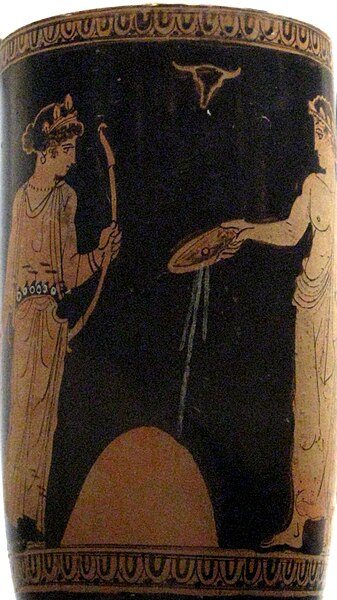
Libation of Artemis and Apollo at the omphalos. Master of Shuvalov (?), ca. 440 BC. Pushkin Museum. ? Wikipedia user Shakko 2009

This is an “insider” perspective, what Smith’s dictionary would characterize as a “naive” explanation.  So we think that we know what sacrifice means both in religion and in other areas of life: a killing (to Christians, Jesus’ bloody death was  the one big, final,  expiating sacrifice of human history), a giving up of pleasures (“She sacrificed her childhood to become a ballerina.”) or of life itself  in service to society (“Military members who gave ultimate sacrifice remembered at WWII Museum”).

Then I see this headline at the Tropaion blog: “Gods Sacrificing: Iconography and Divine Ritual Praxis.” It’s a  review of  Religion of the Gods; Ritual, Paradox, and Reflexivity :

The book examines the numerous iconographic depictions of Gods and Goddesses performing a libation or acting towards performing a sacrifice. One example is the attached picture: a libation of both Artemis and Apollo at the omphalos. In this red-figure lekythos, the poured liquid is visible from the Apollo’s phiale. It is logical that looking closely at those pictorial evidences makes you wonder and immediately questions arise. One of the questions is the following: what these depictions mean?

The review is worth reading, for it addresses the question, if sacrifice is addressed to a “higher” Other, than who is higher than the gods?

There are always surprises in the old Paganism.


1. If “sacrifice” and “offering” can be used simultaneously, what about “libation,” as illustrated on the vase painting? Some would say so; others want life in their sacrifice.

2. Quoted in Jan N. Brenner, “Greek Normative Animal Sacrifice,” in A Companion to Greek Religion, ed. Daniel Ogden (Malden, Mass.: Blackwell, 2007), 139.


Is the Church of England Desperate or Just Confused about Paganism?

With the obvious news peg of summer solstice celebrations at Stonehenge, the Telegraph reports on a rather odd initiative from the Church of England. The article begins,

The church is training ministers to create “a pagan church where Christianity [is] very much in the centre” to attract spiritual believers.

Ministers are being trained to create new forms of Anglicanism suitable for people of alternative beliefs as part of a Church of England drive to retain congregation numbers.

Reverend Steve Hollinghurst, a researcher and adviser in new religious movements told the BBC: “I would be looking to formulate an exploration of the Christian faith that would be at home in their culture.”

He said it would be “almost to create a pagan church where Christianity was very much in the centre.”

To which I can only ask, what are they talking about? Is this Christianity with mistletoe and pentacles? Do they think that they can attract the “party Pagans” to drum circles in the parish hall? The article continues,

The Church Mission Society, which is training ministers to “break new ground”, hopes to see a number of spiritual people align themselves with Christianity.

Andrea Campenale, of the Church Mission Society, said: “Nowadays people, they want to feel something; they want to have some sense of experience.

There is that.

Related: a Church Mission Society article on “being the light of Christ” at a Pagan festival in 2012. They gave free henna tattoos and did card readings with the “Jesus Deck.”

UPDATE: An Anglican priest involved says that the Telegraph’s article overstated what was going on.

i do not believe that a Christian church could adopt Paganism and remain Christian nor that a Pagan group (or individual) could adopt Christianity and remain Pagan. i do think that Paganism has much to say and offer to the world today and much that Christians can adopt – for instance whilst Christianity isn’t polytheistic, the Trinity does include the divine feminine as well as the divine masculine and those, including Pagans, who have criticized an apparently male lone christian deity are right to do so, and we as Christians need to acknowledge that and recover out own tradition of the divine feminine. similarly Pagans have often put Christians to shame when it comes to the environment when St Paul time and again talks of Jesus not saving people from the world but wanting to set the whole of creation free from suffering – we need to recover this ecological vision. i could go on but i hope you get the idea – that is what i meant by saying a Pagan church – on reflection i think i should have said a church in Pagan culture or one that learnt lessons from Paganism.

Vril: It’s the Secret

Before there was Robert Heinlein, Stranger in a Strange Land or The Moon is a Harsh Mistress, water-sharing, grokking, TANSTAAFL, and line marriage, there was Edward Bulwer-Lytton and The Coming Race, published in 1871.

As Egil Asprem recently noted in a blog post titled “The (all too) secret history of Vril,”

It is astonishing how much of modern occultism is dependent on works of fiction. The machinations of secret societies, the malicious rituals of satanic cults, and the magicians’ adventures on the astral plane have all been portrayed in great detail in works of fiction, which have in turn directly influenced the creation of real organisations and inspired new ritual practices among self-styled occultists. The entire current of Rosicrucian initiatory societies even had its main impetus in a text considered by its authors to be a playful ludibrium — although no doubt one that expressed deep convictions.

Read it.

A Country “Under Christian Occupation”

The BBC profiles some Hellenes — modern Greek Pagans — with minimal snark.

Tryphon Olympios leads many of the ceremonies (BBC).

[The summer solstice is] the most important annual festival for followers of The Return of the Hellenes – a movement trying to bring back the religion, values, philosophy and way of life of ancient Greece, more than 16 centuries after it was replaced by Christianity

These people consider Greece to be a country under Christian occupation.

(Not to mention nearly four hundred years of Muslim occupation as well.)

The followers are an odd mix. There are New Age types who revere ancient traditions, leftists who resent the power of the Orthodox Church, and Greek nationalists who see Christianity as having destroyed everything that was truly Greek.

As the modern-day ancients relax in their camp at the base of the mountain, a few sell philosophy books, CDs, food and jewellery. Some wear modern clothes, others togas [sic], and a few sport a wreath.

No, Matthew Brunwasser, every ancient garment is not a “toga.”

Advice for Twenty-Something Magicians

I was one of those, briefly — it didn’t take. But this is pretty good.

On the other hand, I suspect that there will be a few of you—maybe less than a handful, maybe just one or two—who will stick with it, and make the transition into hardcore, practicing magicians, and it is to you in particular that I feel a certain responsibility to write this essay for. As a member of the generation immediately preceding yours, I kind of have a duty to pass on some hard-won information. Most of you will probably ignore it, or not even be ready to listen to it, but I feel like I should put this out there for whatever greater purpose it serves.

Science Fiction and the Grieving Process

At io9, Lauren Davis writes about how science fiction helped her to deal with her grief at the sudden death of her younger brother.

The podcasts were meant to be a distraction, like the wine or the VCDs of movies my mom had brought home from a trip to Asia that Colin had never gotten a chance to watch. But one day, I heard Robert Reed’s story “A Woman’s Best Friend” on Clarkesworld, and I found that I felt inexplicably lighter. I ran home and immediately looked up the text of the story, rereading it for clues to my sudden shift in emotions.

“A Woman’s Best Friend” is a funny story, a sort of multi-worlds parody of It’s a Wonderful Life. Instead of being led through an alternate timeline by a down-on-his-luck angel, George Bailey is dumped in another universe by an interdimensional being who finds amusement in such rearrangements. George does meet a doppelgänger of his wife, Mary, but she’s no sad spinster and is, in fact, hip to the ways of the multiverse. George left behind a drowned corpse in his own world, but he comes to find that his new home universe holds all sorts of wonders.

Really, whether it is Battlestar Galactica (also referenced in the article) or The Iliad, this is one thing that literature is supposed to do, to help you reframe your life’s problems and learn how to deal with them in a quasi-mythic way. So hurray for that.

‘Non-Christian’ License Plate Prompts Oklahoma Lawsuit

An Oklahoma court has cleared the way for Methodist clergyman Keith Cressman to sue the state over his objection to  imagery on that state’s license plate.

The new license plates carry a photo of a statue called “Prayer for Rain,” of an Apache man shooting an arrow into the sky.

His 2011 lawsuit in U.S. District Court in Oklahoma City seeks a court order allowing him either to cover up the image on his plates or to get a personalized plate for the same cost as a standard license plate.

“Mr. Cressman’s (lawsuit) states a plausible compelled speech claim,” the appellate judges wrote Tuesday in a 39-page decision, reversing Judge Joe Heaton’s dismissal of the lawsuit. “He has alleged sufficient facts to suggest that the ‘Sacred Rain Arrow’ image on the standard Oklahoma license plate conveys a particularized message that others are likely to understand and to which he objects.”

Oklahoma has used American Indian imagery on license plates before, but something about this one evidently pushed the Rev. Cressman’s buttons.

Sigh. Maybe they should make a plain black and white plate for militant monotheists.

Pentagram Pizza: Should You Print Out These Links?

pentagrampizzaItems that deserve more commentary, but are not getting it today:

• From  MIT Technology Review: When we read books on paper, do we retain more than when we read on a screen?

Re-creating the sound of ancient musical instruments, sometimes with synthesizers.

A review of Apocalyptic Witchcraft, from Scarlet Imprint.

• At The Journal of Hofstadr Hearth, Alfarrin rethinks the blot in terms of Neolithic and Paleolithic, Aesir and Vanir, reciprocity and sharing. With a big shout-out to Paul Shepard!

• Related issues here at “Heathens in the Military: An Interview with Josh and Cat Heath, Part One,” at the Norse Mythology Blog.

You Want “Paganistan”?

From n + 1

Build Paganistan. A floating Paganistan. “Bulletproof Coffee”? I might try that once.

In addition to seeing government as just another problem that technology can overcome, Seasteaders try to “hack” every aspect of their existence down to their self-care regimens. Many participate in health and fitness regimes like the Paleo Diet and Crossfit—lifestyles that dovetail nicely with more mainstream libertarian retro-futurism, which argues humans ought to live more like they did before their “freedom” was impinged upon by large state governments, all while enjoying the enhancements of technological innovation forged in the free market. It wasn’t just Charlie from the boat cruise who proselytized the health benefits of butter: the unofficial beverage of Ephemerisle was “Bulletproof Coffee”—black coffee with half a stick of butter mixed in—which advocates claim increases their mental acuity and helps them stay trim. The inventor of the concoction claims to have increased his IQ by twenty points and lost 100 pounds as a result of his experiments “hacking” his biology. He was at Ephemerisle, too and later, in an email, told me he’d had a great time.

Have You Accepted Pan?

talk about pan