Tag Archives: writing

Journalistic Cliches and Their Academic Cousins

My least-favorite journalistic cliche is “time will tell.”

Despite the president’s charm offensive, some pundits say that the world will end next Tuesday. Time will tell.

Read the whole list of 150 here.

As a journal editor, I could make my own list, particularly those stupid bits of wordiness that get between the reader and an actual thesis statement, in which the writer actually takes a position on the issue.

Some sample candidates:

I plan to explore the intersection between . . .

In this paper I will argue  . . .

This article compares . . .

Get out of the spotlight, academic writer, and say something about something.

Quick Review: The Wizard and the Witch

wizard and witchOne of my earliest entries on this blog, clear back in 2003, was a complaint about the lack of biographical and autobiographical writing in American Wicca — and I would extend that to all types of new Paganism generally.

That entry did mention Margot Adler’s Heretic’s Heart (1997), but I did not care for Whispers of the Moon (1996), a biography of Scott Cunningham, because it seemed too obviously tidied-up and sanitized. (Sam Webster says that it is still valuable despite that — I won’t dispute the point.)

Michael Lloyd’s The Bull of Heaven (2012) broke the drought. His thoroughly researched book placed Eddie Buczynski in a cultural context — the New York Pagan and Gay Liberation scenes of the 1970s — and explored a wealth of connections and possibilities without blinking.

Now John C.. Sulak, who co-wrote Modern Pagans (2001) for RE/Search Press, has brought us  The Wizard and the Witch: An Oral History of Oberon Zell & Morning Glory.

It is not just the history of a significant slice of  American Paganism from the 1960s until now, but also the love story of a couple married for forty years.

Yet Morning Glory, priestess of Aphrodite, invented the term “polyamory” (but not the concept)  and they embraced it. Paradoxes abound.

Sulak tells the story of Otter and MG through multiple voices, more like a radio documentary — there is even a voice labeled “Narrator.” I thought that was a little weird at first, but I got used to it.

Sometimes the Zells may seem like Pagan rock stars, but then you see them in screaming fights, or admitting that they made mistakes in who they trusted or dealt with their families of birth or how they raised their kids  (Those children, now grown, are also heard from.) Highs and lows, gains and losses, feasts and famines — it’s all here.

Reading it, you can see how the Church of All Worlds, founded by Tim Zell and his close friend Lance Christie, started out as what we now would call “spiritual but not religious,” and changed as it encountered other overly Pagan groups (such as Feraferia) as well as various Witchcraft groups.

There is much about the publishing chronicle of Green Egg magazine and the founding of the Grey School of Wizardry as well, not to mention the growth of the Pagan festival circuit.

When people wonder, “What was the American Pagan scene like in the 1970s, 1980s, 0r 1990s?” they will do well to read The Wizard and the Witch for one answer. It is a sign of Llewellyn’s editorial maturation that they published it, and I applaud that.

Colin Wilson 1951–2013

A prolific writer on mysticism and the paranormal, among other things, the English author Colin Wilson has passed on. In the video (audio recording, really) he discusses some of his work and personal experiences.

Orthography and the Modern Pagan

One thing I did at the recent American Academy of Religion annual meeting was stop by the University of Chicago Press booth and get the name of the managing editor of the press’s Manual of Style, which is the holy book, all 1,028 pages of it, for editors of academic books and journals—plus many publishers of serious nonfiction.

A petition has been sent to her by Oberon Zell of the Church of All Worlds, etc., as well as to the editors of the Associated Press Stylebook, the holy book of American journalists, about the capitalization of the word “Pagan.” Oberon has lined up forty-some writers and academics in support of the petition, which reads in part,

The current journalistic convention of printing lower case for these terms seems to have originated with the Associated Press Stylebook, first published in 1953.  However, a new era of religious pluralism has emerged over the past sixty years. The terms “Pagan” and “Paganism” are now being capitalized in a variety of publications, texts, documents, and references, including religious diversity education resources such as On Common Ground: World Religions in America, The Pluralism Project, Harvard University, and Inmate Religious Beliefs and Practices, Technical Reference Manual, Federal Bureau of Prisons, U.S. Department of Justice.

You can read the full text here.

So far, the University of Chicago Press has acknowledged receiving it and plans to forward it to its Reference Committee.

This is a worthwhile cause, I think, and it is a battle that I have fought since the early 1990s (at least) when I was writing The Encyclopedia of Heresies and Heretics for the reference book publishers ABC-Clio. (A friend working there at the time commissioned it.) I won the battle on Pagan — even for ancient polytheists — but lost on BCE/CE versus BC/AD.

As editor of The Pomegranate, I have continued to insist on capital P’s except in direct quotations. This has put me in gentle conflict sometimes with British and other European contributors who favor “pagan” or at most use “Pagan” for self-conscious contemporary new religions and “pagan” for pre-Christian practices. I think that bouncing back and forth is confusing for the reader’s eye.

So the movement to change the stylebooks is underway, although I expect the process to be a slow one.


Vampires and the Big Blue Marble

I shared a cabin with Margot Adler and some other presenters at the Florida Pagan Gathering four years ago. At that point she had read about seventy vampire novels and was still going strong, looking for the answer to the question, “Why do literary vampires fascinate us?”

Now she thinks she knows:

Every age embraces the vampires it needs, writes feminist author Nina Auerbach in her book, Our Vampires, Ourselves. Every age uses vampires to express their fears and concerns, writes Eric Nuzum, in his book, The Dead Travel Fast.

In 1897 when Bram Stoker wrote Dracula, England had the largest ports in the world. There was fear of incoming disease, of foreigners, of immigration. And Stoker created the perfect monster, Eastern European, bringing dirt from a foreign land. You can do this for every period that has had a wave of interest in vampires. In the 80’s, with Aids, vampires were often described in novels as parasites. You became infected by vampirism, like a disease.

Here is the whole text and video of  her recent presentation.  Read it, and the title of this post will make sense.

Pentagram Pizza: It’s Revived Again

pentagrampizza¶ At Pagan Square, Rebecca Buchanan rounds up children’s books featuring Norse gods and heroes.

Bright Spiral is an online comic about occult initiation. Trippy and complex.

¶ “Chilled-out multitasking hipster psychics don’t seem so eccentric anymore” and “We are in the middle of an occult revival.” Again.

Green Egg is back as a print magazine. And don’t forget the “Best of” anthology, for which I wrote a bunch of chapter intros.

Why Pagans Did Not Fight for Their Gods

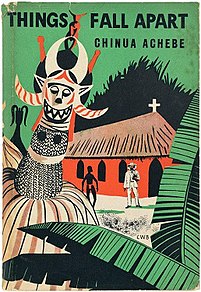
Things Fall Apart, by the Nigerian writer Chinua Achebe, published in 1958, is often labeled as the “archetypal modern African novel.” Set in the 1890s, at the beginning of British colonial rule, its protagonist is a hard-driving Igbo yam farmer, warrior, and village leader named Okonkwo, who holds himself, his wives, and his children to high standards of hard work and respect for ancestral traditions.

Things Fall Apart was always on my list of Classics I Should Read Some Day, and two weeks ago, facing a 1,000-mile drive, I checked out the audio book from the library. Having cleared the urban areas of Colorado Springs and Denver and entered the High Plains on Interstate 76, I slipped the first CD into the player.

Somewhere in  South Dakota I finished it. And I connected it with a a book that I had been reading in September, Alan Cameron’s The Last Pagans of Rome.

Achebe is writing historical fiction about villagers confronted (in the last fourth of the book) by the British colonial apparatus and Anglican missionaries. Cameron is examining the persistent idea that there was a self-consciously Pagan resistance in the Western Roman Empire during the 4th century to imperial Christianity — this a generation or two after the last Pagan emperor, Julian (who would have called himself a “Hellene”), failed in his attempt to decouple Christianity from the power of the empire.

Achebe’s characters are fictional subsistence farmers. Cameron looks at the writing and actions of upper-class Romans 1,600 years earlier, mostly men whose birth and wealth entitled them to a seat in the Roman Senate, even though little power came with the job — the power by then was centered far away in Constantinople.

As the book’s cover blurb notes,

It is indeed widely believed that a largely pagan [sic] aristocracy remained a powerful and active force well into the fifth century, sponsoring pagan literary circles, patronage of the classics, and propaganda for the old cults in art and literature. The main focus of much modern scholarship on the end of paganism in the West has been on its supposed stubborn resistance to Christianity. The dismantling of this romantic myth is one of the main goals of Alan Cameron’s book. Actually, the book argues, Western paganism petered out much earlier and more rapidly than hitherto assumed.

Cameron argues in fine-grained detail that there was no such stubborn resistance based on a clash of theologies. To these high-class Romans, the “old religion” was largely about social position and tradition. To be named to a college of priests was a social honor, perhaps like being invited to serve on the board of directors of a symphony orchestra. (Something similar happened on a smaller scale in Okonkwo’s village.) When they were able to keep their social position (and their copies of the Iliad) while accepting Christianity, they did so.

Likewise, in Things Fall Apart, as the Christian missionaries begin to attract more and more converts, and those converts attack the traditional religion, such as by killing a sacred python in a village shrine, someone asks one of the elders why they don’t fight back.

“It is not our custom to fight for our gods,” said one of them. “Let us not presume to do so now. If a man kills the python in the secrecy of his hut, the matter lies between him and the god. We did not see it. If we put ourselves between the god and his victim we may receive blows intended for the offender. When a man blasphemes, what do we do? Do we go and stop his mouth? No. We put our fingers into our ears to stop us from hearing. That is a wise action.”

And when one group, including Okonkwo, does burn the missionaries’ church, they are punished by the colonial authorities, which breaks their resolve. The disruption of the structure of traditional authority and the disruption of traditional religion go hand in hand.

I am left with some thoughts:

• Whereas the Emperor Julian understood that Hellenic religion, literature, and philosophy were all interrelated and strove to keep that cosmos in place, the glue was looser in the Western Empire.

In their world, confronted by one British district commissioner, his African policemen, and a missionary or two, the Igbo people did not understand the scale of what was happening.

• Most people do not fight over theology anyway. Theology is often just a group marker, “us versus them.” The theological claims themselves are secondary. People fight for their group more than “for the gods,” perhaps.

• People will change religion for a variety of reasons—to get along with a spouse’s family, to gain or to retain their social status (the Roman senatorial class), or to avoid having their heads chopped off (anyone confronted with Islamic expansionism).

• An “organic” Pagan society is the dream of many, but as Things Fall Apart illustrates, such a society can be transformed within one generation.

• I do, of course, consider both the traditional Igbo and the fourth-century Romans to be Pagan, using the term as we now define it. There is no other choice when “traditional religion goes global” either, as the recent New York Times piece about a West African traditional priest working in New York City described. When geographical and cultural boundaries are crossed, we need a “global” descriptor.

• Can we construct a theology — or is it part of Pagan theology today — to say that the gods fight their own battles?

Nevil Drury 1947–2013

drury

Nevill Drury

Nevil Drury, well-known Australian writer and teacher on magical and esoteric topics, died yesterday at home of cancer and liver failure.

I had the experience of working with not long ago when he did an article for The Pomegranate: the International Journal of Pagan Studies on “The Magical Cosmology of Rosaleen Norton.”

His Facebook page. His author page at Amazon.com.

A page of interviews with him from his website.

Good Advice: “Run Your Own Race”

I hit bottom the summer I turned 36. Part-way through grad school, I took a break to work as managing editor of an outdoor magazine, Colorado Outdoor Journal. (You’ve never heard of it. I needed a job.) In May, the publisher pulled the plug on the magazine, but I had already registered for the June annual conference of the Outdoor Writers Association of America, so M. and I packed up our VW camper and — unemployed — drove to that year’s site, Kalispell, Montana.

At a reception, this guy — call him T. — came up and introduced himself. I did not know his face, but I knew his name: he had written several books I admired and was on the masthead of one of the leading magazines.

As freshmen at Reed College, he said, we had been in the same creative writing class. He remembered me. I had totally forgotten his being there. (He dropped out, started writing. I stayed.)

It wasn’t T’s fault, but in the wee hours one morning on that trip I woke up in the camper and had the nearest thing to a nervous breakdown that I ever had experienced. Everything that I thought I was or would be turned to dust and ashes. I was not suicidal, but I was crushed by an overwhelming sense of failure. No job. Maybe no career. Bills to pay. Taking the wrong path . . .

Someone should have given me this to read: “Run Your Own Race.

The best advice I’ve received about surviving in the competitive world of grad school was passed down from a colleague: “Kaitlin, make sure to run your own race.” . . . .  Looking around at your colleagues, there will be people publishing more, teaching more, and people who have more extracurricular activities, or more funding. It can be easy to think you don’t measure up. This self-deprecating thinking ignores strategies that can help make you successful and instead fixates on what others are doing.

I learned that lesson as writer, too: Be happy about your friends’ successes, and don’t measure yourself against them. Run your own race.

Around the Pagan Blogosphere, 25 August 2013

Some bookmarked links are piling up, so let’s clear them away.

¶ Lee Morgan: What happens when a writing project turns mysteriously magical:

It wasn’t long before the story, its characters and underlying mythic themes came to life in very tangible ways for me. Not only did I start to dream about the characters who would inform me of what their ‘future’ should hold, but other friends dreamed about them and sometimes it wasn’t easy to tell if they were the character from the book or being ‘gloved’ by a spirit or god they were aligned to mythically in the book. The characters have become what is known in the western Occult tradition as “egregores’” or thought-forms.

¶ Via Forging the Sampoa link to a post on “The Survival of Animism in Russia — and its Destruction in the West,” which, given the source, you know will focus on Finnic peoples,

¶ But never underestimate Russian xenophobia, now aligned with resurgent Orthodoxy, which has led, among other things, to the closing of the only Mari-language primary school that served this partly-Pagan nation.

¶ The list of polytheistic devotional books (and some Pagan SF) published by the Biblioteca Alexandrina  continues to grow. I have one and should get a couple of others.