Tag Archives: Paganism

Pentagram Pizza: It’s Revived Again

pentagrampizza¶ At Pagan Square, Rebecca Buchanan rounds up children’s books featuring Norse gods and heroes.

Bright Spiral is an online comic about occult initiation. Trippy and complex.

¶ “Chilled-out multitasking hipster psychics don’t seem so eccentric anymore” and “We are in the middle of an occult revival.” Again.

Green Egg is back as a print magazine. And don’t forget the “Best of” anthology, for which I wrote a bunch of chapter intros.

Why Pagans Did Not Fight for Their Gods

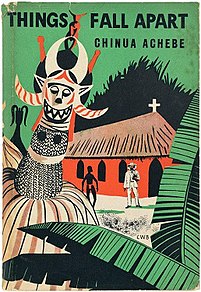
Things Fall Apart, by the Nigerian writer Chinua Achebe, published in 1958, is often labeled as the “archetypal modern African novel.” Set in the 1890s, at the beginning of British colonial rule, its protagonist is a hard-driving Igbo yam farmer, warrior, and village leader named Okonkwo, who holds himself, his wives, and his children to high standards of hard work and respect for ancestral traditions.

Things Fall Apart was always on my list of Classics I Should Read Some Day, and two weeks ago, facing a 1,000-mile drive, I checked out the audio book from the library. Having cleared the urban areas of Colorado Springs and Denver and entered the High Plains on Interstate 76, I slipped the first CD into the player.

Somewhere in  South Dakota I finished it. And I connected it with a a book that I had been reading in September, Alan Cameron’s The Last Pagans of Rome.

Achebe is writing historical fiction about villagers confronted (in the last fourth of the book) by the British colonial apparatus and Anglican missionaries. Cameron is examining the persistent idea that there was a self-consciously Pagan resistance in the Western Roman Empire during the 4th century to imperial Christianity — this a generation or two after the last Pagan emperor, Julian (who would have called himself a “Hellene”), failed in his attempt to decouple Christianity from the power of the empire.

Achebe’s characters are fictional subsistence farmers. Cameron looks at the writing and actions of upper-class Romans 1,600 years earlier, mostly men whose birth and wealth entitled them to a seat in the Roman Senate, even though little power came with the job — the power by then was centered far away in Constantinople.

As the book’s cover blurb notes,

It is indeed widely believed that a largely pagan [sic] aristocracy remained a powerful and active force well into the fifth century, sponsoring pagan literary circles, patronage of the classics, and propaganda for the old cults in art and literature. The main focus of much modern scholarship on the end of paganism in the West has been on its supposed stubborn resistance to Christianity. The dismantling of this romantic myth is one of the main goals of Alan Cameron’s book. Actually, the book argues, Western paganism petered out much earlier and more rapidly than hitherto assumed.

Cameron argues in fine-grained detail that there was no such stubborn resistance based on a clash of theologies. To these high-class Romans, the “old religion” was largely about social position and tradition. To be named to a college of priests was a social honor, perhaps like being invited to serve on the board of directors of a symphony orchestra. (Something similar happened on a smaller scale in Okonkwo’s village.) When they were able to keep their social position (and their copies of the Iliad) while accepting Christianity, they did so.

Likewise, in Things Fall Apart, as the Christian missionaries begin to attract more and more converts, and those converts attack the traditional religion, such as by killing a sacred python in a village shrine, someone asks one of the elders why they don’t fight back.

“It is not our custom to fight for our gods,” said one of them. “Let us not presume to do so now. If a man kills the python in the secrecy of his hut, the matter lies between him and the god. We did not see it. If we put ourselves between the god and his victim we may receive blows intended for the offender. When a man blasphemes, what do we do? Do we go and stop his mouth? No. We put our fingers into our ears to stop us from hearing. That is a wise action.”

And when one group, including Okonkwo, does burn the missionaries’ church, they are punished by the colonial authorities, which breaks their resolve. The disruption of the structure of traditional authority and the disruption of traditional religion go hand in hand.

I am left with some thoughts:

• Whereas the Emperor Julian understood that Hellenic religion, literature, and philosophy were all interrelated and strove to keep that cosmos in place, the glue was looser in the Western Empire.

In their world, confronted by one British district commissioner, his African policemen, and a missionary or two, the Igbo people did not understand the scale of what was happening.

• Most people do not fight over theology anyway. Theology is often just a group marker, “us versus them.” The theological claims themselves are secondary. People fight for their group more than “for the gods,” perhaps.

• People will change religion for a variety of reasons—to get along with a spouse’s family, to gain or to retain their social status (the Roman senatorial class), or to avoid having their heads chopped off (anyone confronted with Islamic expansionism).

• An “organic” Pagan society is the dream of many, but as Things Fall Apart illustrates, such a society can be transformed within one generation.

• I do, of course, consider both the traditional Igbo and the fourth-century Romans to be Pagan, using the term as we now define it. There is no other choice when “traditional religion goes global” either, as the recent New York Times piece about a West African traditional priest working in New York City described. When geographical and cultural boundaries are crossed, we need a “global” descriptor.

• Can we construct a theology — or is it part of Pagan theology today — to say that the gods fight their own battles?

Iron Mountain Ritual Site To Be Restored

Iron Mtn., Manitou Springs

Iron Mountain, Manitou Springs, Colorado. (photo by Colorado Springs Gazette).

When M. and I read this item in the Colorado Springs Gazette, our hearts soared. When we were newlyweds and bought our first house (a barely winterized 1920s cottage, 740 sq. ft.), it was just outside the lower left boundary of this photo of Iron Mountain in Manitou Springs, Colorado.

Iron Mountain is just a foothill, really, but when you look up from below, it blots out the higher ridges behind it.

Before we bought the house, we rented it, and our landlord was Tom McGee, who would later build “The House on Iron Mountain.” (I think the article’s date is wrong; we recall it being built around 1984.)

Before then, we would climb to the summit, where there was a natural stone throne, sometimes using it as a ritual site.

The coven we headed in the early 1980s was the Iron Mountain Coven, and Iron Mountain gave its name to a certain zine of the mid-1980s — Iron Mountain: A Journal of Magical Religion.

I put out only four issues, but they helped to inspire Fritz Muntean to start his own zine called The Pomegranate, and look at it now.

As for the McGees’ house, not only did it ruin “our” ritual site, but it was not even architecturally interesting. So they are razing it today? Hurray! And if that land upon which technically we trespassed becomes public open space, someone else can sit in the “throne,” if it is still there. I suspect that the rock outcropping survived the construction project.

Resources in Pagan Theology

Christine Hoff Kraemer has assembled a list of books and websites on contemporary Pagan theology.

I was happy that I only once reacted with “What is X doing here?” And maybe I ought to give X a second look (or maybe not).

You really ought to read most of those books.

So You Want to Worship the Old Gods . . .

Hipster-Jon-Snow-game-of-thrones-23594329-362-500There are people who think that in order to do so, you have to learn “their” language, as spoken centuries ago, because the gods don’t keep up or something, let alone communicate in non-verbal ways.

All right, then.

You want to deal with Werunos (Sanskrit, Varuna), keeper of cosmic order? Talk this way.

It’s all explained at this link from Archaeology magazine on the reconstructed pronunciation of Proto-Indo-European: “Telling Tales in Proto-Indo-European.”

I played that clip for M., and she said that it reminded her of the 1970s–80s vogue for playing songs backwards to hear the “Satanic messages.” Maybe that’s the crucial fault in reconstructionism.

Around the Pagan Blogosphere, 25 August 2013

Some bookmarked links are piling up, so let’s clear them away.

¶ Lee Morgan: What happens when a writing project turns mysteriously magical:

It wasn’t long before the story, its characters and underlying mythic themes came to life in very tangible ways for me. Not only did I start to dream about the characters who would inform me of what their ‘future’ should hold, but other friends dreamed about them and sometimes it wasn’t easy to tell if they were the character from the book or being ‘gloved’ by a spirit or god they were aligned to mythically in the book. The characters have become what is known in the western Occult tradition as “egregores’” or thought-forms.

¶ Via Forging the Sampo, a link to a post on “The Survival of Animism in Russia — and its Destruction in the West,” which, given the source, you know will focus on Finnic peoples,

¶ But never underestimate Russian xenophobia, now aligned with resurgent Orthodoxy, which has led, among other things, to the closing of the only Mari-language primary school that served this partly-Pagan nation.

¶ The list of polytheistic devotional books (and some Pagan SF) published by the Biblioteca Alexandrina  continues to grow. I have one and should get a couple of others.

Paganism Coming in from the Cold?

British SF writer Liz Williams explores the social position of “paganism” (yeah, the Brits can’t find the shift key) at The Guardian and asks if we are coming in from the cold.

In essence, Pagans are muddling through, what with our tolerance for eccentricity, etc.

(And if we are, who is “Control“?)

New Article on Polish Paganism

Via Scott Simpson, who is quoted in it, “Pre-Christian Slavic Beliefs are on the Rise in Poland” (PDF file), from the Krakow Post.

“The native faith movement as a whole is loosely organised and doesn’t
have a strong dogmatic component, it is actually less about faith – as in
‘correct belief’ – and more about being faithful, living the lifestyle,” said
Scott Simpson, a scholar of religious studies at the Jagiellonian University,
and a co-author [sic] of a recent study of Eastern European neo-paganism.

Scroll to page 22 and watch out for extraneous commas.

Survey: Adult Children of Pagans

If you were “raised within a family and/or communities which practiced a form of neo-Paganism during their developmental years,” a scholar friend of mine, Laura Wildman-Hanlon, wants your opinions on a survey, “Spiritual Beliefs and Social Identity.”

Defining Paganism (2)

Previous: “Defining Paganism (1)” and “Defining Paganism (1.5)”

The first definition that I offered was created by a scholar of religion, Michael York. It facilitates the ability to talk about Paganism not as a set of doctrines, but as a way of being religious.

In an essay that he published in The Pomegranate in 2004 (behind paywall) called “Paganism as Root Religion,” he wrote,

Deep paganism or natural paganism is that recognisable communal and individual religiosity that would appear to be humanity’s spontaneous response to nature, the world about us and our unaffected sense of the animistic or numinous. It is how we respond before we become increasingly conditioned by any theological construct. It survives in our subliminal and automatic behaviours, such as tossing a coin into a water source or fountain, in being awe-inspired by watching a sunrise or sunset, or when we are drawn to a bonfire on a beach at night. This primordial paganism is atavistic and, as such, I am calling it root-religion, the root of religion, the root of all religions.

Whereas York is arguing here for the ability to find Pagan elements in various religious traditions, cutting across doctrinal boundaries, a historian must work within boundaries. No one can write The Compleat History of Everything. Thus historians tend to focus, for example,  on social history, political history, military history, economic history, or even religious history. Within those sub-disciplines there is focus on a particular problem, era, culture, whatever.

This definition, an historian’s definition, comes from doctoral student Sam Webster’s blog:

(January 2013) But, as an apprentice historian (I’m working on my Ph.D.), I am aware that Christianity destroyed the ancient religiosity of Europe and the Mediterranean Basin, while Islam destroyed the Mesopotamian, the Persian, and many of the African branches. There is no historical continuity, but we do have books that inspired our rebirth in the Renaissance, and we have been growing and developing ever since. In fact, it is not respectful to call the ancient peoples ‘Pagan,’ lumping together the religious activities of vastly disparate peoples who never called themselves Pagan, nor saw themselves as a single religious tradition, however much they had in common. Religion wasn’t even a separate cultural category until Christianity impacted the Romans. But the main point is that the old ways need to be rebuilt, but in a manner in accord with contemporary needs and knowledge. Paganism will be something new and different, rooted in the ancient and fulfilling the needs of today.

And as refined in March 2013:

In short, the term “Pagan” only applies to that complex of religions that develop starting with the Renaissance and eventually call themselves Pagan. It does not apply to the ancients, or to cultures outside the European, Mediterranean, and Mesopotamian region. Neither the ancient pre-Christian religions nor those foreign to the aforesaid region call themselves “pagan,” and while they have much in common, they are each distinct and should be referred to by their proper names. Contemporary Paganism is derived from the occult revival that began with the Florentine Renaissance and is a uniquely modern phenomenon. We are a very different people from the ancients and do not share their worldview even as we reconstruct their religions.

I see his mentor’s fingerprints on that second paragraph, I think.

That definition is useful to the historian, but I think “respectful” is a red herring and a dead end. If you define Paganism in York’s way, then it is not a “single religious tradition,” and arguing that it is such is misleading.

In fact, historians, anthropologists, etc. “lump together” ancient peoples all the time. Are we not to call earlier cultures by such descriptors as agrarian, matrilineal, expansionist, peaceful, warlike, patriarchal, pastoral, or whatever?

Terms such as “Neolithic” describe cultural stages that occur in different times and places across the globe. I argue that those are merely descriptive and not disrespectful. Archaeologists may speak of Neolithic cultures in what is now Iraq or in what is now Japan without someone jumping up and saying, “That’s not respectful! You must refer to them by their proper names!”

“Neolithic” refers to a set of cultural accomplishments and markers (e.g., pottery, agriculture, domestication of animals, some social hierarchies), not always developed in the same order. By analogy, why not consider “Pagan” to describe a cluster of attitudes, practices, and concerns?

The value in each of these definitions — and they are not the only definitions — depends on the intellectual field in which is deployed.