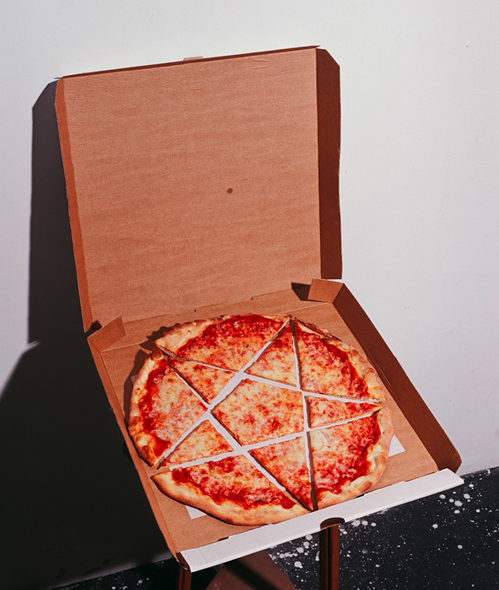
Pentagram Pizza for May 18th

Twelve words for for bloggers, pointed towards people in the medical professions, but likely appropriate for academia as well.

• While we are in the workplace, some thoughts from a Psychology Today article on why “diversity training” is a waste of time. Or why good manners are better than rules enforced by bureaucratic idiots.

• More thoughts on cult-occult films of the 1960s, this time from Zan at The Juggler. I have a couple in my Netflix queue now.

Timothy Leary Floated Here

To raise money for the Multidisciplinary Association for Psychedelic Studies  (MAPS), the organization is auctioning off a floatation tank used by Timothy Leary near the end of his life.

MAPS raises money and lobbies for research in using psychedelic (entheogenic) drugs in mental-health treatments. I donate to them and have the MAPS hoodie to show for it, but a $5,000 opening bid is a little rich for my blood.

But I did try the floatation tank experience, back in the early 1980s. From Wikipedia:

Flotation therapy developed from the research work of John Lilly although he was not primarily interested in therapy, rather in the effect of sensory deprivation on the human brain and mind.

People using early float tanks discovered that they enjoyed the experience and that the relaxed state was also a healing state for many conditions including stress, anxiety, pain, swelling, insomnia and jet lag.

As a result float tanks were produced for commercial uses and commercial float centres offering flotation therapy opened in several countries during the period from 1980 to the present day when there are hundreds of flotation centres in dozens of countries. In almost all cases these float centres offer wellness treatments and in particular the release of stress.

And it was John Lilly himself who donated this tank originally.

I found the experience restful and relaxing, but I did it without the DMT or LSD that made it really “cosmic” for some folks.

In the early 1990s I attended a nature-writing workshop at New Buffalo in Arroyo Hondo, New Mexico. In the late 1960s, funded by one guy’s inheritance, it was a famous commune, until it suffered the typical fate of being overrun by losers and freeloaders, and the residents shut the gates, so to speak. When I was there, the owners were trying to make it a mini-conference center and extremely crunchy B&B.

There was a sign in the main room, which read something like, “Timothy Leary slept here. Or maybe he stayed up all night.”

The Potential Strength of a Liberal Arts Degree

I have written here before about the Higher Education Bubble. Related to that perception, you hear a lot of people devaluing education in the humanities and arts. High-profile news stories about graduates with degrees in, for example, film studies and a big debt load did not help.

But here is an article from a business publication saying that liberal arts grads are being hired—if they can demonstrate what are essentially good research and rhetorical skills. And by “rhetorical” I mean the ability to analyze and argue a given problem or situation. Quintilian, call your office.

From an article titled “Revenge of the Liberal Arts Major,”

More interesting, at least for those of us who got some parental grief over our college choice, was the apparent love being shown for liberal arts majors. Thirty percent of surveyed employers said they were recruiting liberal arts types, second only to the 34 percent who said they were going after engineering and computer information systems majors. Trailing were finance and accounting majors, as only 18 percent of employers said they were recruiting targets.

“The No. 1 skill that employers are looking for are communication skills and liberal arts students who take classes in writing and speaking,” said Dan Schawbel, founder of Millennial Branding and an expert on Generation Y. “They need to become good communicators in order to graduate with a liberal arts degree. Companies are looking for soft skills over hard skills now because hard skills can be learned, while soft skills need to be developed.”

Contrary to what the “expert on Generation Y” says, however, a liberal arts degree is no guarantee of communication skills, however. I see plenty of Facebook and blog posts from professor friends’ complaining of their students’ poor writing, inadequate research, and inability to think beyond checking the right answer on a multiple-choice test.

You have to work at it.


Where to Watch the Eclipse

NASA has the map for Sunday’s celestial event. It looks like we will get a glimpse before sunset.

Pentagram Pizza for May 15, 2012

• At The Allergic Pagan, a three-part series on Neopaganism in America (link goes to the third part) with a lot of “whatever happened to?”.

• Jason Pitzl-Waters uses the reunion of the band Dead Can Dance (one of my favorites) to look back at the history of Pagan music.

• A new blog devoted to the history of Chicago occultism has me excited, since I will be there in November.

Ask Academic Abby

“Ask Academic Abby” is a service of the American Academy of Religion, so it is slanted towards graduate students in religious studies, but a lot of the advice is applicable to academic generally. But it appears only in the online Religious Studies News.

Yeah, Public Altars . . .

. . . like this.

I want to see them.

It’s Time for my Winter Coat . . .

. . . at the Beltania festival, where the temperature is about 45° F with rain now and again.

I spent the morning at one of the volunteer fire department’s monthly training day, helping more people become familiar with the whole process of drafting water from a  creek (hydrants? we don’t need no stinking hydrants) and pumping it into our two 2,500-gallon summer storage tanks (in case the creek goes dry).

Then off to the festival, not too far away, successfully negotiating the Pagan equivalent of the TSA. Merchants Row seemed sort of forlorn — no one was buying all the colorful gauzy garments, for some odd reason. Even those who sometimes swelter under the Colorado sun while dressed for the Scottish Highlands  were wearing extra coats today.

But once the dogs are fed we will go back for the concerts — if the rain holds off.

Pagan festivals are becoming more “tribal” in one sense: you can have people doing some kind of ritual thingie while right next to it, folks are feeding their faces, drinking wine from the bottle, braiding feathers into the air, slouching around like bored teenagers if in fact they are teenagers, and just starting into the warming fires. It’s not like you have to be all churchy and attentive.

POST-CONCERT UPDATE: M. and I had to miss some of the Saturday night music, but we did hear at times the Orpheus: the Pagan Chamber Choir of Colorado, a little of S.J Tucker, Forest of Azure, and Sharon Knight and Pandemonaeon. All good. And Pandemonaeon cleared the skies before midnight—can’t beat that.


Pentagram Pizza for May 1

Four toppings this evening. . .

This made me laugh.

• Some occult-cult films from the past reviewed by Peg Aloi.

• Teaching a course in “world religions” is not as simple as it looks, once you start sorting out “religion,” “religious,” and questions of group identity.

• In the “Finding a God” chapter of Triumph of the Moon, Ronald Hutton describes the rise of Pan in Victorian literature. Sometimes he personified an idealized countryside while at others he was “a battering-ram against respectability.” He appears in America during that period too — this time as sculpture.

A Professional Writer’s Approach to the Job

Kathy Shaidle is not the first person to say that the successful writer is not necessarily the most talented writer, but in this post at PJ Lifestyle she offers some guidance for being a successful freelancer.

One of the reasons I’m a freelance writer is that, frankly, I don’t “play well with others.” I am too introverted, tactless, demanding, opinionated, and “masculine” to fit in with today’s feminized workplace — a pink and purple extravaganza of giggling, weekly birthday parties, crying-in-the-bathroom, “diversity training,” “team building,” and boring baby pictures/anecdotes — everything, it seems, except actual work.

And today, “fitting in” with the company “culture” (of bridal showers and non-stop conversations about food and “stupid husbands”) is prioritized over competence and intelligence.

Yet somehow, even a curmudgeon like me can manage to remain polite, helpful, and engaged for the length of that email or phone call with a client.

So just imagine how impressed they’ll be with a genuinely nice person like you!

Good links, too. The part about working regular business hours is important, I think, if you have clients who expect to reach you by telephone during their regular business hours. For the person working around another job, it might not be so easy.

Somewhere out there is advice for writing after you have just spent three hours grading essays. When I find it, I will post it.