Tag Archives: fairies

Why “Aliens” Might Be Invisible

Magonia, the review blog of esoteric books (0r should that be, books on esoterica?), recently revisited two books on Unidentified Flying Objects from the 1950s by Morris K. Jessup, the first writer, they say, to use the term “UFO” in a commercial publication.

Ah, those were the days, I take it, when the assumed evidence for the reality of alien spacecraft was growing steadily. Soon we would know the truth! Governments would be forced to admit that there was Someone Else! Perhaps a disk-shaped spacecraft would float down onto the White House lawn — or in Red Square, why not? — and a being would step out, proclaiming, “We come in peace.”

Or, conversely, the aliens would not be peaceful, and Earth would have to put aside its wars and rivalries to unite in a battle to save humanity. We have all seen book and movie versions of these possible scenarios, going back to War of the Worlds in 1897, at least.

Astronomers have now found — by calculation if not direct observation — many planets that orbit their suns not too close and not too far — the habitable zone — and which, therefore, could possibly contain life “as we know it.”

But getting there is the thing. With our chemically fueled rockets, which are limited in size, even a trip to Mars would take half a year or more. And right now, that would be a one-way trip — although some people are still volunteering. It did not take so much fuel for astronauts to escape the Moon, but Mars would require quite a bit more.

“Hyperdrive” and “warp drive” are science-fiction plot devices, not technology that is anywhere in sight.

So when it comes to actual physical aliens visiting us, I see only two possibilities:

1. They travel slower than the speed of light, which means that they either have incredibly long lifespans or that they have learned to  “hibernate” while traveling for many years.

2. They travel faster than the speed of light using a sort of “hyperdrive.” But if they can do that, what else can they do?

They would have no need to land a spaceship on the edge of town, leaving scorched spots on the ground, drop a ladder, and climb down wearing silvery suits, looking for someone to put on their operating table and probe.

Instead, their technology would so far ahead of ours that it would seem invisible to us. And so might they. We would not even know that we had been observed.

That blog’s name, Magonia, pays homage, I am sure, to French astronomer Jacques Vallée and to the name of a land in the clouds., taken from a medieval French tale. Vallée borrowed the name when he wrote Passport to Magonia, introducing his “interdimensional hypothesis.”

Briefly, it states that the Visitors/Fairies/aliens etc. are not from Out There but from In Here, “visitations from other ‘realities’ or ‘dimensions’ that coexist separately alongside our own.”

Maybe they live in Icelandic boulders, or as someone in a dream once told me, “inside the walls.” Either way, they should not be disturbed. Contact with them can be extremely upsetting.

This idea has long made more sense to me than the idea of physical “flying saucers” coming chug-chug-chug through interstellar space. Now you see them, now you don’t.
A New Investigation of Fairy Encounters

This request for help with a compilation of contemporary Fairy encounters and lore comes from Simon Young of the re-launched Fairy Investigation Society. The FIS was founded in 1927, died in the early 1990s, and in late 2014 it came back to life.

The survey (‘the fairy census’) is split into three parts: (i) for those who have seen fairies, (ii) those who have second-hand accounts of fairies and (iii) a more general one on fairy belief, which can be filled out by anyone who understands the word ‘fairy’, I did it with my four-year-old daughter yesterday . . . I have used the phrase ‘associated with the FIS’ in all press releases. I did this because I thought it might be a good way to attract extra members, as I was trusting in coverage around the world in the two years it runs. In the first forty eight hours we had forty detailed fairy sightings (in the first and second category). Just to put this in perspective the great and energetic Marjorie Johnson managed a couple of hundred sightings in her two year survey, 1955–1956. It would be great to get to two thousand, which would mean by far the biggest folklore survey of its kind.

He is also the author of a paper on the original Fairy Investigation Society, available at Academia. edu, along with other of his works.

Link to the survey.

I have previously mentioned Diane Purkiss’s historical survey of fairy lore, and I still hold the position that fairies are not your friends.

Fairy Houses, Bee Houses, and Garden Products to Avoid

Some fairies are said to live in boulders, others perhaps in purpose-built housing.

In this blog post, a professional gardener in southern Colorado moves from greenhouses to fairy houses (with her dad as maintenance man) to bee houses.

And please scroll to the bottom — it’s a long post — for a list of bee-killing garden products to avoid.

Where Are the Hidden Folk?


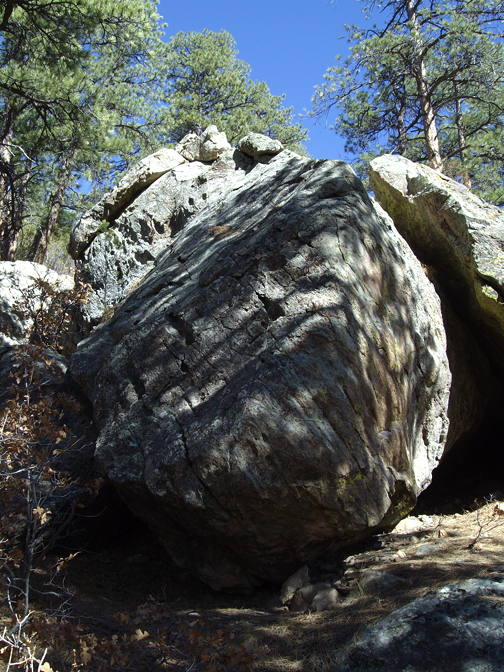
huge boulder

The “cave” is big enough to walk into if if you bend over.

My little patch of the southern Colorado foothills may not be great agricultural land, but it does (or because it does) have boulders. Big ones.

Ever since I posted about the Icelandic huldufólk (hidden folk) documentary, I have been scrutinizing them. Is this one . . . um . . . inhabited?

It is something that I accept in theory. And I have had some interesting dreams about the hidden folk/fairies/”UFO people” (all the same thing, probably) who live inside the house walls or in invisible houses.

So maybe I need a hidden-folk consultant, like the woman at the start of the documentary, who can walk around each boulder and give a nei or já as appropriate.

The Hidden Folk of Iceland

“Two nations live in this country — the Icelandic nation and this invisible nation.”

Huldufólk 102 is a wonderful 2006 documentary about Icelanders’ relationship with the Hidden Folk (elves, fairies) in their landscape. You can watch it online here (74 min.) Here is the trailer.

One of my favorite parts starts eight minutes in, when a primary school teacher is explaining to the kids how the elves live in a boulder.

Only one of the numerous people interviewed is obviously New Age-y, with her talk about earth chakras, etc. And there is one guy in sort-of medieval Norse garb, his cap decorated with runes, who is described in the subtitle as a “sorcerer.” (Some people are speaking English, some Icelandic with subtitles.) The rest are pretty much down-to-earth Icelanders, a couple of whom describe their own outlooks as Pagan and/or Heathen.

You have heard stories about roads being routed around “inhabited” spots? Here is a civil engineer who did it.

Also  the land itself: mountains, geysers, rocky coasts, cliffs — wonderful as well.

UPDATE: Bad link to complete film now fixed.

(Hat tip to Galina Krasskova.)

The CIA, UFOs, Fairies, etc.

I am reading Mirage Men: An Adventure into Paranoia, Espionage, Pyschological Warfare, and UFOs, by Mark Pilkington. (There is a related documentary film.)

Small disclaimer: I met Mark Pilkington a few years ago in England. We did not talk about UFOs nor about the fact that he was one of the people making crop circles for “cereologists” to get all cranked up about.

I have not yet finished the book, but one of its these seems to be that a lot of the UFO material out there is deliberate disinformation by various intelligence agencies.

Why? Consider this scenario, which happened various times in the past: Military radar operators report suspicious “returns” over an airbase. Fighter aircraft are scrambled to intercept the intruders. Once airborne, however, the pilots cannot find the intruders. Must be technologically advanced UFOs!

This means that (a) alien beings have crossed the galaxy in order to play games with our radar operators, or (b) someone here on Earth is working on ways to “spoof” radar signals in order to confuse potential enemies and cause them to fly around looking for intruders that are not there—while, presumably, the real attacker sneaks in undetected.

Occam’s Razor: They sell them in 12-packs at Walgreens and Boots the Chemist.

Why would intelligence agencies feed deliberate misinformation to the public at large and to UFO “researchers” in particular? Some possible reasons:

1. During the Cold War, to baffle the Soviet Union and divert their military from #2, below.

2. To create a belief in “UFOs” that in turn camouflages actual experiments in spy planes, “stealth” technology, drone aircraft, and other secret research.

Create an image and a predisposition, and people will see what they expect to see.

3. To conduct experiments in disinformation in a controlled way: for example, how long does it take a particular piece of “disinformation” to become broadly accepted and by what channels is it disseminated? The whole “Majestic 12” hoax might be an example. Or “cattle mutilations,” or what you will. A lot of Pilkington’s book is devoted to tracing some of these pathways of disinformation.

What about Fairies?

If alien races did arrive here, they probably would not step out of  mechanical “flying saucers” wearing silver coveralls. Anyone who could conquer the whole issue of traveling faster than the speed of light would likely be so advanced that we not even perceive them.

To use a metaphor from the book, do the goldfish in the bowl know that someone is watching them swim around?

All talk of UFOs aside, I do tend to think that there are other beings who share our space, in a manner of speaking.

They have been here all along. They appear in various forms. They are not necessarily our friends. (Which is why the whole phenomenon of “fairy festivals” makes me feel a little queasy.) Lots of weirdness.

Mix them up with your favorite intelligence agency, and watch out!

Another facet of Mirage Men that I appreciate is that it shows how investigating forms of paranormal (or perceived paranormal) activity can have unsettling effects on the investigator. Rampant paranoia is just part of it.

The classic work, to my mind, on this phenomenon is John Keel’s The Mothman Prophecies, published in 1975.  (Ignore the 2002 movie, please, unless you have to watch everything that Richard Gere ever did.)

What is interesting is not whether “Mothman” exists or not, but what happens to Keel and his associates when they begin to investigate it. Talk about having one foot on the Other Side! (Or are they victims of disinformation too? More paranoia …)

It reminded me of the summer when a newspaper reporter friend, a lodge of wannabe ceremonial magicians, and I decided to investigate the so-called cattle mutilations. Things went downhill into weirdness fairly quickly.

I published the story in Fate (“Mutilation Madness.” Fate June 1988: 60-70), but this was back in the pre-digital 1980s, so there is nothing to link to. Sorry.

One last quote from Mirage Men that more or less summarizes it:

The UFO scene is overrun with whistleblowers who regale us with tales of underground bases and intergalactic pacts while waving impressive-looking documents around as evidence. To the believers these people are clearly on the side of ufology and are to be welcomes. That the role of [the U.S. Air Force Office of Special Investigations] and other agencies in distributing this same material has been public knowledge for twenty years seems not to have sunk in. Meanwhile, those insiders who suggest that the UFO phenomenon is a complex brew of security, secrecy, psychology, sociology, politics, and folklore, perhaps driven by rare but genuinely anomalous events, are obviously part of the cover-up.

Gallimaufry with Distinctions

• Ule-Alfarrin (a/k/a Robin Artisson, if I am not mistaken) lists differences between “New Ager” and “Heathen.” I like this one:

13. Almost no one who in the course of their religious practice, takes a first, middle, or last name which is the same as an animal, a plant, a weather-based phenomenon, an element, a mineral, or a combination of any of those things can speak for me, nor do they likely believe anything like me.

Being a Heathen is often about making such distinctions, ja?

• Anne Johnson discusses building fairy houses. She understands that the fairies are not always cute.

• Talking to Unitarians about animism. I have to do something similar later this month.

• Anne Hill suggests two great books on dreams. She should know.

The Fairies of Torchwood

I never joined the Doctor Who cult, although I had friends who remembered every episode and could debate whether Peter Davison made a better Doctor than William Hartnell.

At a post-INATS dinner, however, a publisher friend said that I had to see Torchwood, a Doctor Who spin-off. He compared it to the X-Files. Netflix had it, so I ordered Season One (2006).

We-l-l-l. The X-Files it’s not. Underneath the aliens and “time rifts” and occasional goriness, it’s not as dark  — there is not the sense of hopelessness against greater forces and the personal doubts that pervade the world of agents Scully and Mulder.

In fact, every time that I see the four main Torchwood operatives running down the street — they seem to run a lot, for running and frenetic music cover up plot slippages and cheesy special effects — I want to sing along, “Hey, hey, we’re the Monkees.”

But I heartily approved of the episode called “Small Worlds.”

Every time I see someone who gets all mushy about fairies, I want to remind them, “The fairies are not your friends, anymore than the coyotes are your friends.” You can interact with them, but under other circumstances they would eat you. They are a different life form, and they are not All About Us.

Down the Paratemporal Rabbit Hole

“The infamous” Brad Hicks writes a great blog post on shifting realities.

Personally, I blame the Fairies.

Sheesh, who knows. Ask me about my lost-time episodes. No, please don’t. One of them involves a beautiful Russian girl in a Mercedes two-seater, and everyone would assume that she had to be an interdimensional being.

Fairies, the Dead, and Book-Blogging

Spring semester has started, and teaching does cut into blogging time. And my reading list (for myself) is huge: all the books that I ordered at AAR-SBL (and elsewhere) started arriving in December.

I just finished At the Bottom of the Garden: A Dark History of Fairies, Hobgoblins, and Other Troublesome Things. Author Diane Purkiss is an Oxford historian, primarily of early modern England, and this book is a romp. She does not set out to “explain” fairies, but rather to trace the different ways that they have been depicted–from being rather interchangeable with the Dead to being literary creations, evocations of rural charm, inspiration of Irish nationalism, and advertising gimmicks.

Factoid: Proctor & Gamble won’t admit it, but apparently in the early 1930s the company dropped its successful Fairy Soap and Fairy Liquid, previously sold with images of helpful fairies assisting the housemaids, because the term “fairy” was increasingly synonymous with “homosexual.”

While dealing with Fairy-like characters in The X-Files, Purkiss oddly misses Jacques Vallee’s Passport to Magonia which argued back in 1969 that Fairies and UFO aliens were the same class of interdimensional beings in different guises.

The Trickster and the ParanormalThese are stacked on the dog kennel-nightstand:

Dereck Daschke and Mike Ashcraft, eds., New Religious Movements: A Documentary Reader. Rastafarians! UFO cults! Wiccans! All of us in the study of new religious movements are in it for the spectacle.

Sabina Magliocco, Witching Culture: Folklore and Neo-Paganism in America. I mentioned it earlier, but I had to send the review copy to someone else and only recently acquired my own.

Robert Cochrane, The Robert Cochrane Letters: An Insight into Modern Traditional Witchcraft. Never mind the oxymoron in the subtitle; it’s the subtle and shifty Cochrane in his own words.

Nikki Bado-Fralick, Coming to the Edge of the Circle: A Wiccan Initiation Ritual. Taking on Arnold van Gennep’s hallowed theory on initiation–and Nikki is the new Pomegranate reviews editor, too.

George P. Hansen, The Trickster and the Paranormal. Back in the 1950s and 1960s, Ufologists saw a progression happening, from “saucer” sightings to “alien” sightings to . . . certainly . . . the “third kind”–direct contact. But why is resolution always just beyond our grasp?

David H. Brown, Santería Enthroned: Art, Ritual, and Innovation in an Afro-Cuban Religion. It’s not just for Cubans anymore.