Freelancing: the Horror

Via Rod Dreher’s new blog, Macroculture, comes this essay by Richard Morgan on the horrors of freelancing.

By the time that I finished it, I was thinking of Knut Hamsun’s novel  Hunger. See the movie version—I saw it as a teenager, and how I ever became a writer afterwards, I do not know. Youthful optimism, I suppose.

I used to tell magazine-writing students that the first rules of successful freelancing were “Don’t quit your day job” and “Have an employed  spouse/partner who thinks that being married to/living with a writer is wonderful, romantic arrangement.”

Morgan, of course, was trying for the top tier of consumer magazines. Quite a few writers do make livings—of sorts—by specializing in something less eye-catching but more lucrative than celebrity-interviewing.

Specialists in financial writing or science writing might have a better chance.

P.E.I. Bonewits 1949-2010

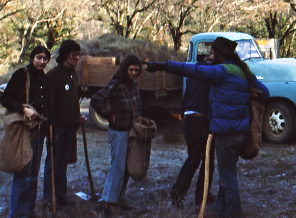
Isaac Bonewits (2nd from left) at the Greenfield Ranch tree planting, Jan. 1978

Isaac Bonewits, second from left, at a tree-planting in 1978.

All around the Pagan blogosphere, tributes are being written today for Isaac Bonewits, who died today.

Here is a chronology of his life and tribute by Ian Corrigan.

I can add only that he was one of the most prolific and visible figures of the Pagan revival from the 1970s forward.

As a student, he took what had been a sort of spoof “Druidry” and turned it into a genuine Pagan religion with a spoofy name, the Schismatic Druids of North America.

That in turn  become Ar nDraiocht Fein (ADF), which is very much alive today.

Druids are always associated with trees, and the photo is one that I took in January 1978 at a tree-planting at “Annwfn,” part of Greenfields Ranch, near Ukiah, California.

From left, Isaac’s then-wife Selene Kumin vega, Isaac (leaning on his hoedad), Morning Glory Zell, someone obscured (possibly Gwydion Pendderwen), and would that be Oberon Zell with arm outstretched?

I am glad that I was able to offer Phaedra some help in finding a home for his papers. Although I did not see Isaac often, we were always friends at a distance, and I shall miss his presence on the Pagan scene. Ave atque vale.

Maybe the Oldest Pagan Fashion Statement

The ongoing excacations at the Mesolithic site of Star Carr in Yorkshire has turned up what is now thought to be the oldest house in Britain—10,500 years.

Archaeologists describe finding “red deer skull tops which were worn as masks.”

“And the artefacts of antler, particularly the antler head-dresses, are intriguing as they suggest ritual activities.”

(Red deer are essentially the same as North American elk.)

So there you have it: antler headdresses and masks go way back.

Despite the recent slump in housing prices, the Star Carr home, originally built for a cost of three flint choppers, is now worth at least fifty bear skins.

What I Do Instead of Blogging

Lammas, according to my authoritative source, fell on Saturday by the solar calendar, so M. and I were only a day early when we celebrated our own wild harvest.

Lammas (or whatever you want to call it) does not seem like a highly ritualistic holiday—certainly not one on which you would like to be indoors.

I have been glued to my desktop computer the past couple of days, pushing along with a book-layout project. After three to four hours of Adobe InDesign, however, I feel halfway brain-dead.

I am re-copy-editing the book at the same time, which adds to the workload. Then I give the chapters to M. for additional proof-reading.

In the old days of hot lead and movable type, compositors were notorious boozers. I can see why.

I was going to link to a blog post about reading one scholarly article per day to keep your mind sharp, but I can’t find it where I thought it was. Did its creator delete it? Have I forgotten where I read it (Google is not helping)? Or did I hallucinate it?

Robots, Foreward!

Robots are set to explore the Great Pyramid. Just think, ever since the Napoleon’s scientists put ancient Egypt back on the map of the public imagination during his 1798–1801 campaign, we remain fascinated by this structure.

No one knows what the shafts are for. In 1992, a camera sent up the shaft leading from the south wall of the Queen’s Chamber discovered it was blocked after 60 metres by a limestone door with two copper handles. In 2002, a further expedition drilled through this door and revealed, 20 centimetres behind it, a second door.

“The second door is unlike the first. It looks as if it is screening or covering something,” said Dr Zahi Hawass, the head of the Supreme Council who is in charge of the expedition. The north shaft bends by 45 degrees after 18 metres but, after 60 metres, is also blocked by a limestone door.

Now technicians at Leeds University are putting the finishing touches to a robot which, they hope, will follow the shaft to its end. Known as the Djedi project, after the magician whom Khufu consulted when planning the pyramid, the robot will be able to drill through the second set of doors to see what lies beyond.

“Agora”: Pagans vs. Christians or Atheists vs. Religious?

Living in the cinematic boonies as I do, I will probably not see Agora until it comes out on DVD.

Here is a long dissection of it, from period-incorrect Roman armor to its avoidance of exactly what Hypatia taught:

But because the film never bothers to make her neo-Platonist asceticism clear – exactly what her philosophical views might be is never explored except in the vaguest terms – this incident doesn’t really make much cultural sense – she comes as a modern career academic “married to her job” rather than a disciple of the school of Plotinus.

Writer Tim O’Neill also notes that the conflict in the movie is not Pagans versus Christians so much as it is non-theistic philosophy (rational) versus religious people (fanatical).

Nevertheless, it is tempting to read Hypatia’s story as (not hostile to science) Pagans versus (book-burning) Christians. I nudged it that way a little bit myself in the entry I wrote on Hypatia years ago in the Encyclopedia of Heresies and Heretics. I had a little fun with the telling.

But is that how the conflict should be framed?

Holy Blueberry

Blueberry Festival is coming, and the Anglicans are ready.

The blueberry of our Lord Jesus Christ keep you in everlasting life.

It’s another stab at nature religion of a sort. At least they are acknowledging something outside The Book.

(Photo from Wilmington, Vermont. The painted fiberglass bear is one of those community art projects—something else all together.)

Pagans Advise Advice Columnists

Not one but two Pagans write to the syndicated advice column Annie’s Mailbox to explain that they are not offended when someone offers a Christian blessing at a meal. (Scroll down to the second “Dear Annie.”)

If you really are a polytheist, then Jesus is a god too. Maybe he did not start out as one, but after 2,000 years of being treated as one, he ought to qualify.

Take it away, polytheologians!

Related: “When You Enter a Village, Swear by its Gods.”

You May Think that You Have a ‘Self’

But maybe you are just the talking part of a large collection of bacteria.

We continue to be colonized every day of our lives. “Surrounding us and infusing us is this cloud of microbes,” said Jeffrey Gordon of Washington University. We end up with different species, but those species generally carry out the same essential chemistry that we need to survive. One of those tasks is breaking down complex plant molecules. “We have a pathetic number of enzymes encoded in the human genome, whereas microbes have a large arsenal,” said Dr. Gordon.

Don’t miss the part about the fecal transplants. All these health nuts giving themselves high colonics may be going at it backwards, so to speak.

Should You ‘Out’ Yourself as Pagan?

Subaru plastered with Pagan bumper stickers

I wonder what religion this Subaru's owner follows. (Colorado Springs, June 2010)

Over at Pagan + Politics the call is for everyone to “out” themselves for the good of the movement or something:

I did notice that those who are in the “come out, come out, where ever you are” camp are becoming more vocal about the need for the majority of us to be more public and open about our faiths. Not that they wish for us to go around saying “Goddess Bless” to everyone while wearing huge Pagan bling, but they do want us to be more unapologetic and matter of fact about our faith. To live our lives in the sunshine, not just by the light of the moon.

What surprises me is the assumption that it’s an all-or-nothing proposition.

In some cases, such as university teaching in some departments, being a faithful follower of any religion brands you as a “anti-intellectual” and a “fanatic,” with a possible exemption for easy-going Reform Jews.

As for family, I have long been “out” to some, while to  others I might prefer to say that I just was not the church-going type and preferred to go fishing on Sundays.

And what’s wrong  with the light of the moon, anyway?

Youthful black-and-white thinking. Bah, humbug.