Tag Archives: animism

When Trees Disappear

First, the background story. Back in 2011, I wrote about making an offering to Tlaloc, Southwestern god of the hydrological cycle (among other things), at a tiny mountain spring near my home.

The spring is high on the side of a ridge, fed by that year’s snow and rain, which meant it often dries up in late summer.

It had its guardian, a three-foot-long (92 cm) rattlesnake, whom I encountered several times.

The area was thickly forested in ponderosa pine, Douglas fir, and Gambel oak — too thickly, to my eye. (This is what comes of being a forester’s son.) The pines were thick — in some places they lay like jackstraws, toppled by the chinook winds of winter.

When this slope burns, I thought, it will burn like a volcano. And it did, on October 23, 2012, a date seared into my memory.

October 23, 2012: The spring would be just left of the brightest area. My home is on the other side of the ridge.

I took this photo at dusk, bracing my pocket camera against a corral post (one of the ones that was not burning like a candle) while waiting for the the fire engine I was working on to be re-filled with water at the landowner’s well. It was too windy for air tankers, too close to darkness for hand crews to hike up there, so it just burned, while I implored the west wind to keep pushing the fire away from my home.

M. and I returned in November 2012 to see if we could find the little spring again with all the landmarks gone. For instance, there was a boulder that I called Bonsai Rock because of the tenacious little evergreens growing out of cracks in the stone. Not anymore.

Fisher the dog did what he does best, finding animal parts in the woods (including a bear cub’s paw) but even that activity seemed sadder.

We returned again in May 2013 to make an offering at the spring. During the previous month, the Bureau of Land Management had hired a contractor to re-seed the area with a grass mix by helicopter. The purpose was to get something growing and stabilize the slopes against the summer thunderstorms. It worked. We had adequate summer rains (not like the storms and flooding in northern Colorado), and by late summer the slopes were almost lush, as the photo below will show.
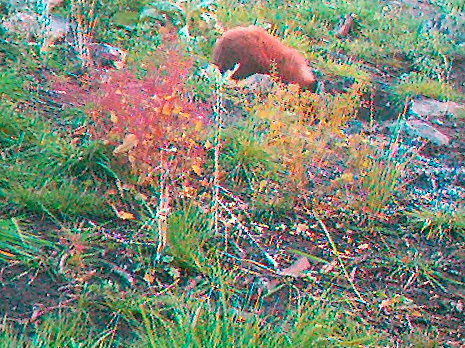
bear cub2

October 2013: A bear cub drinks at the spring.

I put my most expendable scout camera up there from late September until a couple of days ago — although the batteries died some time in November — which is how I got the photo. The best part is to see the spring running—you can see water flowing down the right-hand edge of the photo.
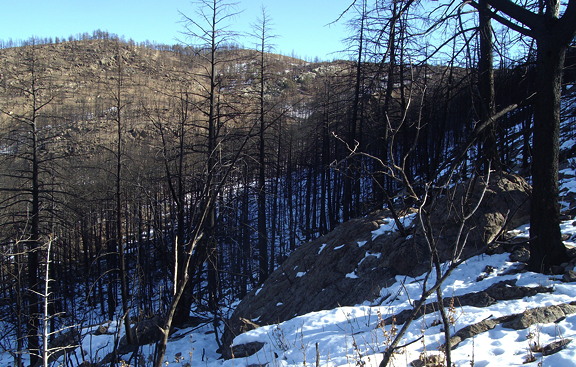
burn in December_sm

December 2013: Winter scene, with the spring off in the middle distance.

All this is prelude to thinking about how an animistic/polytheistic outlook copes with such changes to the land. No, it is not like someone paved it over and put up a Family Dollar store. Something will come back—the scrubby Gambel oak has re-sprouted, and there were wildflowers last summer, but the ponderosa pine and Douglas fir will be much slower to return. I probably won’t see this valley forested again.

I will never forget walking around a week or two after the fire, when the slopes just felt nuked. Crows overhead were the only life—the rattlesnake guardian almost certainly died, if tree roots were being burned underground.

The little seasonal spring, however, remains as sort of natural shrine, a focus for hope and continuity, bear cubs and wild turkeys.

Animism, Religion, Bloggers, and the AAR

The annual meeting of the American Academy of Religion is followed by what I think of as Hell Weekend. At least it is that if you chair or co-chair one of the many program units. Me, I am co-chair of the Contemporary Pagan Studies Group, but I suspect that all my colleagues go through the same process — after Thanksgiving wears off, you have just a weekend to answer the online survey that constitutes your program-unit survey and, most importantly, to compose the “call for papers”  for next year’s meeting.

The last part is done in collaboration with your steering committee, which in our case is scattered over nine Northern Hemisphere time zones — plus one in Australia.

The “call” is released in January, and people have about two months to submit proposals for papers, invited panel discussions, roundtables, etc. — most of which will be turned in at the last possible minute, for what are professors but students who never left the university?

Then the AAR staff, aided by wizard computer algorithms and trained owls, must fit all of the planned sessions into a four-day meeting, knowing that whoever gets the dreaded Tuesday-morning slots (when many participants are already leaving) will feel marginalized, disrespected, and sad.

One of our themes in 2014 (in San Diego) will be the New Animism, “new” in that it moves away from Edward Tylor’s old idea that animism is merely the first step of the ladder on the way to monotheism and instead treats it as a viable way of approaching the world, in which other-than-human entities are also active agents.

Not coincidentally, there is a book tie-in, the release of Graham Harvey’s edited collection, the Handbook of Contemporary Animism, currently available only in high-priced hardback from the friendly people at Acumen Publishing for whom I have nothing but the highest regard.

But while academia moves at its careful pace, there are plenty of other people writing about animism.

I have some books that I need to review here, but, meanwhile, click over to read about the December Animist Blog Carnival on the theme of “Animism and Religion.” Lots of good stuff here. (No connection with the AAR.) And consider this blog post to be my after-the-fact contribution to the blog carnival.

Tree Beings, New Age Bodies, and Censored Folklore

Here is the table of contents of the latest Journal of Ethnology and Folkloristics ( vol. 7, no. 1 ), published in Finland, “a multidisciplinary forum for scholars. Addressed to an international scholarly audience, JEF is open to contributions from researchers all over the world. JEF publishes articles in the research areas of ethnology, folkloristics, museology, cultural and social anthropology.”

Links go to PDFs of the articles.

Full Issue

View or download the full issue PDF

Table of Contents

Articles

Folk Religion in Discourse and Practice PDF
James Alexander Kapaló 3-18
Tree Beings in Tibet: Contemporary Popular Concepts of klu and gnyan as a Result of Ecological Change PDF
Jakub Kocurek 19-30
Sowing the Seeds of Faith: A Case Study of an American Missionary in the Russian North PDF
Piret Koosa 31-48
The Body in New Age from the Perspective of the Subtle Body: The Example of the Source Breathwork Community PDF
Katre Koppel 49-64
Immoral Obscenity: Censorship of Folklore Manuscript Collections in Late Stalinist Estonia PDF
Kaisa Kulasalu 65-81
Anthropological Interpretation of the Meaning of Ritual Objects in the Contemporary Urban Wedding in Bulgaria PDF
Rozaliya Guigova 83-104
Places Revisited: Transnational Families and Stories of Belonging PDF
Pihla Maria Siim 105-124
Official Status As a Tool of Language Revival? A Study of the Language Laws in Russia’s Finno-Ugric Republics PDF
Konstantin Zamyatin 125-153

Gendered Rural Spaces PDF
Piret Koosa

Animist Blog Carnival: Human Mating & Dating

Heather Awen has the summaries and links.

The Human Dating & Mating issue of the ABC gave me concerns from the beginning. I chose the topic because I do not know right relationship is with those with whom we have sex and romance. Animism is all about right relationship. Although I expected most writers to be as lost as I, I also hoped in their blog posts would be some inklings on which to muse. At the very least, I’d feel less alone.

Animist Blog Carnival: Death and the Blogger

This month’s Animist Blog Carnival is up. The theme is “death.”

I am represented by something from Southern Rockies Nature Blog.

Around the Pagan Blogosphere, 25 August 2013

Some bookmarked links are piling up, so let’s clear them away.

¶ Lee Morgan: What happens when a writing project turns mysteriously magical:

It wasn’t long before the story, its characters and underlying mythic themes came to life in very tangible ways for me. Not only did I start to dream about the characters who would inform me of what their ‘future’ should hold, but other friends dreamed about them and sometimes it wasn’t easy to tell if they were the character from the book or being ‘gloved’ by a spirit or god they were aligned to mythically in the book. The characters have become what is known in the western Occult tradition as “egregores’” or thought-forms.

¶ Via Forging the Sampoa link to a post on “The Survival of Animism in Russia — and its Destruction in the West,” which, given the source, you know will focus on Finnic peoples,

¶ But never underestimate Russian xenophobia, now aligned with resurgent Orthodoxy, which has led, among other things, to the closing of the only Mari-language primary school that served this partly-Pagan nation.

¶ The list of polytheistic devotional books (and some Pagan SF) published by the Biblioteca Alexandrina  continues to grow. I have one and should get a couple of others.

Blog Carnival of Animism

The August animist blog carnival had the there of Birds, and you can find it linked on Animist Jottings here.

There is quite a bit there, so go visit.

Looking at Birds, Listening to Birds

July 1st started out well and then rapidly went downhill as I got the news about the Granite Mountain Hotshots on the Yarnell Fire in Arizona.

By the 2nd, I was so drained from constantly accessing news videos, etc., that I had to get away, and so I went fishing. I wanted to try to different approach to a mountain stream that I fish now and then — it involved some gravel county roads, then two miles in four-wheel-drive down a steep descent into its canyon, followed by a short walk.

As I came out of the dry juniper and oak brush into the lusher creekside vegetation hawk flew low over me — an accipter, probably a sharp-shinned hawk. Its head turned, and it looked at me.

It felt like a welcome, I thought.

“Bullshit,” I told myself, “it’s just cruising the riparian zone looking for lunch. I happened to be here, so it checked me out.”

Maybe the flip side of the New Animism — the focus on relationships between yourself and the other-than-human world — is that you cannot think that these encounters are All About You.

The wild birds are always watching, and they do talk to you. And they talk about you. Several times I have had crows and Steller’s jays tell me something when I was hunting deer or elk — but it is up to me to act correctly on their information. Apparently our relationship is not yet perfectly harmonious. But if they would help me more, they would have something to eat. Isn’t that fair?

What gets under my skin is when someone says something like, “My totem is Hawk,” because I want to know which hawk? There is a boatload of difference between a Cooper’s hawk and a Mississippi kite, for instance. (Oh well, they probably meant red-tailed hawk anyway, the pickup truck of buteos — large, useful, and ubiquitous.)

A Pagan-Flavored Study of Religion

Graham Harvey, one of founders of contemporary Pagan studies, has a new book out, Food, Sex and Strangers, which “offers alternative ways of thinking about what religion involves and how we might better understand it. Drawing on studies of contemporary religions, especially among indigenous peoples, the book argues that religion serves to maintain and enhance human relationships in and with the larger-than-human world. Fundamentally, religion can be better understood through the ways we negotiate our lives than in affirmations of belief – and it is best seen when people engage in intimate acts with themselves and others.”

Like Michael York’s definition of Paganism that I offered earlier, Harvey’s perspective on religion is heavy on relationship. Not surprising for someone who has also helped to define “the New Animism.”

Doug Ezzy, an Australian scholar of Paganism, writes in his cover blurb, “Harvey’s ideas about religion are some of the most important and ground-breaking of our time. He demonstrates that religion is not about belief but about practices.”

Survey: Your Spiritual Relationship with Animals

Sabina Magliocco, anthropologist and folklorist and author of Witching Culture: Folklore and Neo-Paganism in America, among other books, has a new research project underway on people’s spiritual relationships with animals.

The purpose of this study is to understand how we imagine our relationship to animals, how we incorporate animals into our spiritual or religious beliefs, and how this may motivate our actions in the everyday world.

She invites you to take her survey.