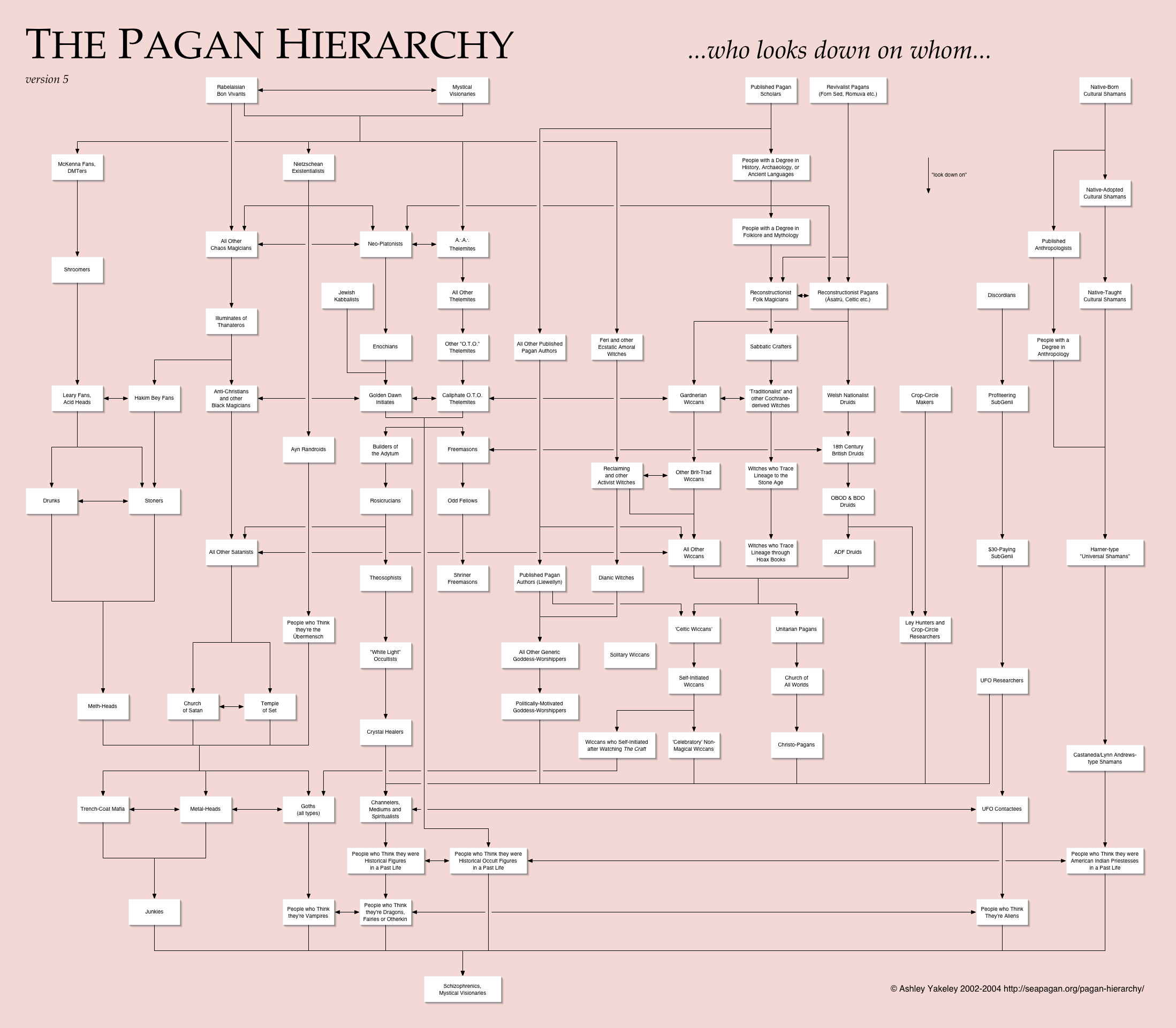
Who looks down on whom

An interesting graphic on the hierarchy of snobbery in Pagan/entheogenic/shamanic circles–and fairly accurate, too. (Link courtesy of The Pagan Prattle). The chart was created by Ashley Yakeley, who runs the Seattle Pagan Information web site.

Mis sueños

Having sent all the text for the next issue of The Pomegranate: The International Journal of Pagan Studies to the copyeditor in England, I thought I could rest for a couple of days–just read books and do mindless work like shoveling snow and restacking the woodpile, partly soaked by melting snow.

But my Dream Self would have nothing of it. Since I had been reading Narcocorrido: A Journey into the Music of Drugs, Guns, and Guerrillas, by the musicologist Elijah Wald, I was treated last night to a editor’s nightmare, in which I suddenly remembered that I was also responsible for a second journal, one on the literature of the American-Mexican border region–there is Wald’s influence. In the dream, I was struggling to think of someone whom I could ask to edit the second journal, since I obviously was not keeping up with it.

Put Narcocorrido in a boxed set with Charles Bowden’s Down by the River–there would be a useful combination to help you understand all the “War on (some) Drugs” craziness/locura.

From a corrido recorded by Los Hermanos Gaspar and translated by Wald:

Un compadre que yo tengo sinaloense
El me trajo la semilla de amapola,
Me dió clases por sembrarla y abonarla,
Que bonito siento andar rayando bolas.

A compadre of mine from Sinaloa,
He brought me poppy seeds,
He gave me classes in planting and fertilizing them:
How good I feel as I go along scoring pods.

(And ahí en British Colombia, what we Americans think of as el norte, perhaps someone is tuning his guitar and singing “The Ballad of BC Hydro,” how it keeps the indoor grow lights burning brightly and must not be privatized.)

A Cigar for Ken Hanson

The Reed College alumni magazine came today, announcing the passing of several faculty members of my time there, including my thesis advisor, the poet Kenneth O. Hanson. (I like the way the article calls Greece “the country that he discovered in 1963.” Land ho!)

Regrets: that I never gave his poetics and prosody class the attention it deserved.

Hanson was something of a “Poundling,” an admirer of the poet Ezra Pound. I was much more under the influence of Robert Graves; it was in the summer between my junior and senior year, while helping to build a house in Talpa, New Mexico, for another of Hanson’s friends, Robert Peterson, that I read The White Goddess, was swept away, embraced Her faith, and set out to read virtually everything Graves had written.

Graves’ essays included much criticism of Pound, whom, among other things, he considered uneducated; Pound’s background in Latin was lacking, raw American that he was (both Pound and Hanson had roots in Idaho.)

During one of our thesis conferences (held always in Hanson’s living room), he puffed his cigar, admitted Graves’ fine command of poetic diction, and then added, “But then there is that Moon Goddess nonsense.”

I bit my tongue.

The relationship with your thesis advisor always has multiple levels. While I did not ever become a great admirer of Pound (leaving his politics entirely aside), I did start smoking cigars. Because I was an impoverished student, getting food stamps, walking or hitch-hiking everywhere, the cigars were usually cheap ones, such as Swisher Sweets.

Today I bought a medium-priced cigar at a tobacconist and smoked it, walking up and down the muddy drive, putting away the garbage cans at the cabin, listening to the rushing of Hardscrabble Creek, watching cloud-blurred Venus hanging in the western sky.

My thesis was A book of poems titled Queen Famine, after a line by Graves. In a letter to Peterson that I sneaked a look at after my graduation, Hanson wrote: It was good, he said, but not as good as it could have been. That comment burned into my soul, of course.

Hanson’s example also stopped my cigar-smoking. First, there was the experience of coming home to my little apartment, part of a tall wooden house by the southeast Portland rail yards, and smelling the reek of stale cigars.

Second, I remember stepping into Hanson’s kitchen, where he had a wall-mounted white telephone–a rotary-dial telephone, as most of them were. Under the dial, going all the way around, was a brown smear, left by his cigar-stained fingers as he dialed. I was grossed out.

But I still have my copy of The Distance Anywhere. And I have reached the age that he was when he was my advisor.

Robert Anton Wilson’s cultural influence

Jesse Walker writes from Reason Online that “We’re living in Robert Anton Wilson’s world.”

The co-author of the Illuminatus! triology, he says, is “the unacknowledged elephant in our cultural living room: a direct and indirect influence on popular books, movies, TV shows, music, games, comics, and commentary. (His late co-author has left less of a mark: Many of Wilson?s books have cult followings, while the only Shea effort to make a big splash was the trilogy he wrote with Wilson.) Allusions to Wilson?s work appear in places both classy and trashy: There?s a Wilsonian stamp on films as diverse as Magnolia, The Mothman Prophecies, and Sex and Lucia, and it?s because of Wilson and Shea that the Illuminati, a secret society that once lurked only in right-wing conspiracy tracts, became the villains of Lara Croft, Tomb Raider. Now Wilson?s the star of a lively documentary, Maybe Logic, that?s being screened at film festivals and distributed on DVD.”

Robert Anton Wilson’s cultural influence

Jesse Walker writes from Reason Online that “We’re living in Robert Anton Wilson’s world.”

The co-author of the Illuminatus! triology, he says, is “the unacknowledged elephant in our cultural living room: a direct and indirect influence on popular books, movies, TV shows, music, games, comics, and commentary. (His late co-author has left less of a mark: Many of Wilson?s books have cult followings, while the only Shea effort to make a big splash was the trilogy he wrote with Wilson.) Allusions to Wilson?s work appear in places both classy and trashy: There?s a Wilsonian stamp on films as diverse as Magnolia, The Mothman Prophecies, and Sex and Lucia, and it?s because of Wilson and Shea that the Illuminati, a secret society that once lurked only in right-wing conspiracy tracts, became the villains of Lara Croft, Tomb Raider. Now Wilson?s the star of a lively documentary, Maybe Logic, that?s being screened at film festivals and distributed on DVD.”

Robert Anton Wilson’s cultural influence

Jesse Walker writes from Reason Online that “We’re living in Robert Anton Wilson’s world.”

The co-author of the Illuminatus! triology, he says, is “the unacknowledged elephant in our cultural living room: a direct and indirect influence on popular books, movies, TV shows, music, games, comics, and commentary. (His late co-author has left less of a mark: Many of Wilson?s books have cult followings, while the only Shea effort to make a big splash was the trilogy he wrote with Wilson.) Allusions to Wilson?s work appear in places both classy and trashy: There?s a Wilsonian stamp on films as diverse as Magnolia, The Mothman Prophecies, and Sex and Lucia, and it?s because of Wilson and Shea that the Illuminati, a secret society that once lurked only in right-wing conspiracy tracts, became the villains of Lara Croft, Tomb Raider. Now Wilson?s the star of a lively documentary, Maybe Logic, that?s being screened at film festivals and distributed on DVD.”

Robert Anton Wilson’s cultural influence

Jesse Walker writes from Reason Online that “We’re living in Robert Anton Wilson’s world.”

The co-author of the Illuminatus! triology, he says, is “the unacknowledged elephant in our cultural living room: a direct and indirect influence on popular books, movies, TV shows, music, games, comics, and commentary. (His late co-author has left less of a mark: Many of Wilson?s books have cult followings, while the only Shea effort to make a big splash was the trilogy he wrote with Wilson.) Allusions to Wilson?s work appear in places both classy and trashy: There?s a Wilsonian stamp on films as diverse as Magnolia, The Mothman Prophecies, and Sex and Lucia, and it?s because of Wilson and Shea that the Illuminati, a secret society that once lurked only in right-wing conspiracy tracts, became the villains of Lara Croft, Tomb Raider. Now Wilson?s the star of a lively documentary, Maybe Logic, that?s being screened at film festivals and distributed on DVD.”

Saint Valentine . . . not a culture hero?

Those fundamentalist Saudis mentioned earlier are not alone in their hatred of hearts, flowers, and by extension, divine Eros. They have company on the Indian subcontinent, where other Muslims and the Hindu Shiv Sena party also rage against the evil foreign holiday, or at least they did last year.

Other people who simply felt out of the romantic loop this year can find their consolation and links to Web anti-Valentine sites here.

Saint Valentine . . . the pagan?

Islamic clerics in Saudi Arabia (our good friends, the Saudis) denounce Valentine’s Day as a “pagan Christian holiday” and forbid its celebration in the kingdom. Other news reports speak of reprisals against shop owners selling Valentine’s Day items. Ah, wonderful, a jihad against hearts and flowers. More here: scroll down.

Valentine’s Day was just fine in this Pagan household, thanks for asking.

Rejection

Rejection Collection is a web site to which writers submit their rejection letters and then comment on how the letters made them feel.

While dwelling on their feelings, few seem to resolve to write better and to research markets better.

Here, an editor reflects at greater length about how these wounded writer egos are missing the whole point and/or are ignorant about how publishing works. Zowie!

Remember, the first million words are just for practice.