Editing Canadians

As The Pomegranate changes from being a Canadian journal with a Canadian editor to being published in Britain with an American editor, issues of spelling, punctuation, and usage arise. Contributors come from those three nations and others as well, including some for whom English is not their native tongue.

Having taught composition, rhetoric, and advanced nonfiction writing at the community college and university level, as well as having worked on newspapers and magazines, I think that I have a good grasp of formal American usage.

Canadian writer Stephen Henighan comments that his fellow Canadians veer inconsistently between American and British spellings and wonders if their inconsistency is not partly ideological: “A conscious move away from British spelling toward American forms might be interpreted as an ideological statement in favour of integration into U.S. culture?and to some extent the promotion of U.S. spelling in Alberta and British Columbia may be seen in this way. ”

The Pomgranate’s British copyeditor, an advanced member of the Society for Editors and Proofreaders in the UK, admits to having given “considerable thought” to the matter and quotes another SfEP member as saying, “There is a whole chapter about spelling in the Editors’ Association of Canada’s style guide, Editing Canadian English. The tone is rather despairing. Basically, there is no such thing as standard Canadian spelling–it is a hybrid. Choice of spelling style can be determined by the intended market, the client, the subject matter or type of publication.”

The copyeditor reminds me that the contributor guidelines specify either British or American spelling and punctuation, consistent within each article if not for the journal as a whole. What this comes down to is that I can leave Canadians their “labour” and “honour” and otherwise Americanize [not -ise] their writing. Probably no one will notice or object. Hegemony marches on.

Witchcraft and folklore

Folklorist Sabina Magliocco, an anthropologist at California State University-Northridge and a previous contributo to The Pomegranate, has a new book out, Witching Culture: Folklore and Neo-Paganism in America.

From the publisher’s catalog:

Taking the reader into the heart of one of the fastest-growing religious movements in North America, Sabina Magliocco reveals how the disciplines of anthropology and folklore were fundamental to the early development of Neo-Paganism and the revival of witchcraft.

Magliocco analyzes magical practices and rituals of Neo-Paganism as art forms that reanimate the cosmos and stimulate the imagination of its practitioners. She discusses rituals that are put together using materials from a variety of cultural and historical sources, and examines the cultural politics surrounding the movement–how the Neo-Pagan movement creates identity by contrasting itself against the dominant culture and how it can be understood in the context of early twenty-first-century identity politics.

Paul Bremer as Pilate, 2

Ah, the bloggers at Crooked Timber had indeed noted the parallel.

Paul Bremer as Pilate, 1

Today is Ash Wednesday, the day that Mel Gibson’s movie The Passion of The Christ opened at theatres. (I noticed a student with a smudge on her forehead and almost called her attention to it–then I caught myself!)

I am waiting for all the political bloggers to leap on this:

Paul Bremer, US administrator in Iraq = Pontius Pilate?

The Ayatolla al-Sistani = the Jewish high priest Caiphas?

Rampaging mobs of followers of an Abrahamc religion = rampaging mobs of followers of an Abrahamic religion?

Shocking for evangelicals

Although he does not use Harvey Whitehouse’s division between “semantic” and “episodic” experiences of religion (or, “arguments” and “icons”), this review of The Passion of the Christ by Kenneth L. Woodward in the New York Times (free registration required) takes a similar approach–which explains why the movie is stranger for Protestants than for Catholics–or for Pagans, possibly.

Sueños, part 2

A follow-up to my post of the 22nd: The CD made to accompany Elijah Wald’s book is available from Down Home Music. It contains many of the featured artists, including Los Tigres del Norte, Jenni Rivera, Pedro Rivera, Los Pajaritos del Sul, and Chalino S&aacutenchez–but not Los Hermanos Gaspar.

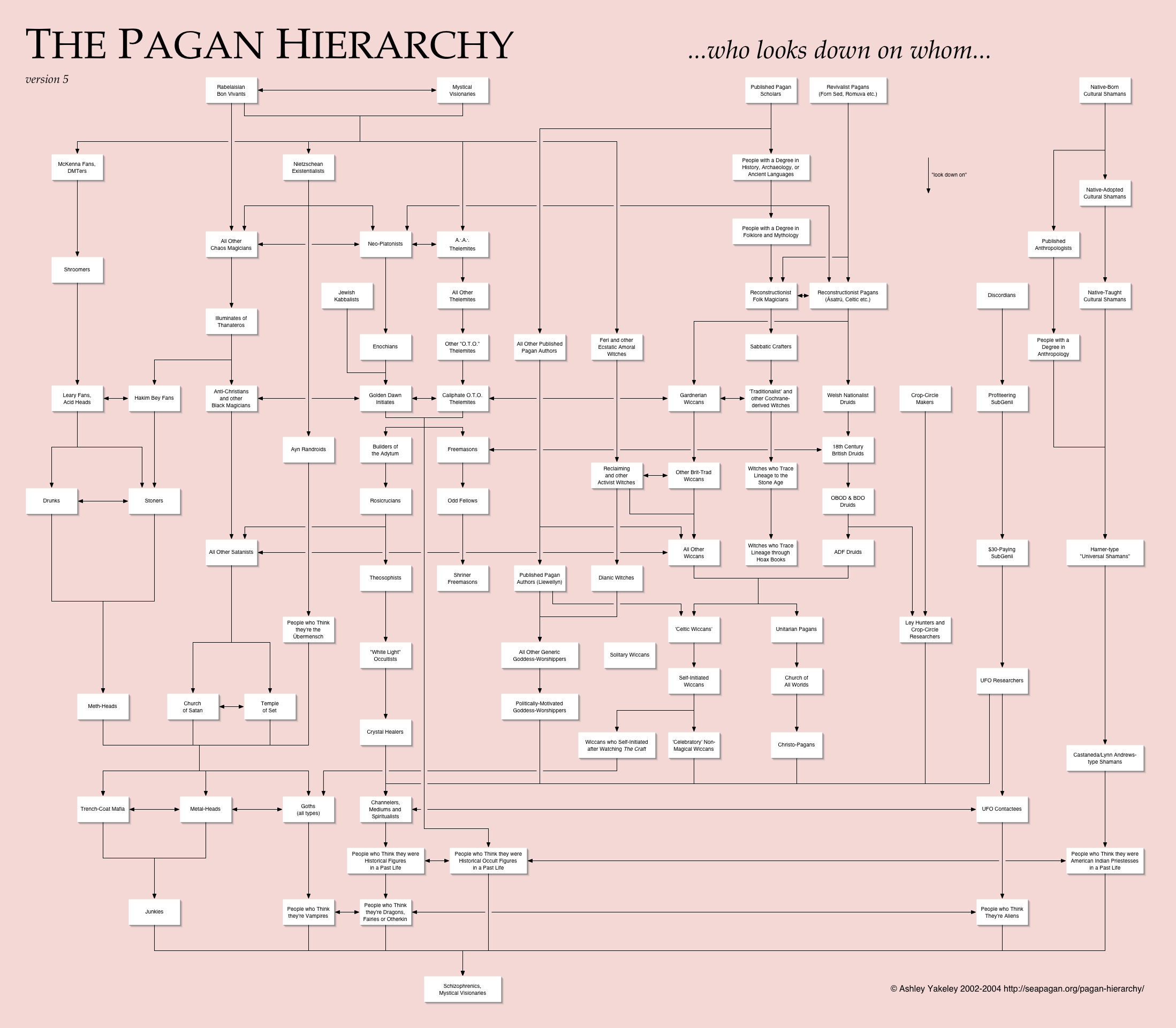
Who looks down on whom

An interesting graphic on the hierarchy of snobbery in Pagan/entheogenic/shamanic circles–and fairly accurate, too. (Link courtesy of The Pagan Prattle). The chart was created by Ashley Yakeley, who runs the Seattle Pagan Information web site.

Mis sueños

Having sent all the text for the next issue of The Pomegranate: The International Journal of Pagan Studies to the copyeditor in England, I thought I could rest for a couple of days–just read books and do mindless work like shoveling snow and restacking the woodpile, partly soaked by melting snow.

But my Dream Self would have nothing of it. Since I had been reading Narcocorrido: A Journey into the Music of Drugs, Guns, and Guerrillas, by the musicologist Elijah Wald, I was treated last night to a editor’s nightmare, in which I suddenly remembered that I was also responsible for a second journal, one on the literature of the American-Mexican border region–there is Wald’s influence. In the dream, I was struggling to think of someone whom I could ask to edit the second journal, since I obviously was not keeping up with it.
Put Narcocorrido in a boxed set with Charles Bowden’s Down by the River–there would be a useful combination to help you understand all the “War on (some) Drugs” craziness/locura.

From a corrido recorded by Los Hermanos Gaspar and translated by Wald:

Un compadre que yo tengo sinaloense
El me trajo la semilla de amapola,
Me dió clases por sembrarla y abonarla,
Que bonito siento andar rayando bolas.

A compadre of mine from Sinaloa,
He brought me poppy seeds,
He gave me classes in planting and fertilizing them:
How good I feel as I go along scoring pods.

(And ahí en British Colombia, what we Americans think of as el norte, perhaps someone is tuning his guitar and singing “The Ballad of BC Hydro,” how it keeps the indoor grow lights burning brightly and must not be privatized.)

A Cigar for Ken Hanson

The Reed College alumni magazine came today, announcing the passing of several faculty members of my time there, including my thesis advisor, the poet Kenneth O. Hanson. (I like the way the article calls Greece “the country that he discovered in 1963.” Land ho!)

Regrets: that I never gave his poetics and prosody class the attention it deserved.

Hanson was something of a “Poundling,” an admirer of the poet Ezra Pound. I was much more under the influence of Robert Graves; it was in the summer between my junior and senior year, while helping to build a house in Talpa, New Mexico, for another of Hanson’s friends, Robert Peterson, that I read The White Goddess, was swept away, embraced Her faith, and set out to read virtually everything Graves had written.

Graves’ essays included much criticism of Pound, whom, among other things, he considered uneducated; Pound’s background in Latin was lacking, raw American that he was (both Pound and Hanson had roots in Idaho.)

During one of our thesis conferences (held always in Hanson’s living room), he puffed his cigar, admitted Graves’ fine command of poetic diction, and then added, “But then there is that Moon Goddess nonsense.”

I bit my tongue.

The relationship with your thesis advisor always has multiple levels. While I did not ever become a great admirer of Pound (leaving his politics entirely aside), I did start smoking cigars. Because I was an impoverished student, getting food stamps, walking or hitch-hiking everywhere, the cigars were usually cheap ones, such as Swisher Sweets.

Today I bought a medium-priced cigar at a tobacconist and smoked it, walking up and down the muddy drive, putting away the garbage cans at the cabin, listening to the rushing of Hardscrabble Creek, watching cloud-blurred Venus hanging in the western sky.

My thesis was A book of poems titled Queen Famine, after a line by Graves. In a letter to Peterson that I sneaked a look at after my graduation, Hanson wrote: It was good, he said, but not as good as it could have been. That comment burned into my soul, of course.

Hanson’s example also stopped my cigar-smoking. First, there was the experience of coming home to my little apartment, part of a tall wooden house by the southeast Portland rail yards, and smelling the reek of stale cigars.

Second, I remember stepping into Hanson’s kitchen, where he had a wall-mounted white telephone–a rotary-dial telephone, as most of them were. Under the dial, going all the way around, was a brown smear, left by his cigar-stained fingers as he dialed. I was grossed out.

But I still have my copy of The Distance Anywhere. And I have reached the age that he was when he was my advisor.