Put Away the Maypole …

Zombie Awaress Month Gray Ribbon campaign. . . and load all the guns, because it’s Zombie Awareness Month.

Supporters of Zombie Awareness Month wear a gray ribbon to signify the undead shadows that lurk behind our modern light of day.  From May 1 through May 31, concerned citizens take this small step to acknowledge the coming danger.

My ‘Third Law’ in Action

Over at The Juggler, Sara Adrian links to a video clip of a bunch of Scots demonstrating Clifton’s Third Law of Religion: It’s not a real religion unless it has torchlight processions.”

And remember, ritual precedes myth, not the other way around.

More Field Work from Miskatonic University

It began with the unprecedented Vermont floods of 1927 . . .and a visiting scholar’s investigation.

Check the blog and trailer of a noir-ish movie in progress based on H.P. Lovecraft’s The Whisperer in Darkness. Very well done!

Is Lovecraft the “shadow” of Zecharia Sitchin?

(Via Odious and Peculiar)

Gallimaufry with Grosbeaks

Black-headed grosbeak, evening grosbeak, downy woodpecker. Photo by Chas S.  Clifton

First black-headed grosbeak of the season (left).

If it’s Beltane, why I am still splitting firewood? Usually I observe the rhythms of the “Celtic” year by turning off the furnace at Beltane and relighting it at Samhain, using just supplemental wood heat otherwise. Not this year.

But during a brief sunny interval yesterday morning, the first black-headed grosbeak of the season landed on a feeder, and I snapped a quick picture through the window. That’s a downy woodpecker on the shadowed side, and up above, facing the camera, a male evening grosbeak—they have been hanging around for a couple of months, an unusual “irruption,” as birders say.

Other stuff:

•  The Beltania music festival happens next weekend, just down the road. The weather still looks iffy. A friend on a Colorado Pagan email list said that spring weather is “manic depressive.”  My own mental image for Beltane is snow on lilac blossoms.

• I liked this quote from an interview with Lon Milo DuQuette at Patheos:

I have a new book coming out in November (from Llewellyn) titled Low Magick — It’s All in Your Head, You Just Have No Idea How Big Your Head Is. It’s autobiographic and contains stories of magickal operations I’ve done over the years. The title is a bit tongue-in-cheek, facetiously using the term “Low Magick” to refer to any magickal operation one actual performs rather than those one just talks or argues about.

• Jonathan Ott, who gave us the world “entheogen,” had his home destroyed by fire, needs help.

• An article on depression and dreams offers this:

In the 1970s, psychologists noted that people suffering from depression also report more dreams than average. In fact, people who are clinically depressed may dream three or four times as much. The quality of REM dreams (also called “paradoxical sleep”) is different too: more intense emotions, more negative themes, more nightmares, and more unpleasant dreams, in general.

And consequently depressed people often sleep worse. It’s a vicious circle.  Processed food is also linked to depression—another vicious circle. Feel low -> eat worse, etc.

• The Pagan Newswire Collective has two new group blog projects: The Juggler, on the arts, and Warriors & Kin, about issues facing past and current Pagan military personnel. They will be added to my blogroll.

Real Estate and the Dead

My niece, a real estate agent in central Missouri, called me today with welcome news: The sale of her mother’s (my oldest sister’s) home was finally closed today, four years after my sister’s death.

It’s hard to sell a house when the real-estate market is depressed, as it has been since 2008. It is hard to sell one of the biggest houses in a economically depressed small town, no matter how well restored it is. It is hard to sell someone’s house when, perhaps, their “crossing over” was not easy.

Last winter, however, I was reading Robert Moss’s The Dreamer’s Book of the Dead: A Soul Traveler’s Guide to Death, Dying, and the Other Side, a book that I will have more to say about in a later post. (Thanks to Anne Hill for telling me about it.)

Something hit me:  As trustee and thus de facto manager of her properties, I had dealt with lawyers, tenants, ex-tenants, insurance agents, city and county government, and via my niece, the on-site manager, with contractors, inspectors, and potential buyers.

When I went back to Missouri in March 2006, I was preoccupied with tenant issues at another building, not to mention straightening out other issues that my sister’s death left unresolved.

But I forgot one thing. I was so busy inventorying the “big house’s” contents and thinking about water damage on the porch roof, etc., that I forgot to cleanse it.

Gods below, man, and you call yourself a practitioner.

This is the fourth time in my life that I have served as an executor or personal representative or trustee for someone who died. When you are the youngest kid, everyone expects you to outlive them, so they name you in their will  to clean up behind them. I have seen the same pattern in other families.

In two out of three previous cases, I received pretty definite confirmation that the deceased had made it to the Other Side successfully. (Although my stepmother and I were close, perhaps the absence of a blood tie meant that I was not on the mailing list, so to speak?)

But the message on my sister was much more ambiguous, which troubled me.

In all those previous instances, the homes of the deceased had sold relatively quickly. Of course, they were in more desirable areas—not in depressed little Missouri railroad towns.

Reading The Dreamer’s Book of the Dead, something hit me. My sister loved to restore old houses. In fact, a friend of hers once joked that she liked houses better than people. Was she still holding on to this one? Was that one reason why two or three deals on it had fallen through?

I called my niece about it. And I sent her a copy of the book, which she said brought her to tears, for she had been having her own dream-life issues with her mother. I asked her if she could arrange a cleansing.

(My niece is a sort of eclectic Jew—my family is nothing if not religiously diverse.)

She said she would get some sage or something and do it herself, for she agreed that we had been remiss not to cleanse the house.

A couple of months later, the house was under contract again. This time the deal went through. Maybe the federal government’s tax credit for homebuyers—which expires today—had something to do with April 30th being the closing day as well.

All I can say is that after we finally cleansed the house, we got a buyer.

And I am so relieved.

That Wicked Man

Aleister and Rose Crowley, 1910

Via Plutonica, a Life magazine  slideshow on Aleister Crowley and his influence on pop culture.

I had not known that Sidney Blackmer played his character, Roman Castevet,  in the occult thriller Rosemary’s Baby, partly on impressions of Crowley.

When the movie came out, I was too young to appreciate the depth of its scariness, let alone know who Crowley was. I should watch it again.

Vampires of Santa Fe

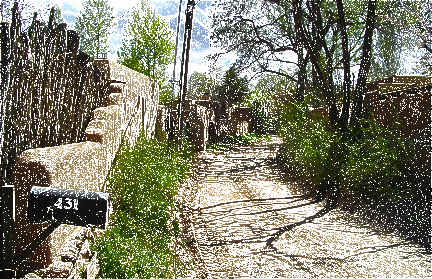
Corn plant grill work in Acequia Madre neighborhood, Santa Fe, New MexicoA week ago I walked through a snow squall on Cathedral Place in the heart of Santa Fe, New Mexico, and thought, “Santa Fe needs a vampire novel.”

I had in mind something like Anne Rice meets Jake Page meets Michael McGarrity.

It turns out that a Santa Fe-based writer, S.M. Stirling, has in fact been writing in that vein (heh).  Here is his protagonist, hanging out in the Plaza, pondering an eternal Santa Fe question—shopping or museum-ing:

A homeless man was approaching, ready to ask for a handout; leathery skin and rank scent and layers of tattered cloth. She glared at him and found the weakness—a blood-vessel in the brain ready to rupture, weakened by drugs, bad feeding, alcohol and stress from the untreated chemical imbalances that rode him more savagely than even her kind could do. She pushed. The world shifted slightly as might-be switched to is, like a breath of cold air up the spine and a tightness that went click and released around the brows. The man collapsed.

Adrienne rose and stepped by him; it would probably be minutes before someone noticed it was more than the usual unconsciousness. She’d planned on spending the afternoon at the O’Keefe Museum, or possibly shopping for jewelry, but…

Sample chapters of the book, A Taint in the Blood, are available at his Web site. Stirling seems to have a fondness for superhuman characters who, we might say, clean out the weak, which fits with the literary-vampire ethos.

(Earlier mentions of Stirling’s work here and here.)

Santa Fe might be called the New Orleans of the West, only “earthy” in an elemental sense rather than “watery.

It caters to tourists and offers them a good time. Tourist Santa Fe, selling High Culture (art and opera) to Texans (and others) co-exists with governmental Santa Fe just hundreds of yards away—after all, it has been a provincial capital since 1608.

But underneath . . . layers and layers. Ethnic balkanization and people cherishing hatreds and triumphs that go back centuries. Martyrs and massacres.  Deep roots in the earth.

A New Muslim Witchhunt

Following Saudi Arabia’s recent threat to execute Lebanese radio personality Ali Sabat for “sorcery,” the progressive government of Bahrain now plans to make sorcery and witchcraft criminal offenses, evidently part of a new Arab Muslim attack on the psychic arts.

People found guilty of sorcery and witchcraft would face unspecified jail terms and undetermined fines or both, the paper reports.

The article is illustrated with a stock photo of Australian Witch and writer Caroline Tully, oddly enough.

Viewing with alarm, a Saudi professor of Islamic studies claims that Arabs spend $5 billion annually on magic and sorcery, so the Islamic witch-hunters have their work cut out for them.

Meanwhile, in Iran, they want to arrest women for having sun tans, which “defy Islamic values.”

The Horse Boy: See it for the Shamanism

When a psychology professor and a human-rights activist/journalist have an autistic son, their lives become incredibly difficult. Among other things, little Rowan never learns bowel control, and like many autistic children, he is prone to screaming, inconsolable tantrums.

But his parents live in rural Texas, and they discover when Rupert is 2 years old that horseback riding calms him. Some San Bushman healers also seem to help him.

So they make a trip to a land of horses and resurgent shamanism: Mongolia. That is the premise of The Horse Boy, a documentary film now out on DVD, as well as the book of the same title.

See it for the shamanism, at least, even if you know no autistic children.

(Actually, I have horse and donkey-owning friends whose autistic son also improves when riding, but they have not taken him to Mongolian shamans. Perhaps they wonder if they should.)

Mongolian shamanism was officially suppressed when the country was Communist. Even as Rowan’s parents seek the shamans’ help, I could not help but wonder if their coming halfway around the world was also validating the shamans, from the latter’s point of view.

No camera can capture the essence of shamanism, but it is still good to see how the externals are managed. And the final two-day ride to the reindeer people’s shaman is just gorgeous  footage.

One shaman lays part of the problem on a relative of Rowan’s mother, a relative whom she admits was mentally ill. That is a hard description of reality for the psychology professor to hear, you might suspect. Our society does not normally blame any problems on dead ancestors. (I want to come back to this topic in a future post.)

Yet Rowan’s degree of improvement at the end is undeniable.

The Oddest Kind of Comment Spam …

. . . is one that WordPress has been stopping. It consists of comments that merely duplicate earlier comments on a blog post.

These pseudo-commenters generally use free accounts—Hotmail, Gmail, etc.—no surprise there.

Often there is a URL linked to the commenter’s name, but instead of directing you to a site trying to sell something, it just goes to a blog with no entries.

So what is the point?